24 Under-Stairs Storage Ideas for Small Homes
The space under a staircase is the most overlooked storage in a small home. It runs the full length of the stairs, it sits in the middle of the house where you actually need things, and most families use it for a vacuum cleaner and a box they never open. A fitted under-stair unit turns that dead triangle into a wardrobe, a shoe store, an office, or even a kitchenette, without taking a single inch from any room.
The ideas below are grouped by what the space does, not by how it looks, so you can decide the job first and the finish second. Hide it away is closed storage for the clutter you never want to see. Show it off is open shelving and display for the things that earn their place. Put it to work gives the space a second job entirely: a desk, a bar, or a reading nook. Start with the job, then steal the pieces that fit your stairs.
Hide it away: drawers and cupboards
Closed storage is the workhorse of under-stair space. It holds the vacuum, the coats, the wrapping paper, and the things you reach for once a season, all behind doors that keep the hallway looking calm.
Fit drawers and a tall cupboard in light wood
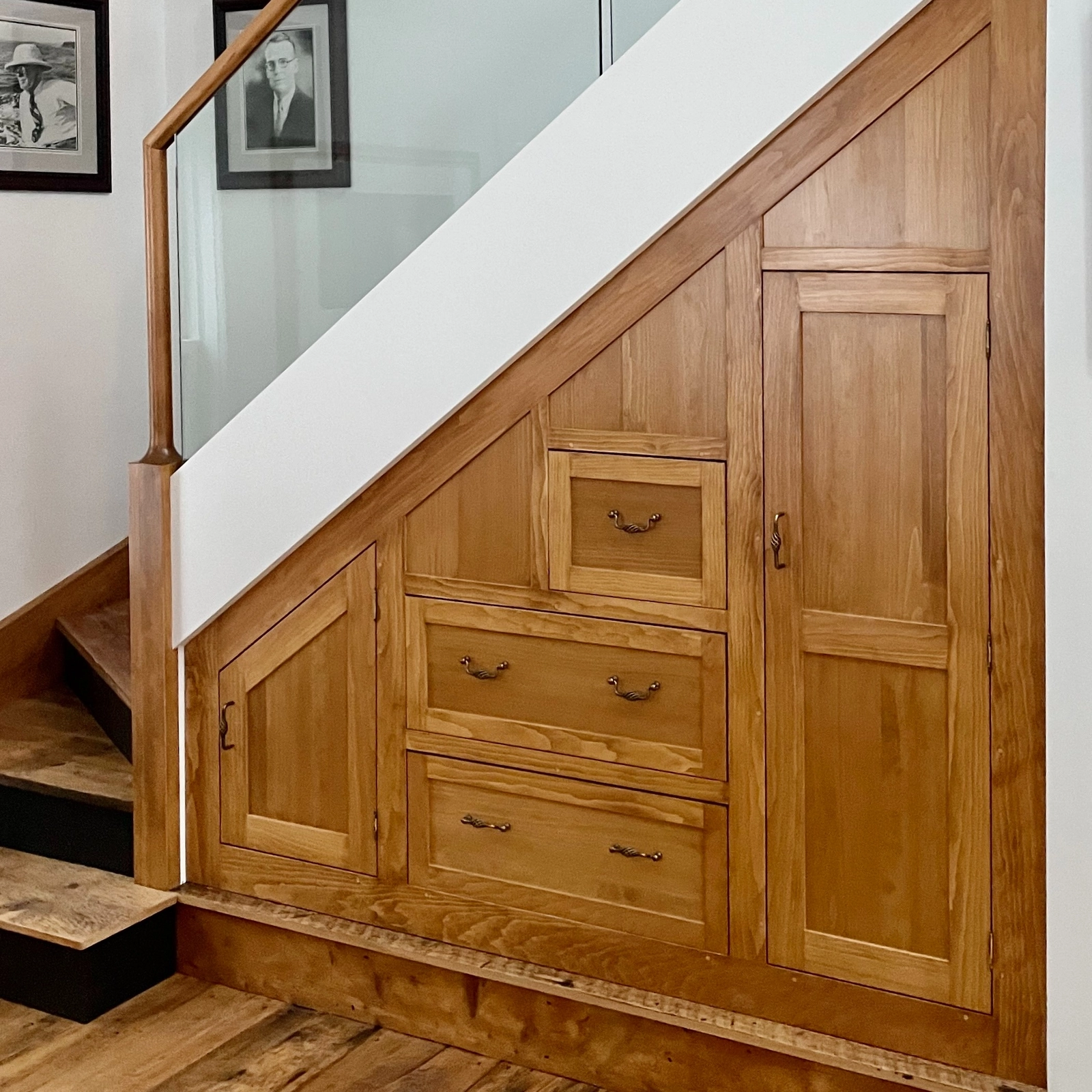
Photo: @jamesconstablewoodworks on Instagram
A run of light-wood drawers with a tall cupboard at the end is the classic under-stair layout, and it works because it matches the slope: shallow drawers at the low end, a tall cupboard where the stairs rise. The brass pulls warm up the pale wood, and the whole run reads as furniture rather than a fitted afterthought.
Drawers beat cupboards for the low end of the stairs because you can pull a drawer out and see everything inside, while a low cupboard door hides a dark corner you will never reach into. Save the tall cupboard for the high end, where it can hold coats, an ironing board, or the vacuum upright.
Step the drawers up with the staircase
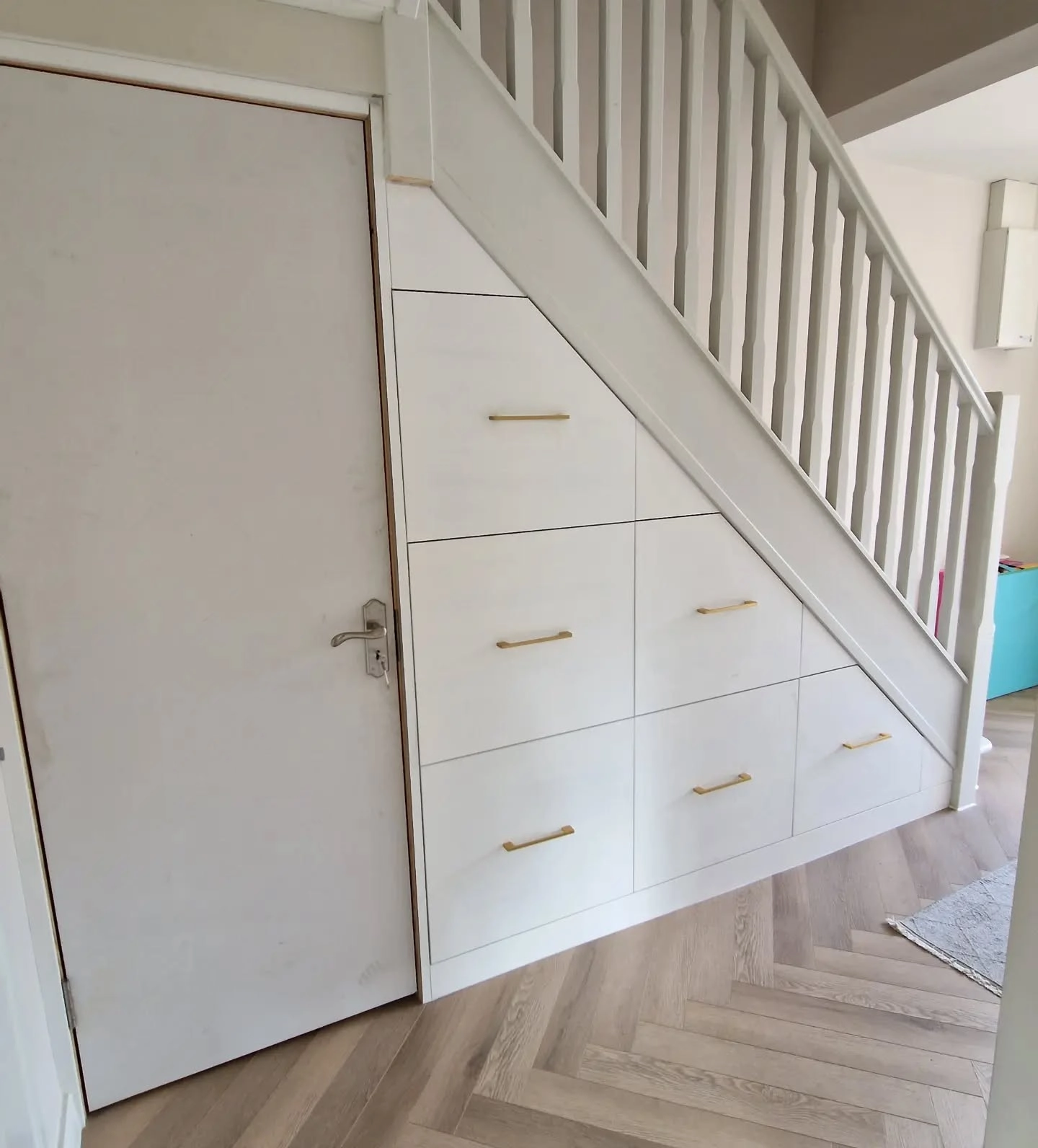
Photo: @sgwoodwork on Instagram
Stepped drawers that follow the rise of the stairs squeeze storage out of every inch of the triangle. These six white drawers get taller as the stairs get higher, with gold handles tying them together, and the result looks like it was always part of the staircase. Nothing is wasted, not even the lowest corner.
Stepped drawers suit narrow hallways best, because they sit flush with the stair and never stick out into the walkway. Keep the drawer fronts plain and handleless or small-handled, since anything that protrudes will catch hips and shopping bags in a tight hall.
Pull out deep drawers on heavy runners
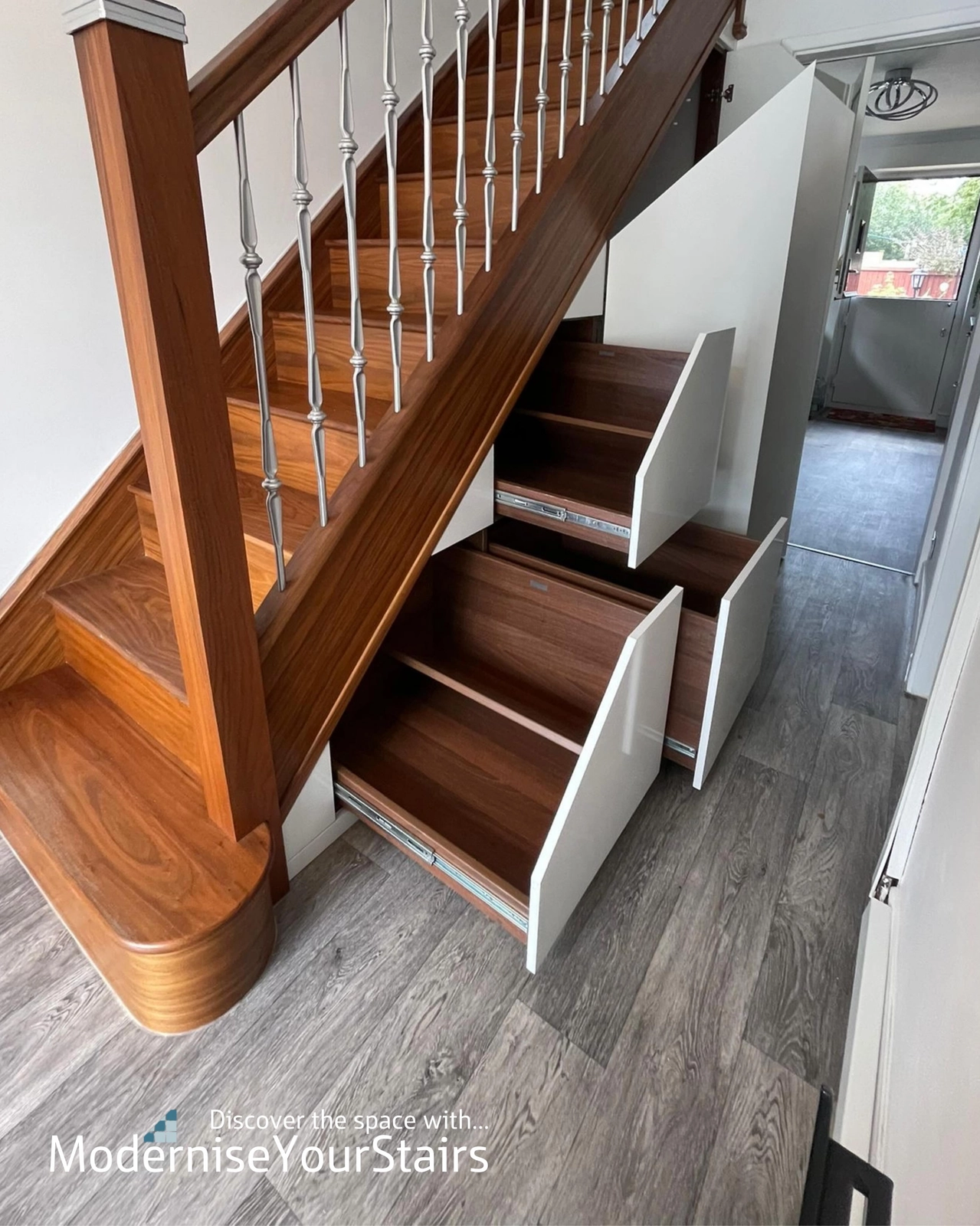
Photo: @moderniseyourstairs on Instagram
Three deep pull-out drawers under walnut stairs hold more than a whole chest of drawers, because each drawer is the full depth of the stair. They roll out on heavy-duty runners, so you can reach the back without kneeling, and they close flush to keep the walnut run looking clean.
Deep pull-outs are the best under-stair storage for heavy things: tools, paint tins, the sewing machine, the box of cables. A deep drawer that pulls fully out beats a cupboard of the same size every time, because a cupboard this deep would swallow things at the back forever.
Paint the cupboards sage green and panel them
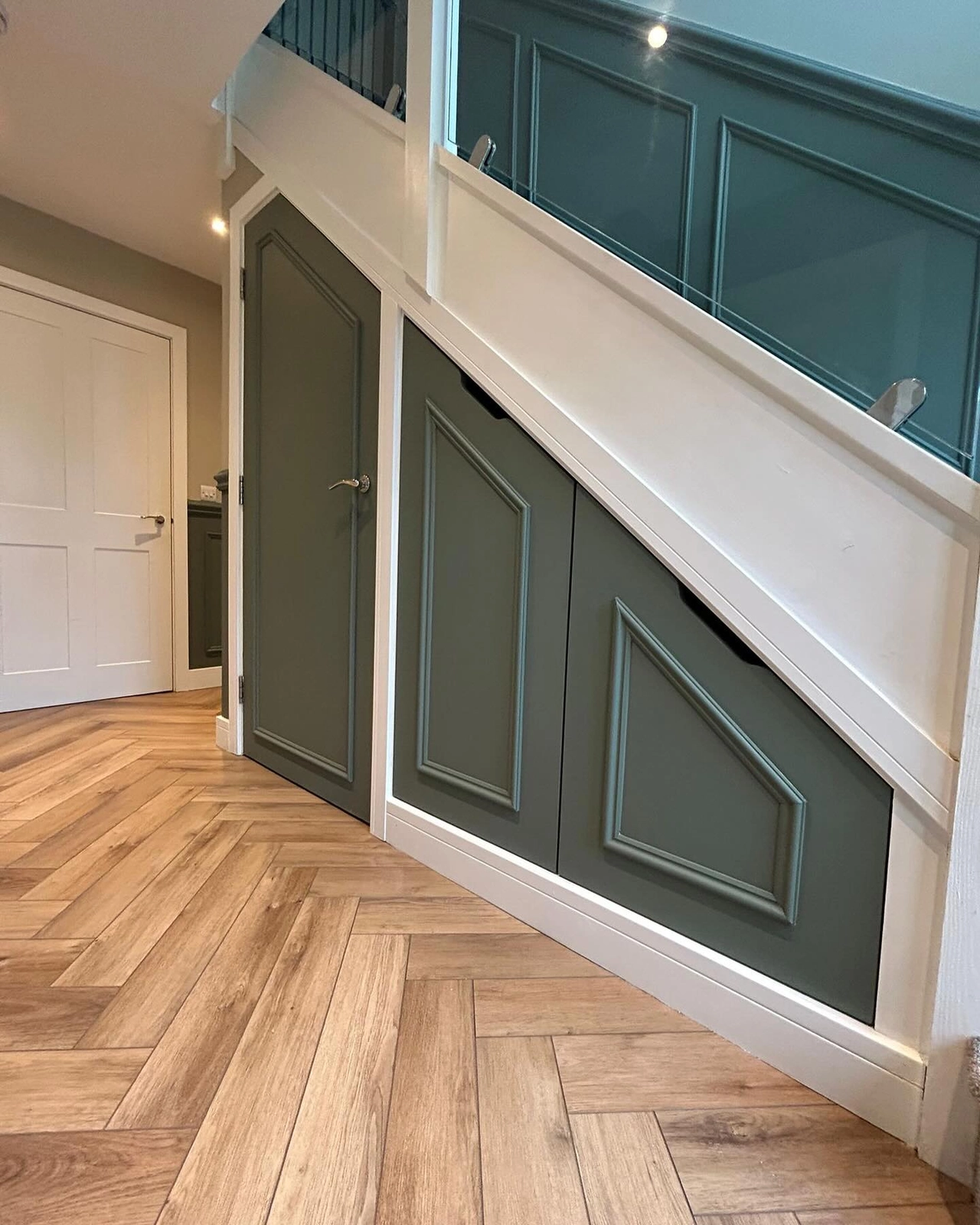
Photo: @howdensjoinery on Instagram
Sage-green panelled cupboards turn the space under the stairs into a feature instead of a hiding place. The panel detailing gives the doors the same language as the rest of the house, so the storage reads as architecture, and the soft green sits easily in a hallway that gets little natural light.
Painted cupboards are the right call when the under-stair space opens onto the living room rather than a dark hall. A colour you love means the doors stay part of the room instead of something you wish would disappear, and panelled fronts forgive fingerprints and scuffs better than flat ones.
Run grey-blue cupboards the full length
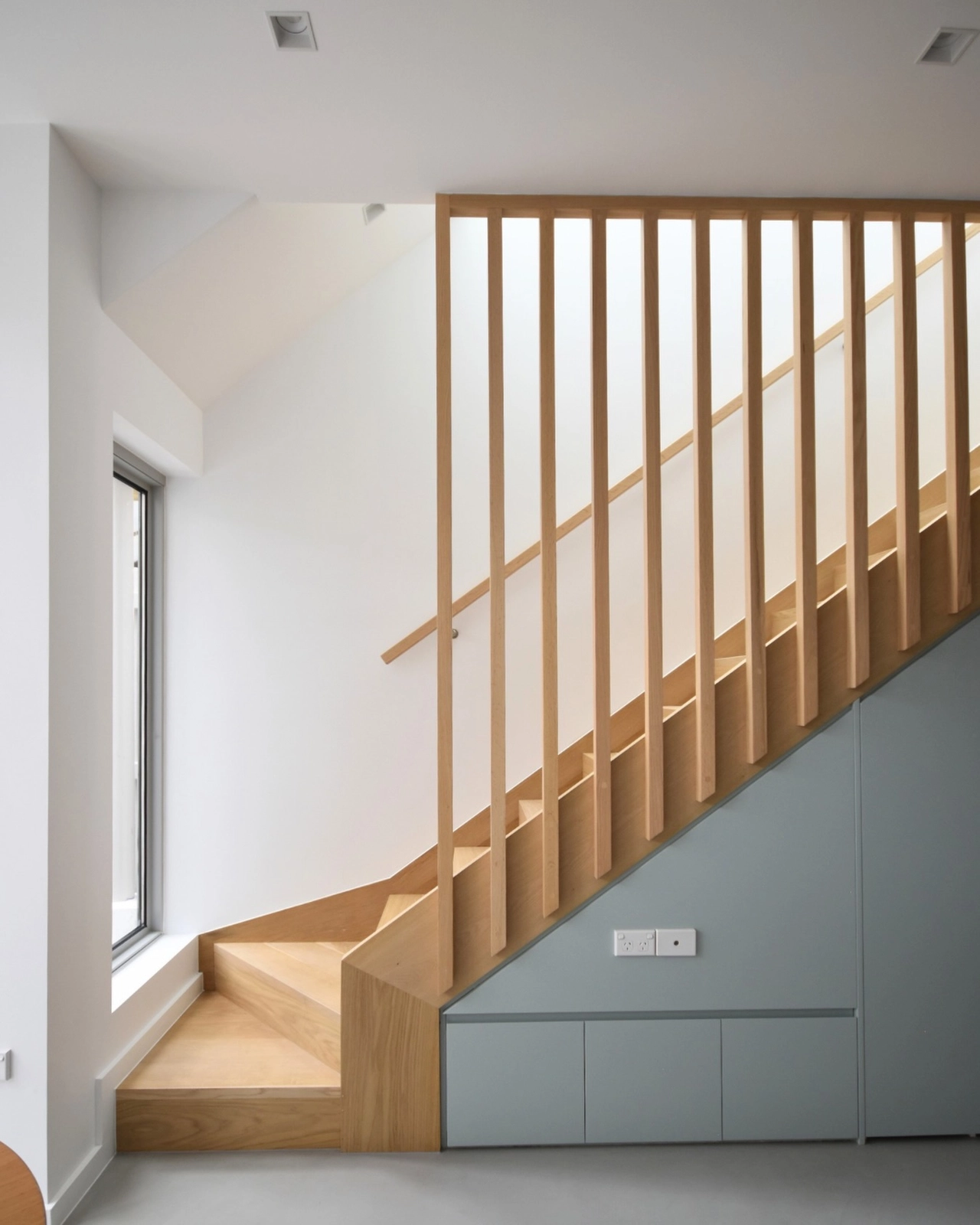
Photo: @nathaliescipioniarchitects on Instagram
A full-length run of grey-blue cupboards and drawers is the maximum-storage move: every inch of the under-stair triangle gets a door or a drawer. The blue-grey keeps the big run of doors from feeling flat, and it pairs with the storage rhythm of the rest of the house, so the hallway feels planned rather than patched.
A full run works when you commit to one job per door: coats in the tall one, shoes in the drawers, cleaning in the low one. Label nothing and decide everything, because a full run of mystery cupboards becomes a full run of junk within a year.
Follow the slope with white cupboards and drawers
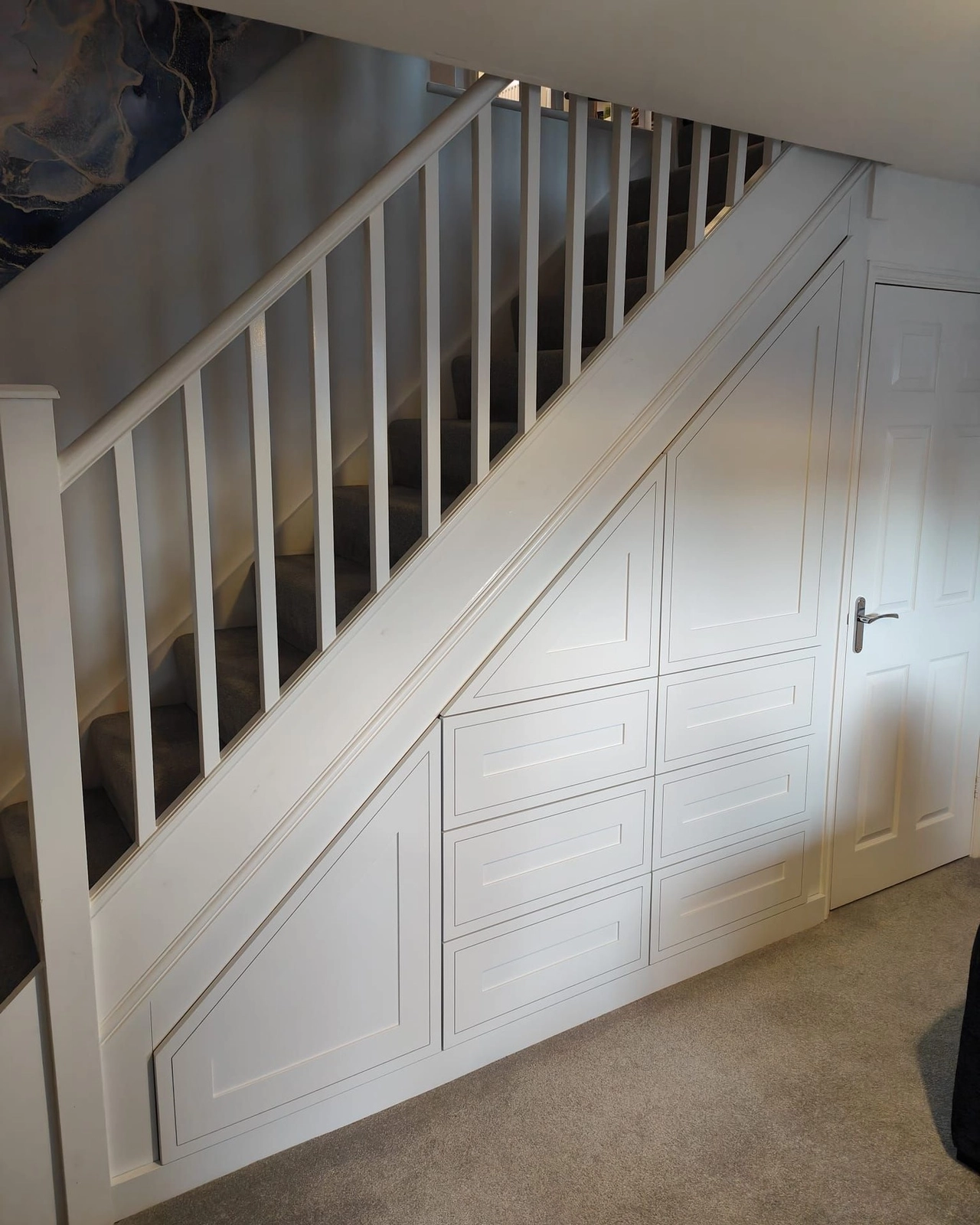
Photo: @waterfallfittedfurniture on Instagram
White cupboards and drawers cut to follow the stair slope make the storage disappear into the wall. The angled tops trace the staircase exactly, so the eye reads one clean line from the hall into the stair, and the white finish bounces light into what is usually the darkest corner of the house.
Slope-following joinery costs more than square boxes, but it earns it back in a narrow hallway where every inch of visual calm matters. Keep the handles minimal or push-to-open, since the whole point is a wall that happens to open, not a wall of visible hardware.
Mix walnut drawers and cupboards for a warm run
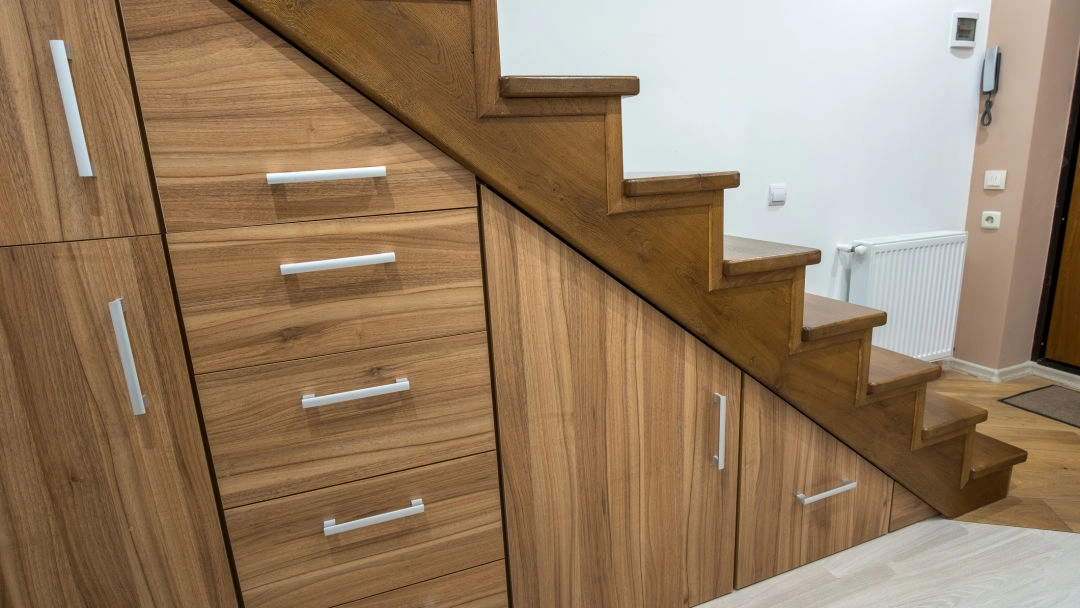
Photo: @happyhomesbyhelene on Instagram
Walnut drawers and cupboards under the stairs bring the warmth of the living room into the hallway. The dark wood hides scuffs and dust better than white, and the mix of drawer and cupboard doors lets each part of the slope hold what suits it: drawers low, cupboards high, tall doors at the tall end.
Dark wood under the stairs needs one good light nearby, or the run can read as a shadow. A picture light or a downlight above the doors is enough, and it turns the walnut into the richest thing in the hallway instead of the darkest.
Keep it simple with panelled doors and brass handles
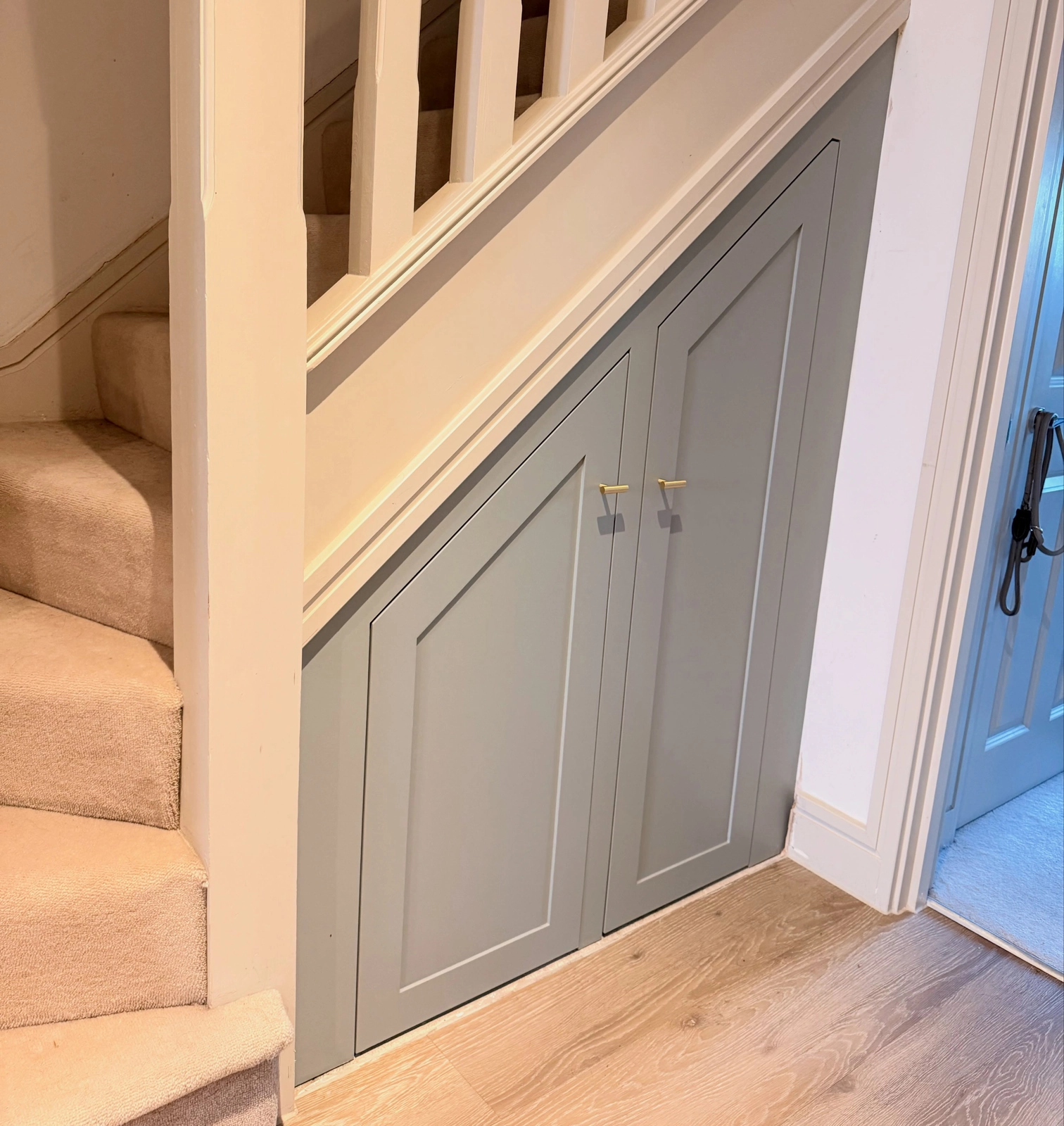
Photo: @mbcarpentry_ on Instagram
Light-grey panelled doors with brass handles are the quietest under-stair storage in this list, and sometimes quiet is the job. The doors sit flush under the stairs with nothing to show except the handles, and the room around them gets to be the interesting part.
Simple panelled doors suit rented homes and resale-minded owners best, because they offend nobody and date never. If you can only afford one under-stair upgrade, make it doors: closing off the space instantly makes the hallway look bigger, even before you organise what is behind them.
Show the whole system in one four-panel unit
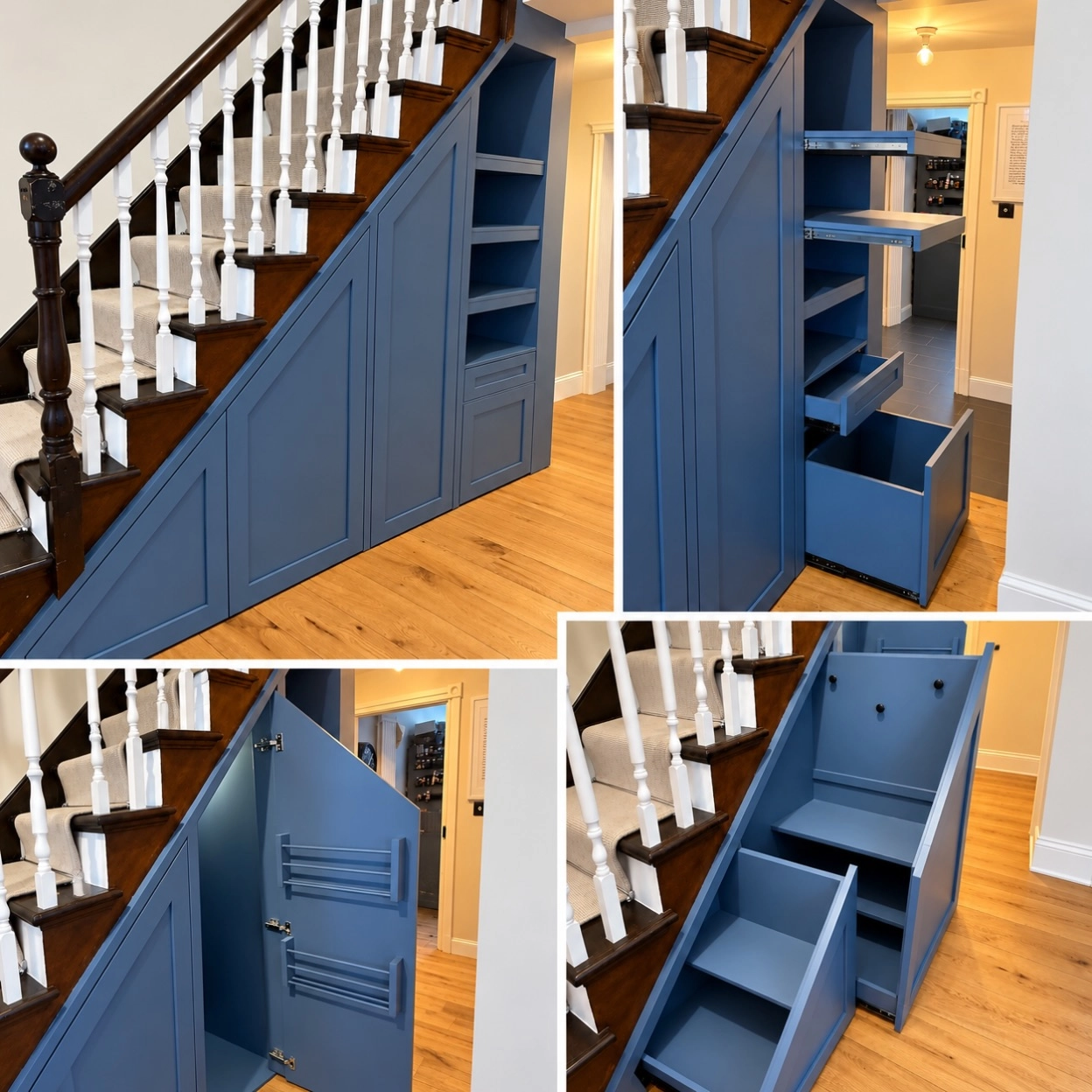
Photo: @diamondcarpentry.uk on Instagram
A four-panel view of one blue under-stair unit shows what a proper system looks like: closed cupboards for coats, pull-out drawers for the everyday, a cupboard with racks on the door for the awkward things, and pull-out shelves for the back corners. Each panel opens a different way because each part of the triangle stores a different thing.
This is the unit to show your joiner when you get a quote, because it proves one craftsman can solve the whole triangle in one visit. Ask for a mix of door types in the quote: a single type of door is cheaper, but the mix is what makes the triangle actually usable.
Measure the slope before you fall in love with a door type. Pull-outs need clear floor in front, hinged doors need swing space, and the triangle forgives neither. Tape the outline on the floor, swing the imaginary doors, and only then call the joiner.
Show it off: shelves, display, and benches
Open under-stair storage puts the good stuff on display and keeps the everyday stuff within reach. It suits hallways and living rooms where the stairs are part of the room, not a corridor you hurry through.
Combine tall cupboards, drawers, and open shelves
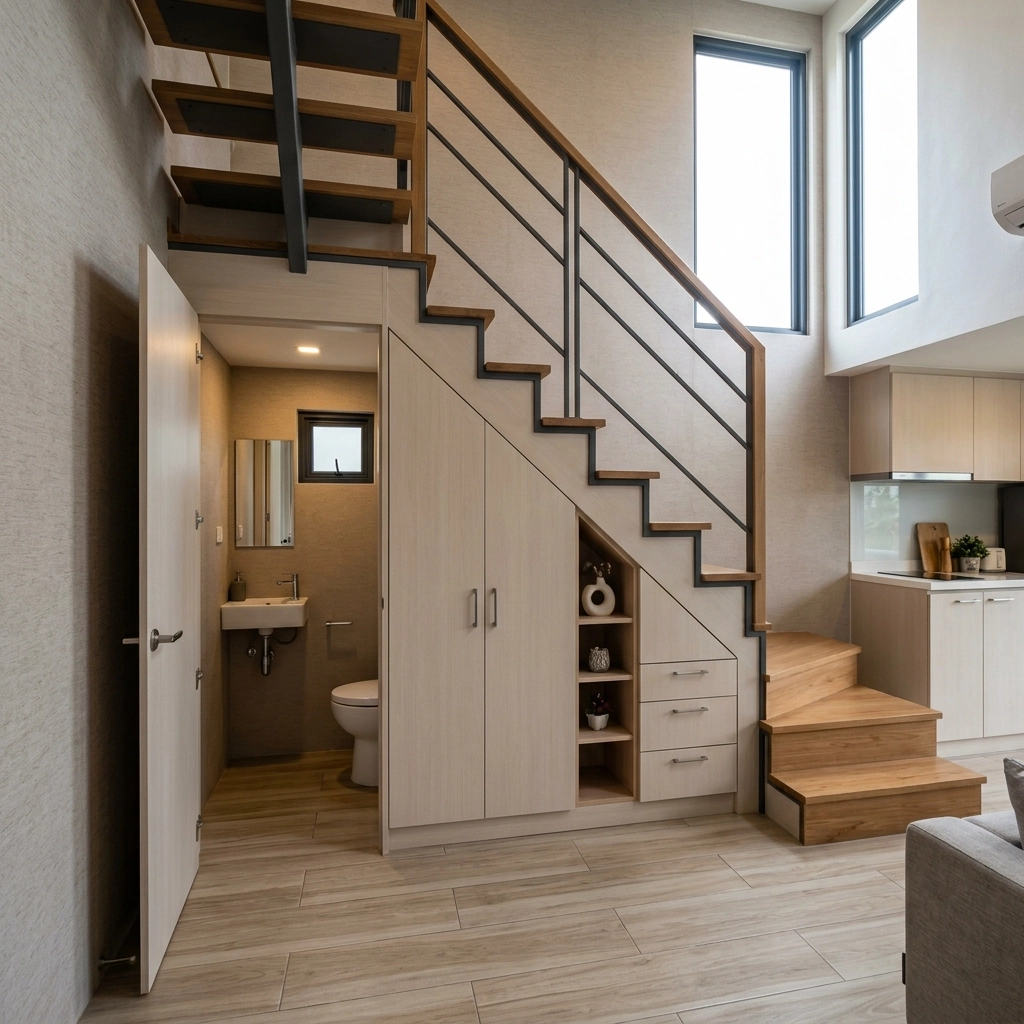
Photo: @kkhomedesign on Instagram
Tall cupboards, drawers, and open shelves in one under-stair wall give every category of stuff its right home. The closed cupboards hide the mess, the drawers hold the daily things, and the open shelves show the books and the plant, so the wall works as hard as a whole room of furniture.
The open shelves are the detail that makes this work in a small home: they break up the run of doors and give the wall a place to breathe. Keep the shelves to the high end of the stairs, where they are easy to reach and easy to dust, and leave the low end to doors.
Top the cabinets with a wood counter and bookshelves
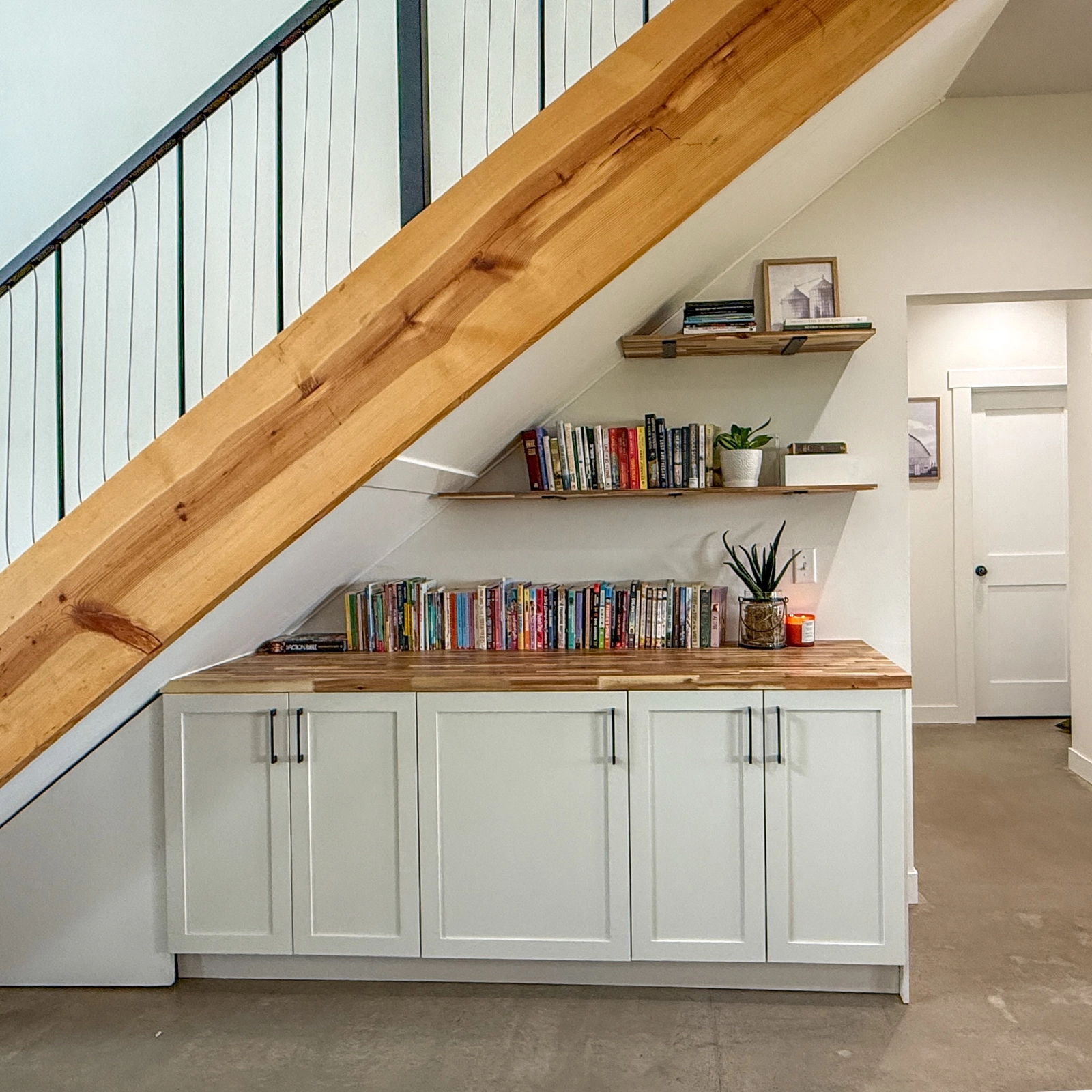
Photo: @midwestmomsd on Instagram
A wood countertop over under-stair cabinets, with floating bookshelves above, turns the stairs into a library wall. The cabinets hold the closed storage, the counter gives you a surface for keys and post, and the shelves hold the books where you actually pass them every day.
A countertop at hall height is the hardest-working surface in a small home: it catches everything on the way in and everything on the way out. Make it wood rather than stone, because wood forgives the daily knocks of keys, bags, and parcels.
Pull open light-oak drawers and shelves
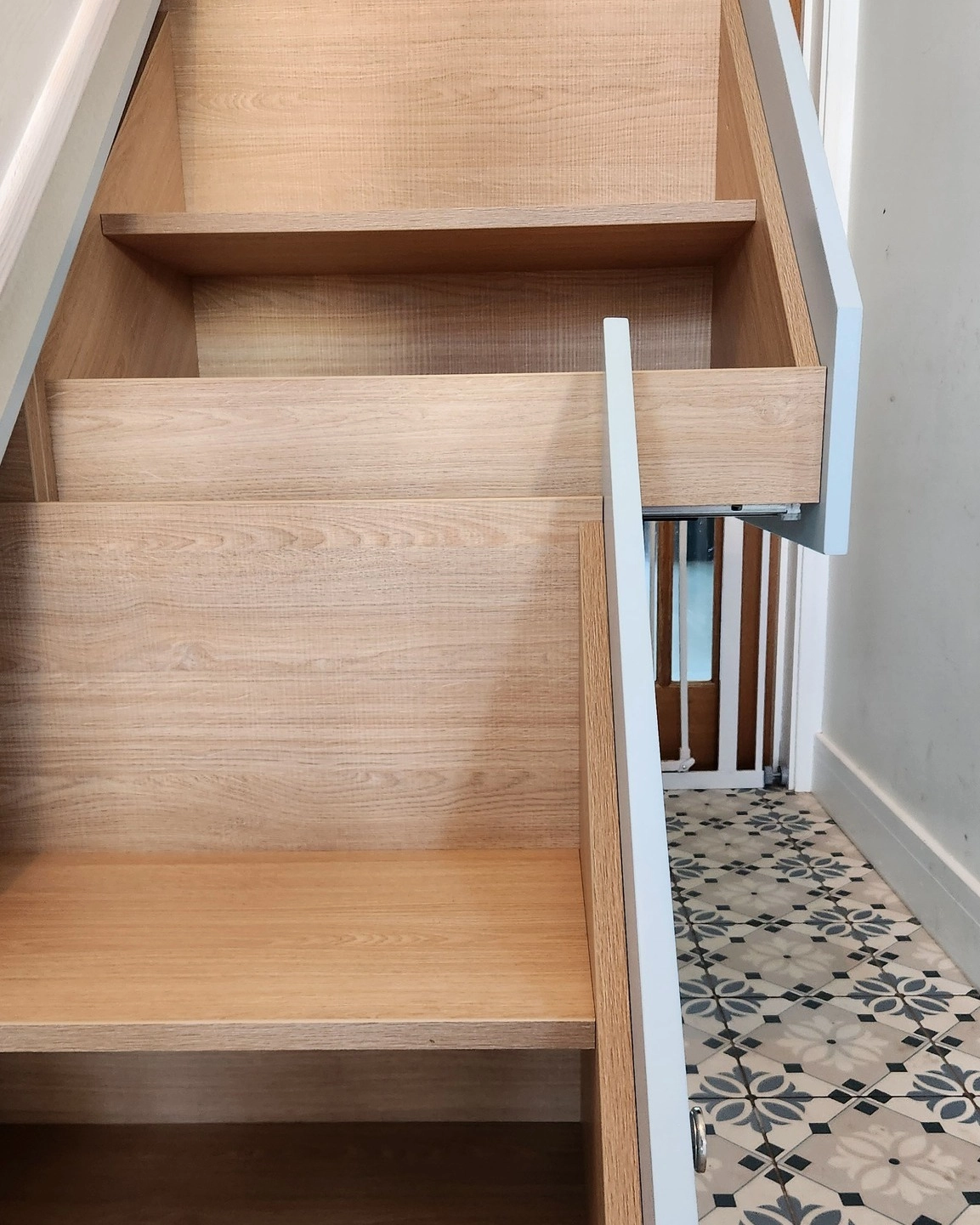
Photo: @mywooddesigns on Instagram
Light-oak pull-out drawers and shelves under the stairs bring the storage out to you instead of making you crawl in. One unit pulls open to show deep shelves, and when it closes the wall is clean oak again. The pull-out is the whole trick: it turns the deepest part of the triangle into the easiest part to use.
Pull-out shelving suits the middle of the stairs best, where the space is too low for doors and too deep for fixed shelves. Fit soft-close runners so the heavy unit cannot slam, and keep the heaviest things at the bottom so it rolls out smoothly.
Dedicate the pull-outs to shoes
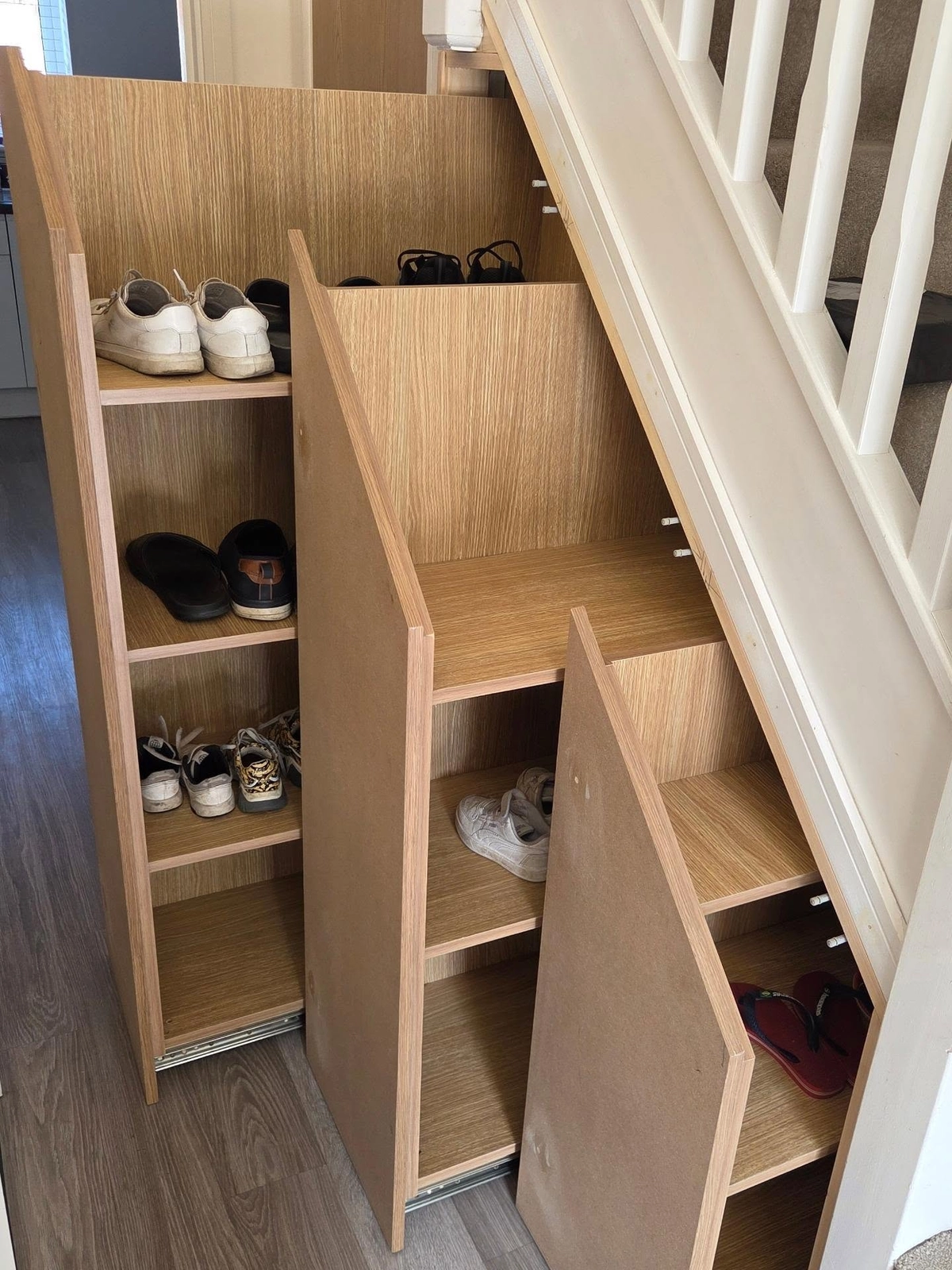
Photo: @woodfallbrighton on Instagram
Angled pull-out shoe units under the stairs are the end of the hallway shoe pile. Each unit pulls out to show rows of shoes on sloped shelves, and the whole family collection lives behind the stair instead of across the floor. The units in this photo hold a dozen pairs each and still close flush.
Shoe pull-outs work because shoes are shallow: a sloped shelf holds them with no wasted height. Give each person one unit or one shelf, and the morning argument about whose shoes are in the way ends the week the units go in.
Light a glass display in a glossy wardrobe wall
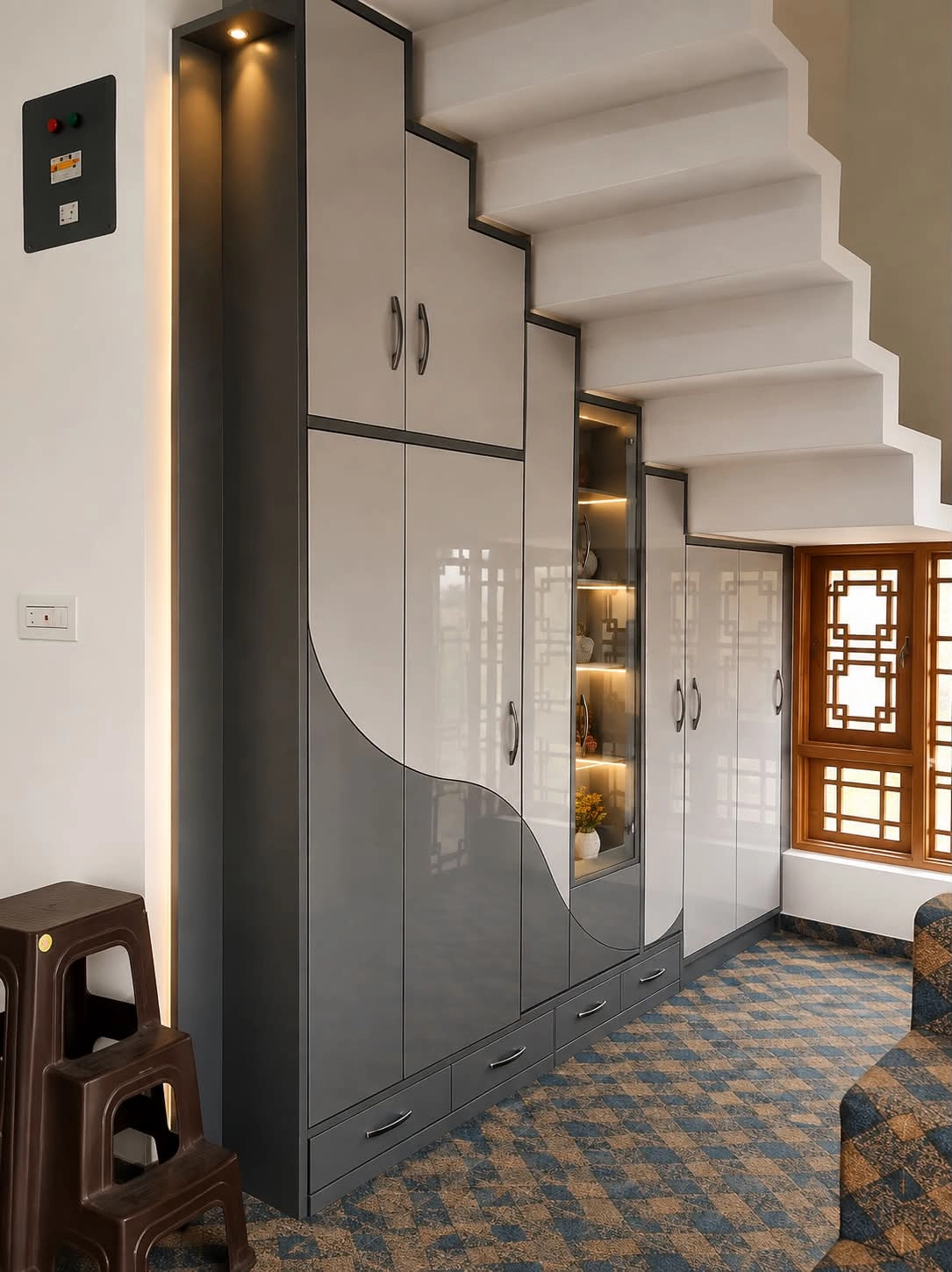
Photo: @bilal_carpenter_kashmir on Instagram
A glossy grey-and-white wardrobe wall with a lit glass display turns under-stair storage into a showcase. The wardrobe holds the everyday behind gloss doors, and the lit display holds the glasses and the good bottles, so the stairs get a moment of glamour in an otherwise practical run.
A lit display is the one luxury worth paying for in under-stair joinery, because it is the only part you see when the doors are closed. One glass door with a light inside costs a fraction of the whole wall and does all of the showing off.
Open the wardrobe doors to a lit interior
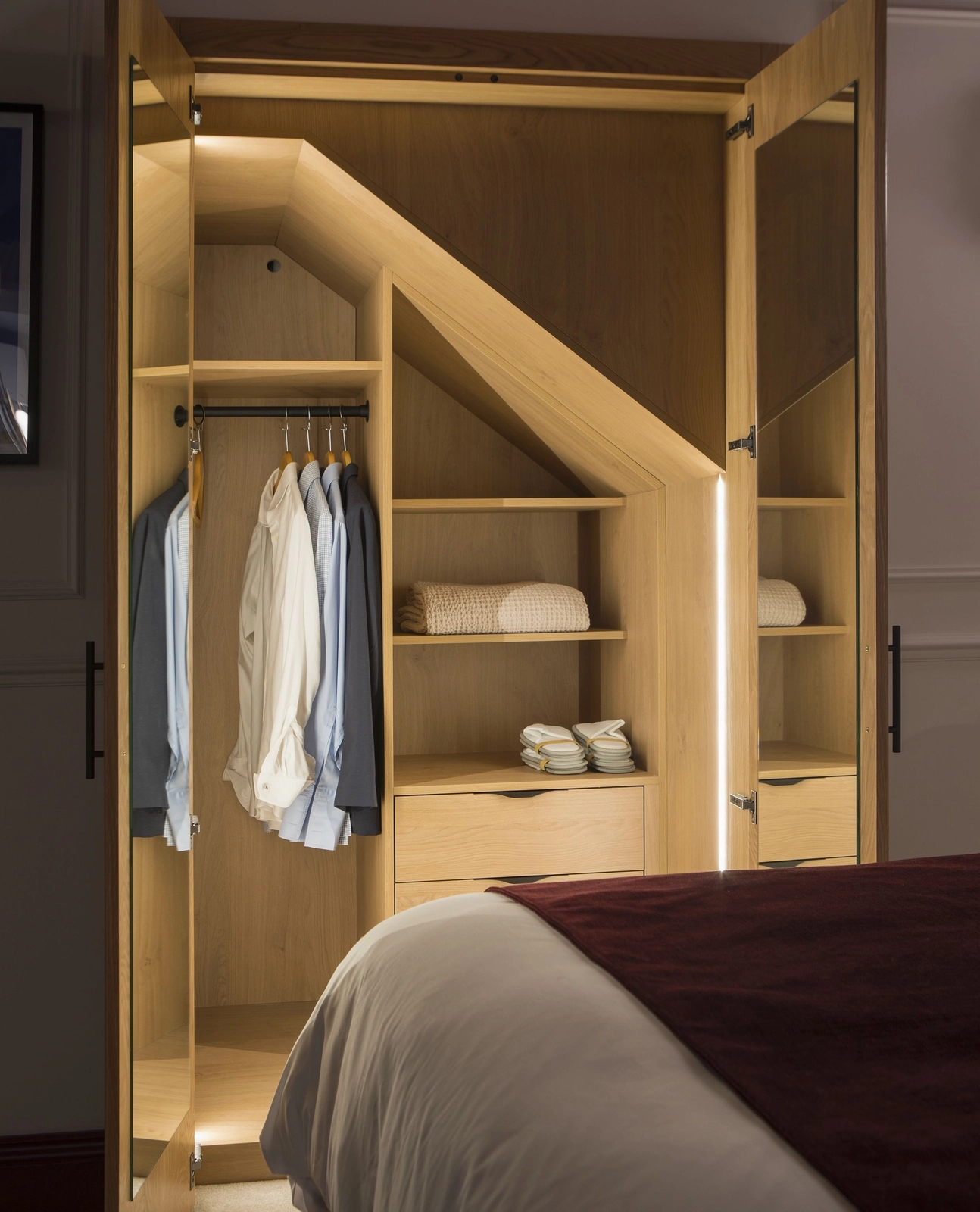
Photo: @elixirinteriordesign on Instagram
An open oak wardrobe under the stairs, with mirrored doors swung wide, shows how much a lit interior can hold: a hanging rail for shirts, shelves for folded knitwear, drawers below, and mirrors on the doors that throw light into every corner. The stair slope becomes the top of a proper wardrobe, not a compromise.
Mirrored doors are doing double duty here: they close the wardrobe and they light it, because the mirrors catch the LED strip and bounce it around the interior. If your under-stair space is dark, mirrors plus one light beat two lights with no mirrors.
Build cabinets around a lit display and a bench
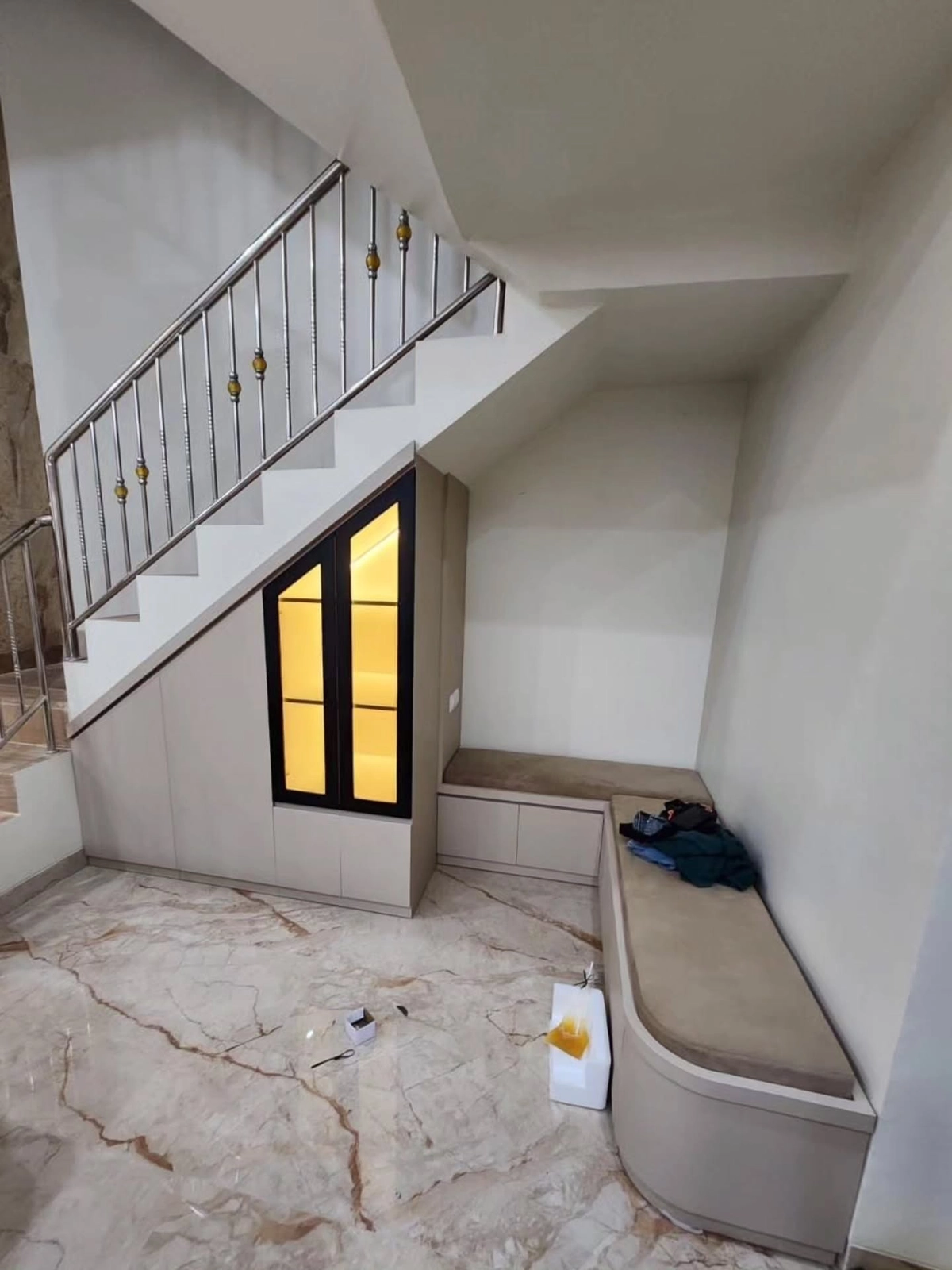
Photo: @sal_furniture_interior on Instagram
Under-stair cabinets with a lit glass display and an L-shaped storage bench turn the stairs into the most useful wall in the house. The display shows the good pieces, the cabinets hide the rest, and the bench gives you somewhere to sit to put shoes on, with storage inside the seat.
A storage bench under the stairs is the piece guests notice first, because it is the one they use. Build the bench at sitting height with a hinged top, and put the shoes you wear daily inside it, so the hallway stays clear and the bench stays honest.
Add a bench seat with a drawer to the cupboard run
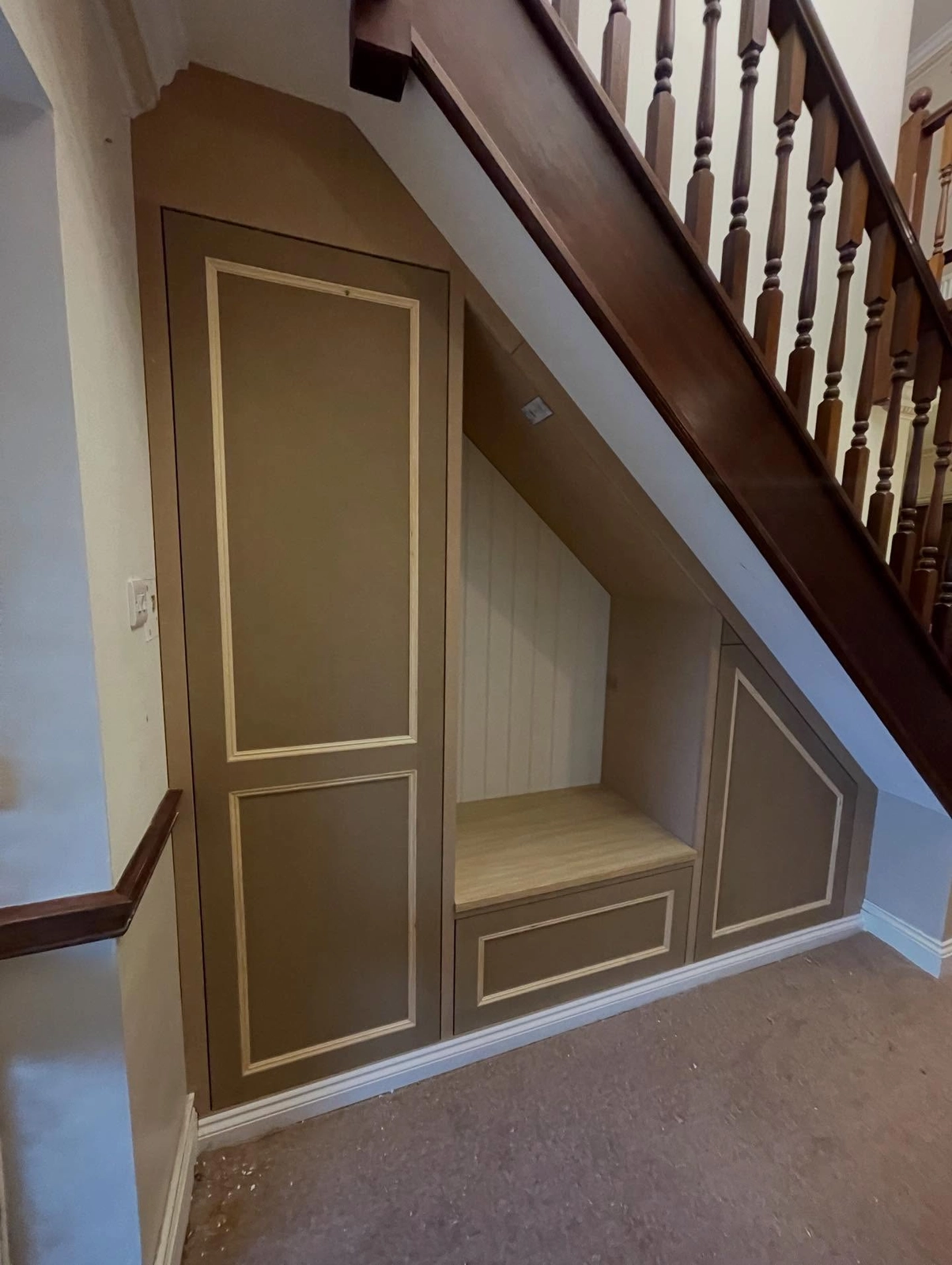
Photo: @rusticvibeuk on Instagram
A tall cupboard run with a bench seat and a drawer built in gives the hallway a place to pause. The cupboards hold the coats, the bench holds the sitting, and the drawer under the seat holds the shoehorn, the spare laces, and the things that live by the door.
A bench under the stairs works in the tall end of the triangle, where there is headroom to sit upright. Keep the bench cushion simple and washable, because a hallway bench takes more wear in a month than a living room sofa takes in a year.
Which under-stair storage fits what
Match the mechanism to the job before you call the joiner. The wrong door type is the most expensive mistake in under-stair storage, because the triangle forgives nothing.
| Storage type | Best for | Watch out for |
|---|---|---|
| Pull-out drawers | Heavy and everyday things: tools, shoes, toys | Needs clear floor in front to roll out |
| Hinged cupboards | Tall and bulky things: coats, vacuum, ironing board | Needs door-swing space in a narrow hall |
| Stepped drawers | Using every inch of a low, narrow staircase | Smallest capacity per door; costs more to build |
| Open shelves | Books, plants, and display in a living-room stair | Dust; everything on show must earn it |
| Pull-out shelving unit | Deep middle sections too low for doors | Heavy when loaded; fit soft-close runners |
Put it to work: desks, bars, and nooks
The boldest under-stair ideas give the space a second job entirely. A staircase triangle is about the size of a generous cupboard, which is also about the size of a desk, a bar, or a reading nook.
Float an oak desk for a home office nook
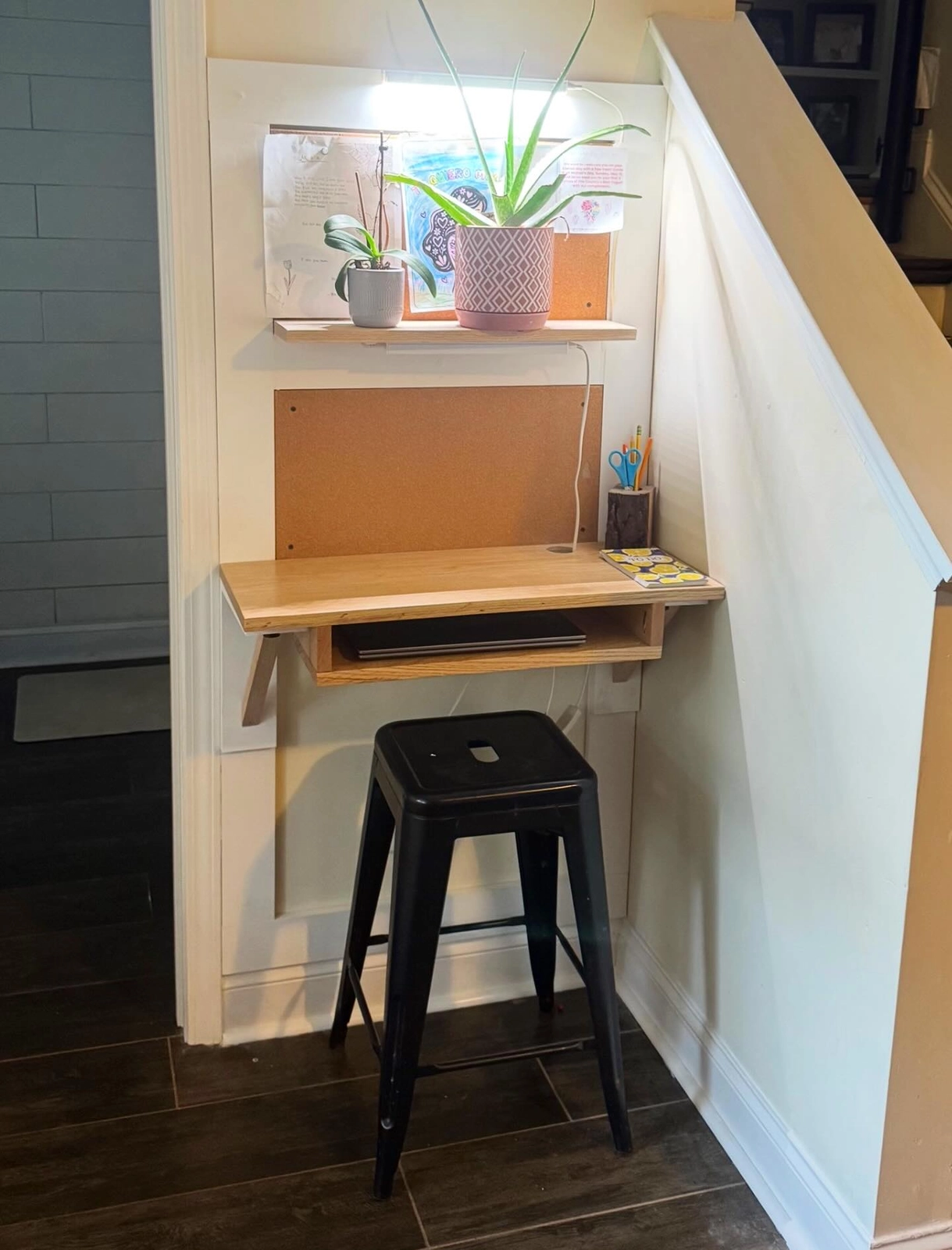
Photo: @rawlingswoodworks on Instagram
A floating oak desk under the stairs, with a shelf, a corkboard, and a stool, is a complete home office in the footprint of a cupboard. The desk hangs off the wall so the floor stays clear, the corkboard uses the slope, and the stool tucks underneath when the workday ends.
A floating desk suits stairs that open onto a living room, because it reads as furniture rather than an office. Keep the work gear in one box on the shelf, so the nook can go from office to hallway in the time it takes to close a laptop.
Line the nook in wood for a proper study
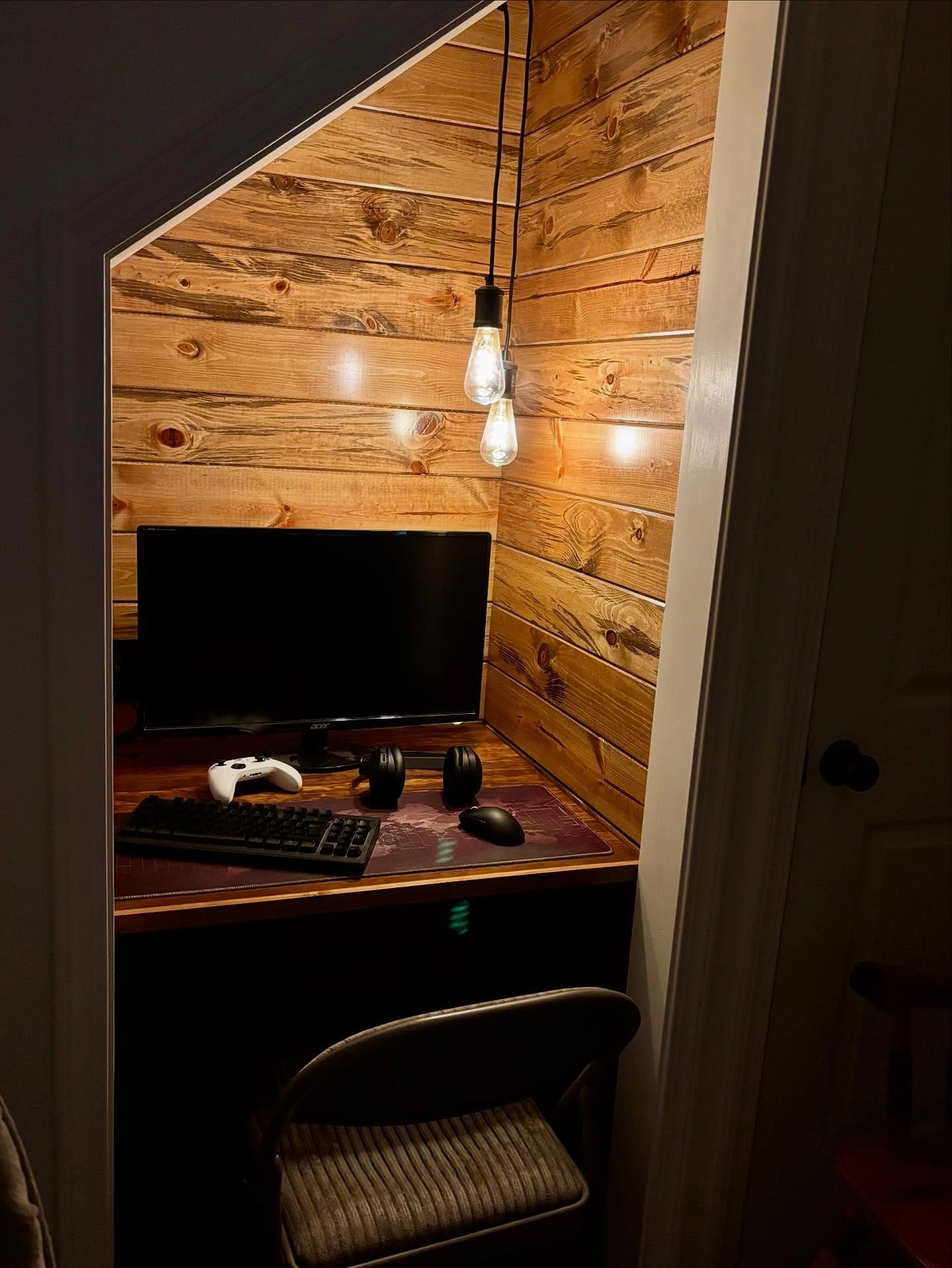
Photo: @martinholsinger on Instagram
A wood-lined desk nook with a monitor, a keyboard, and pendant bulbs is the most finished home office in this list. The wood panels warm up the triangle, the pendants light the desk without taking surface, and the whole nook feels like a room of its own rather than a gap under the stairs.
Wood lining is worth the money when the nook is permanent, because it hides every awkward angle of the stair underside. Run the lining first and the desk second, so the desk sits against a finished wall instead of a patchwork of plaster and stringers.
Build the office around a marble-top desk
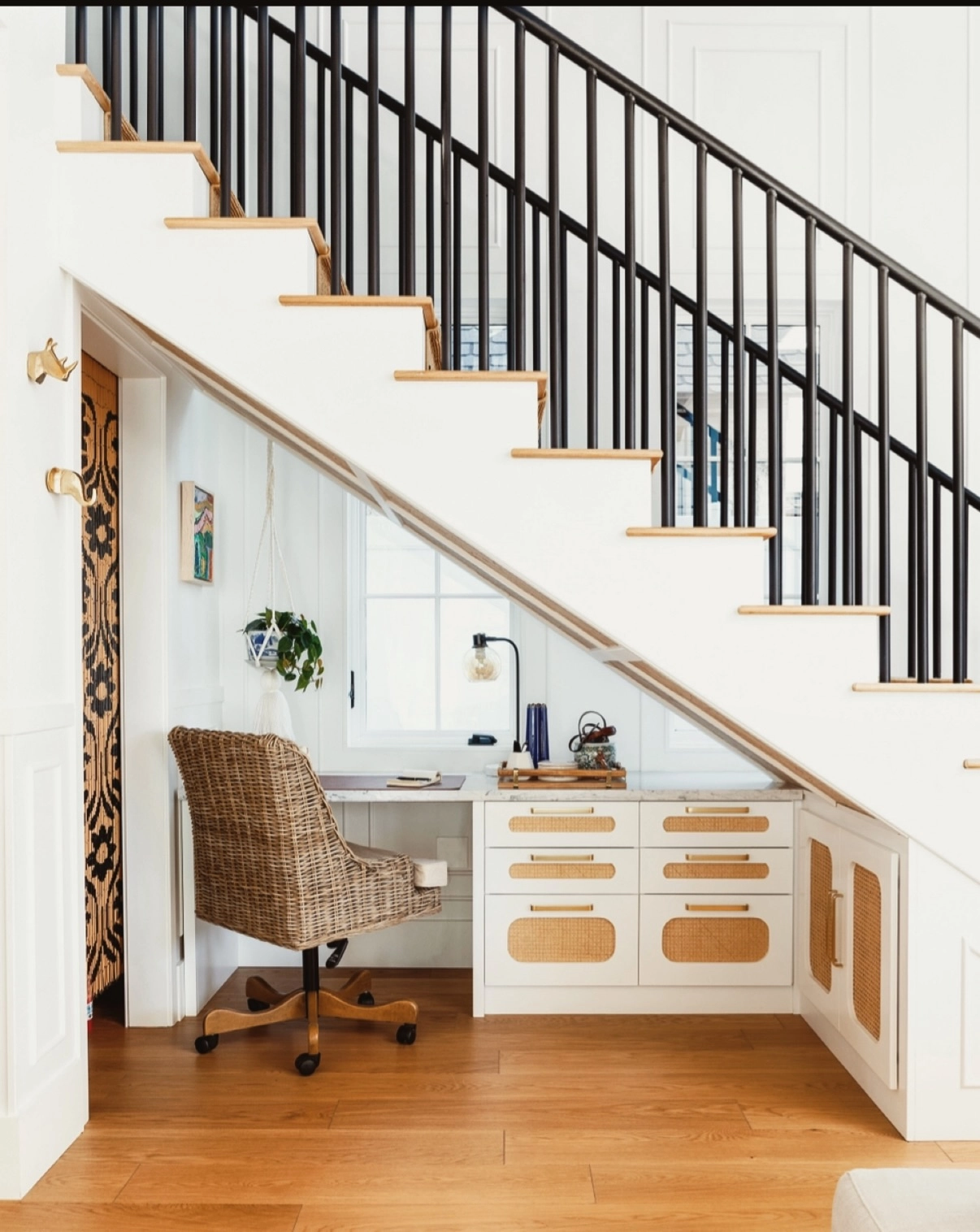
Photo: @casaduhagon on Instagram
A marble-top desk with cane-front drawers and a wicker chair under the stairs is an office that looks like it belongs in a magazine. The marble lifts the whole nook, the cane fronts keep the drawers light, and the wicker chair slides fully underneath, so the office disappears into the stair when it is not in use.
A chair that slides fully under the desk is the detail that matters most here, because an office chair left sticking out blocks the hallway. Measure the chair against the desk height before you buy, or the tuck will not happen.
Go dark for a study under bay windows
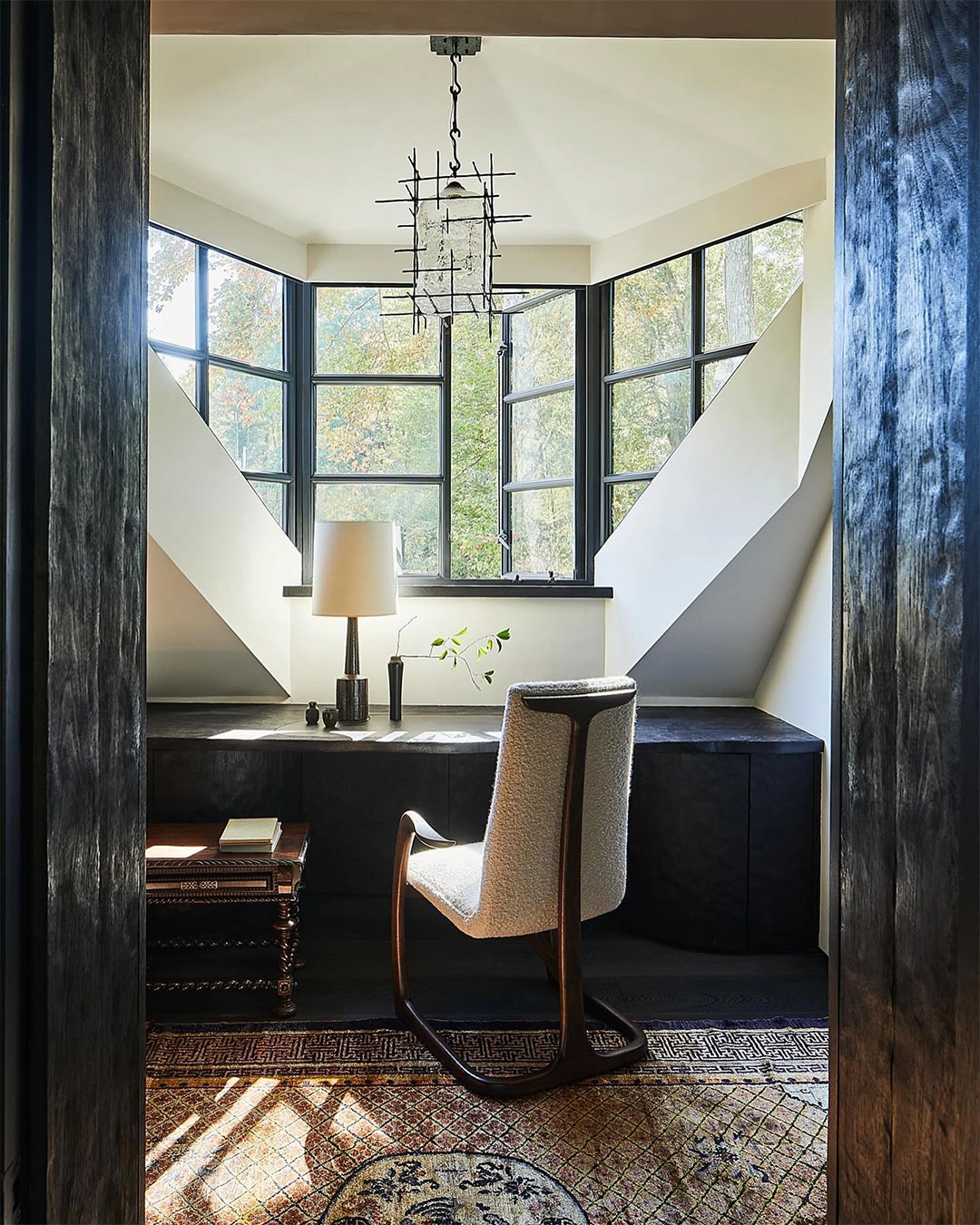
Photo: @doris_leslie_blau on Instagram
A dark desk and cabinets under bay windows make an under-stair study that feels like a library corner. The boucle chair softens the dark joinery, the lamp warms it, and the windows give the desk the best light in the house. The home office hides in plain sight under the stairs.
Dark joinery under the stairs needs daylight or it becomes a cave, so this idea suits stairs with a window at the landing or beside the nook. If the stairs are internal, keep the joinery light and let the chair and rug carry the mood instead.
Keep it calm with sage drawers and a good lamp
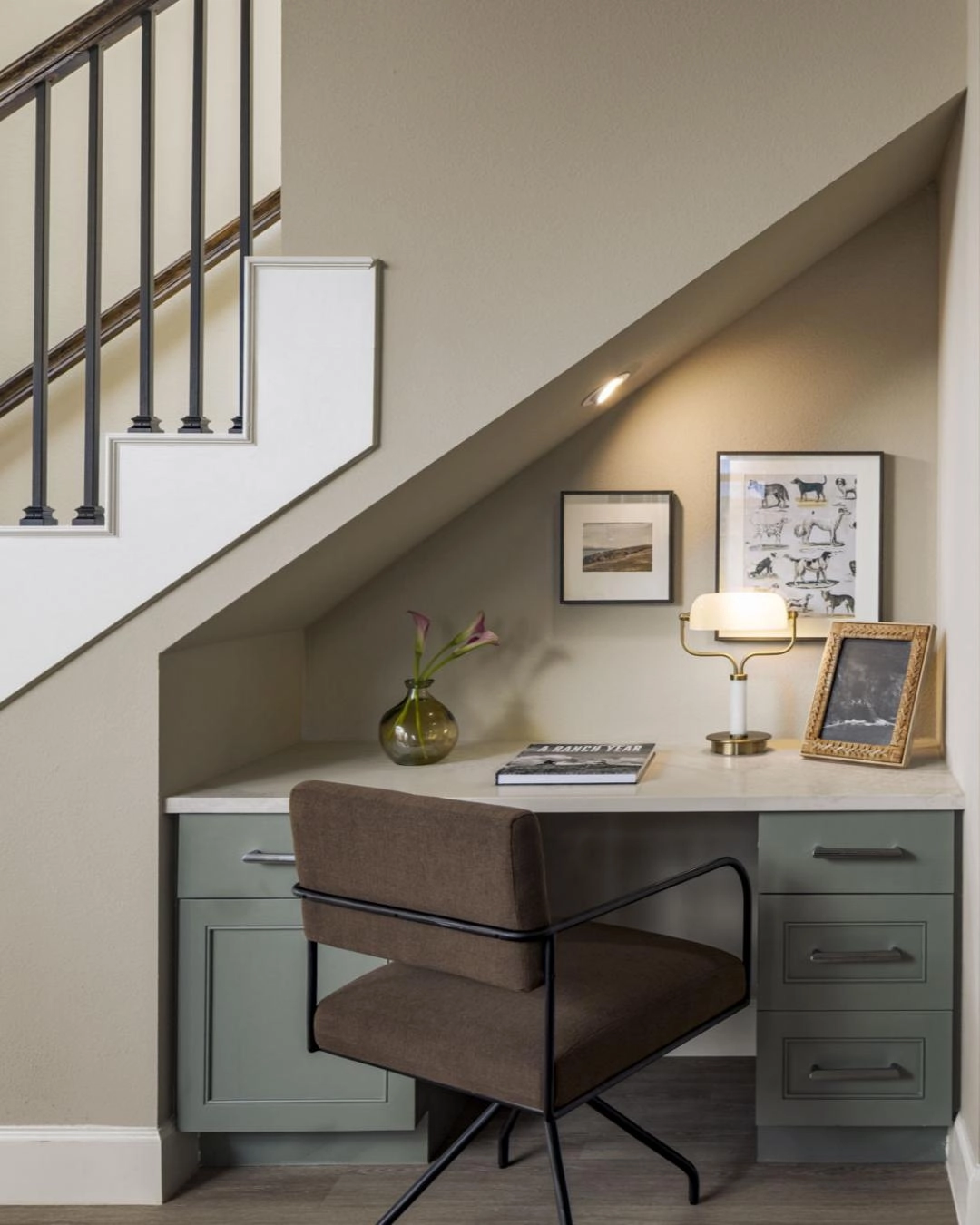
Photo: @thelindenviridian on Instagram
Sage green drawer cabinets, a brown chair, a brass lamp, and framed art make an under-stair desk nook that feels settled rather than squeezed. The drawers hold the office supplies, the lamp lights the work, and the art makes the slope feel like a wall in a real room.
Art is the cheapest way to make an under-stair nook feel intentional: two small frames turn a triangle into a study. Hang them where the slope is highest so they sit at eye level, not tilted into the low corner.
Build a kitchenette and bar under the stairs
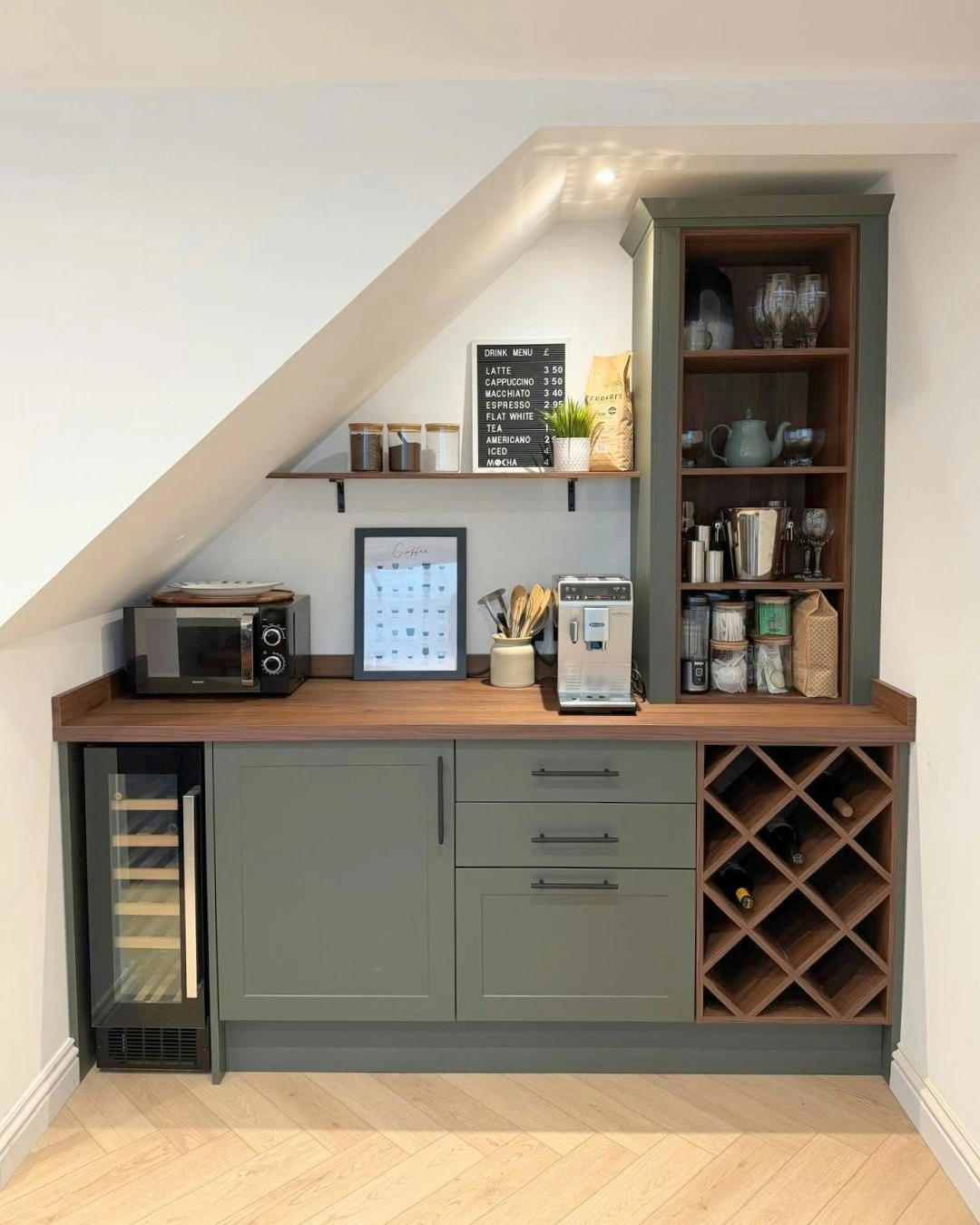
Photo: @howdensjoinery on Instagram
A sage kitchenette with an espresso machine, a microwave, a wine rack, and a wine cooler turns dead stair space into the drinks station of the house. The cabinets hold the cups and the coffee, the open shelf holds the menu board and the jars, and the cooler keeps the wine at the right temperature.
A drinks station under the stairs works when it sits near the living room, so the walk with the tray is short. Check the electrics before you commit: an espresso machine and a wine cooler need two sockets, and running new wiring under a staircase is the part of this job that costs real money.
Carve out a reading nook with wallpaper
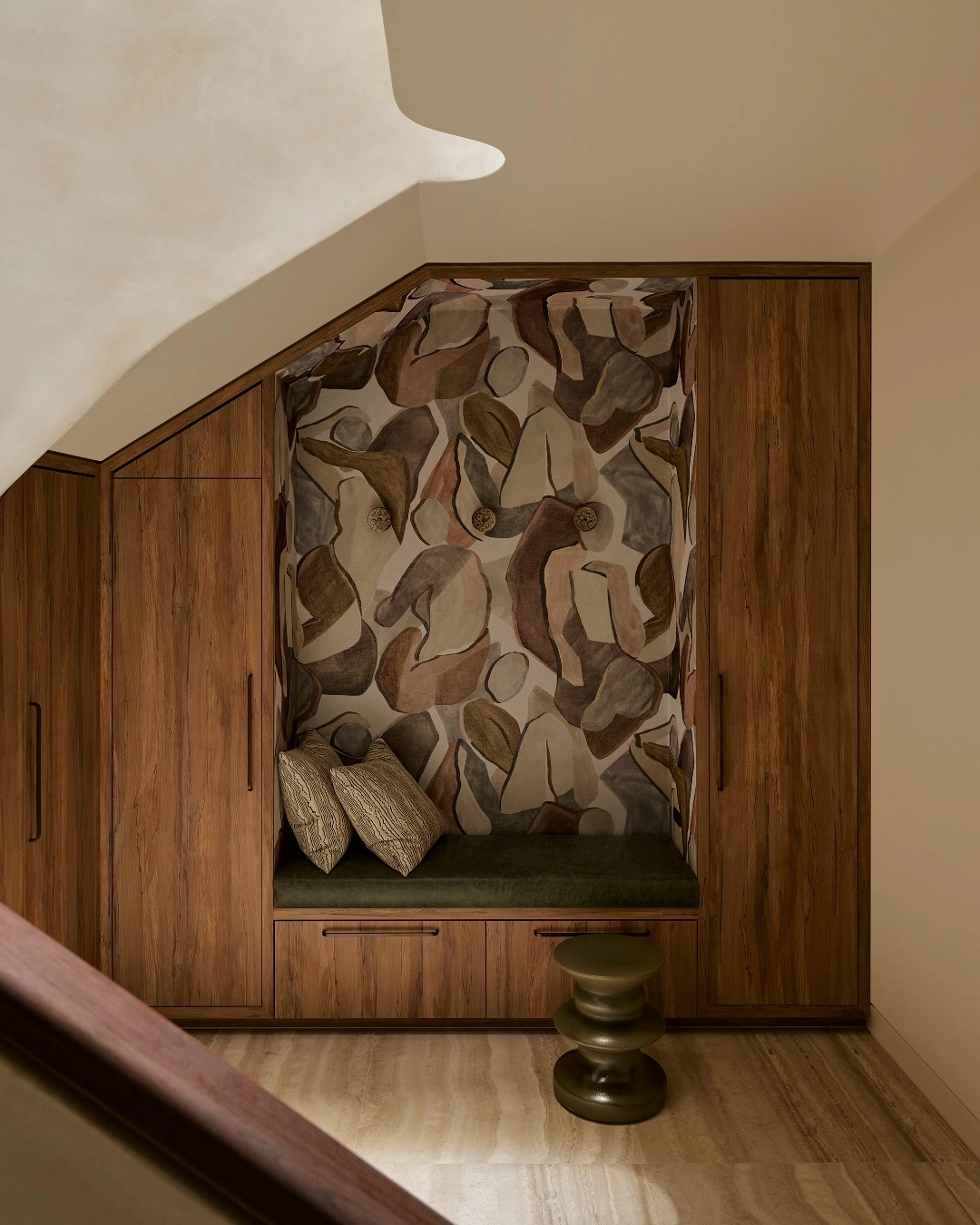
Photo: @gregnatale on Instagram
A reading nook with abstract wallpaper, wood cabinetry, and a bench with drawers is the most indulgent use of under-stair space. The wallpaper makes the triangle feel designed, the bench gives you the seat, and the drawers underneath hold the blankets and the books you are saving.
A reading nook needs three things to get used: a light you can read by, a cushion you can lean on, and a door you can close on the rest of the house. Skip any one of them and the nook becomes decoration; include all three and it becomes the best seat in the house.
Start with the job, not the finish
Every idea in this list started with a job: hide the clutter, show the good stuff, or give the space a second life. Decide the job first, because the job picks the door type, and the door type is the expensive part. The finish, the paint, the handles, the wallpaper, comes last and costs least.
And leave the vacuum a home. Whatever you build under the stairs, keep one tall cupboard for the awkward things that have to live somewhere. A beautiful under-stair wall with nowhere for the mop is a wall you will resent within a month.