28 Small Closet Organization Ideas That Fix the 5 Problems Every Small Closet Has
Every small closet fails in the same five ways. Nothing fits, nothing can be found, shoes take over the floor, the top shelf holds mysteries nobody remembers, and whatever you fix on Sunday is undone by Wednesday.
This list is organised around those five problems instead of around products. Each chapter names the pain, then shows the fixes that real closets use against it, photographed as they are. Twenty-eight ideas, and every one of them answers a complaint you have probably made out loud.
Bring a tape measure. Half of these fixes fail only because nobody measured the closet first, and the other half fail because nobody emptied it first. Do those two things and the rest is easy.
Every fix below comes from a real closet, photographed as it is. No renders, no showrooms, no closet you need a second mortgage to build.
Problem 1: Nothing fits
The rod is full, the shelf is full, and the floor is where the overflow lives. The closet is not too small. It is using one level when it could use two, and the walls when it could use the floor.
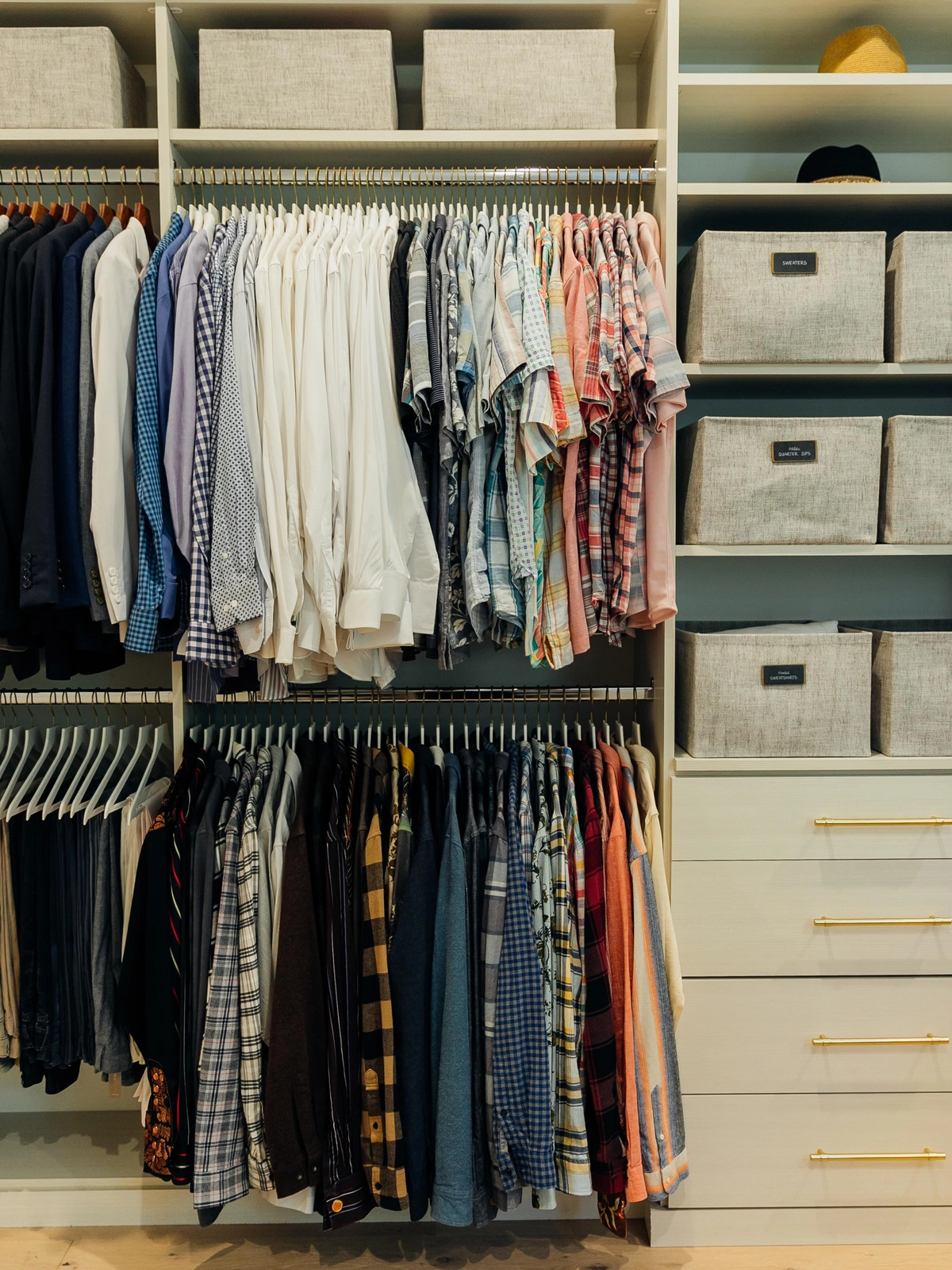
Photo: @tsgtidewater on Instagram
Fix 1: Hang twice, not once
Two levels of hanging turn one rod into two closets. Shirts and folded trousers live on the upper rod, longer pieces and skirts on the lower, and the drawers underneath catch what neither rod wants. It is the single highest-yield change in this whole list, and it costs one extra rod.

Photo: @omaha_neat on Instagram
Fix 2: Two rods beat one long rod
A walk-in with two levels of hanging and linen bins on the top shelf shows the same trick at full size. Short things double up, long things take the end, and the bins above hold the linens that never belonged on a rod. Measure your longest dress first, then set the lower rod under it.
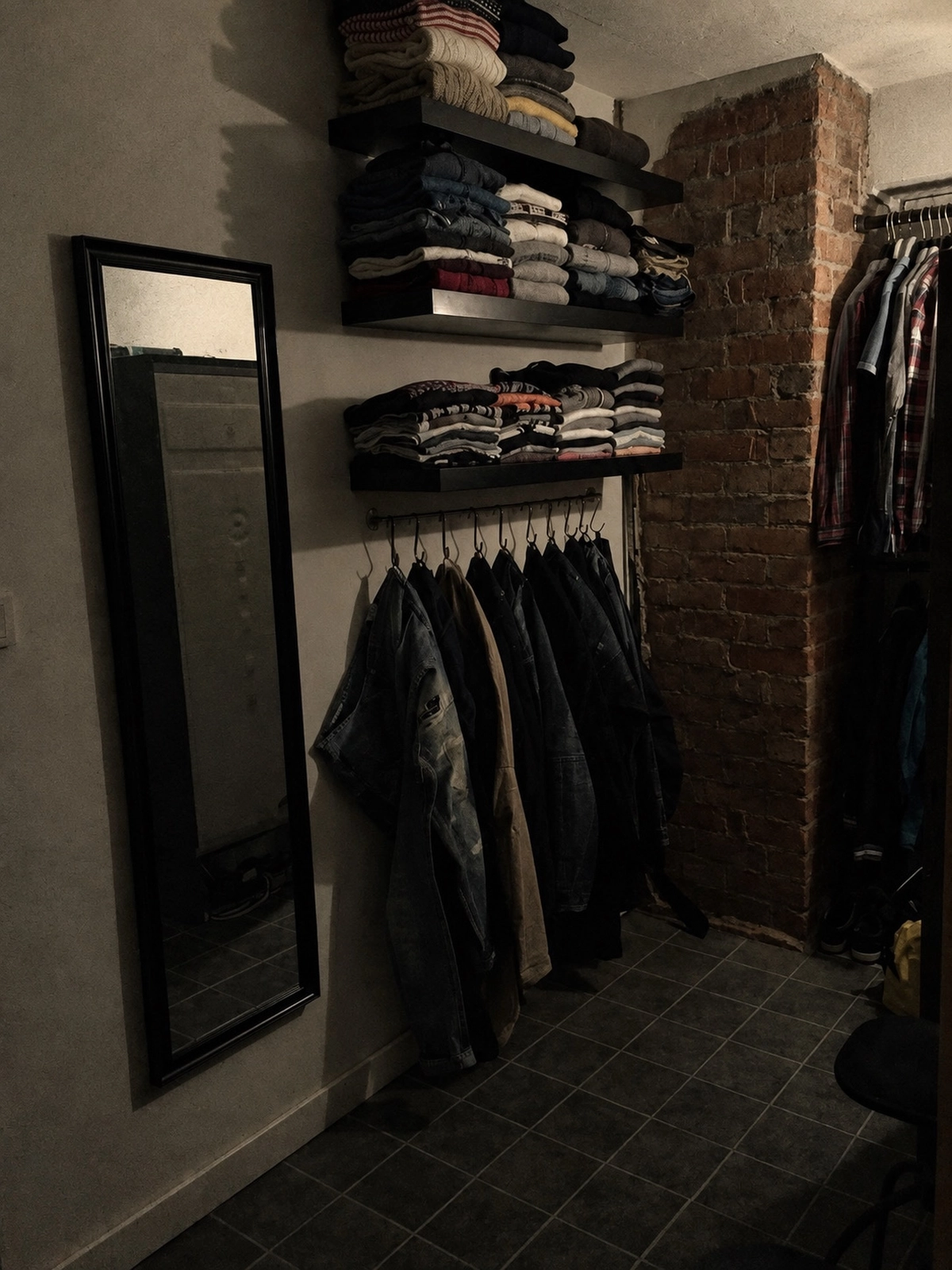
Photo: @noesislogic on Instagram
Fix 3: Steal the wall, not the floor
Floating shelves above a hanging rail turn a dead corner into three shelves of folded clothes. This closet has a brick wall, a mirror, and no built-ins at all, just shelves and a rail, and it holds a full wardrobe. Walls are free storage; floors are not.
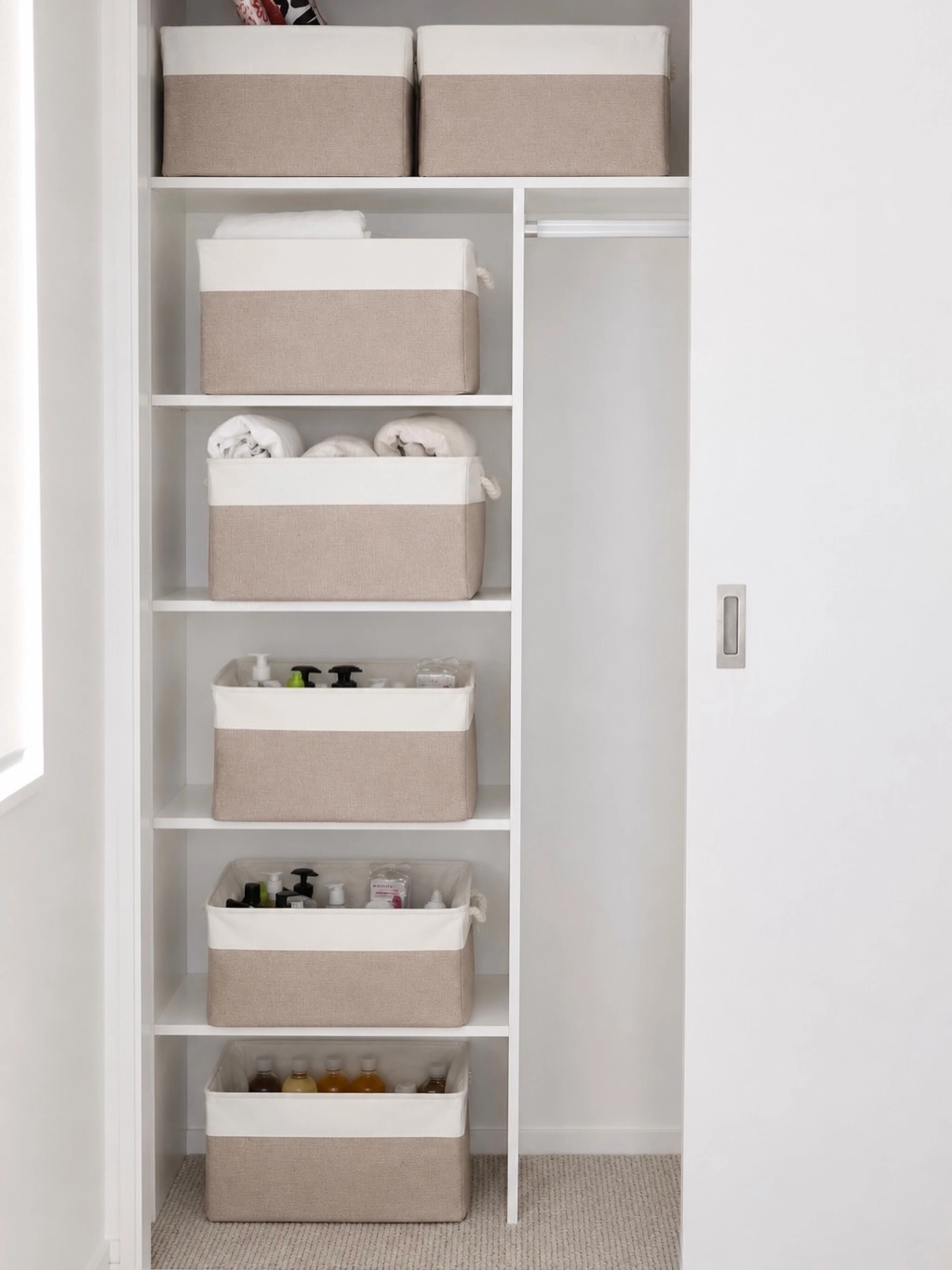
Photo: @simone_anderson on Instagram
Fix 4: Bins up high, daily stuff at eye level
A narrow closet with fabric bins stacked on the top shelves keeps the rarely used where it belongs: up high. The hanging rail below stays clear for what you actually wear. The rule is simple and worth printing out: if you touch it weekly, it lives at eye level.
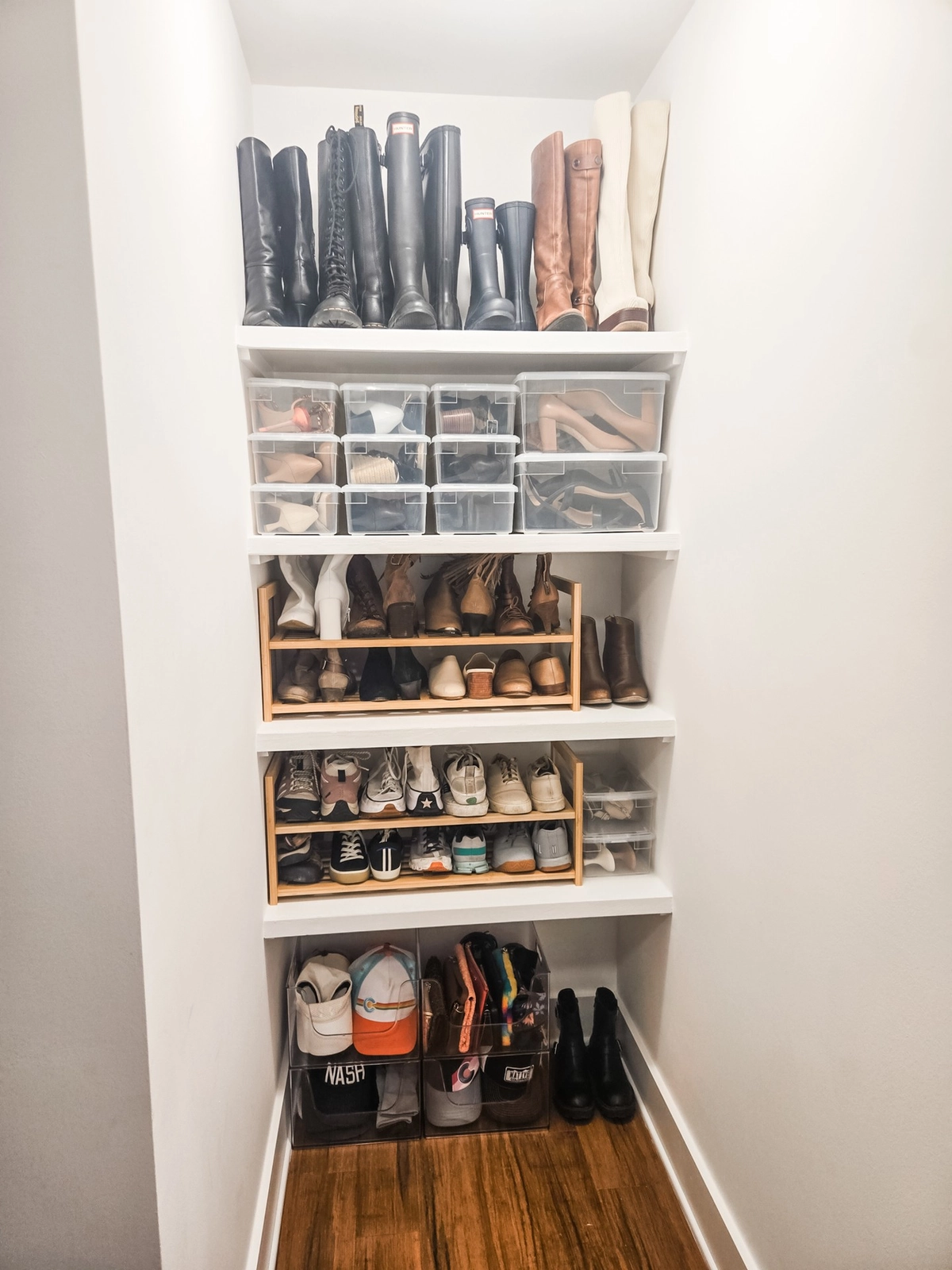
Photo: @afreshspace on Instagram
Fix 5: Build into the narrow gap
A narrow closet with built-in shelving, boots below, and clear bins above proves the awkward gap is not wasted space, it is a shoe closet waiting to happen. Narrow is fine when the shelves fit the gap exactly; measure twice, build once, and the boots stop living by the front door.
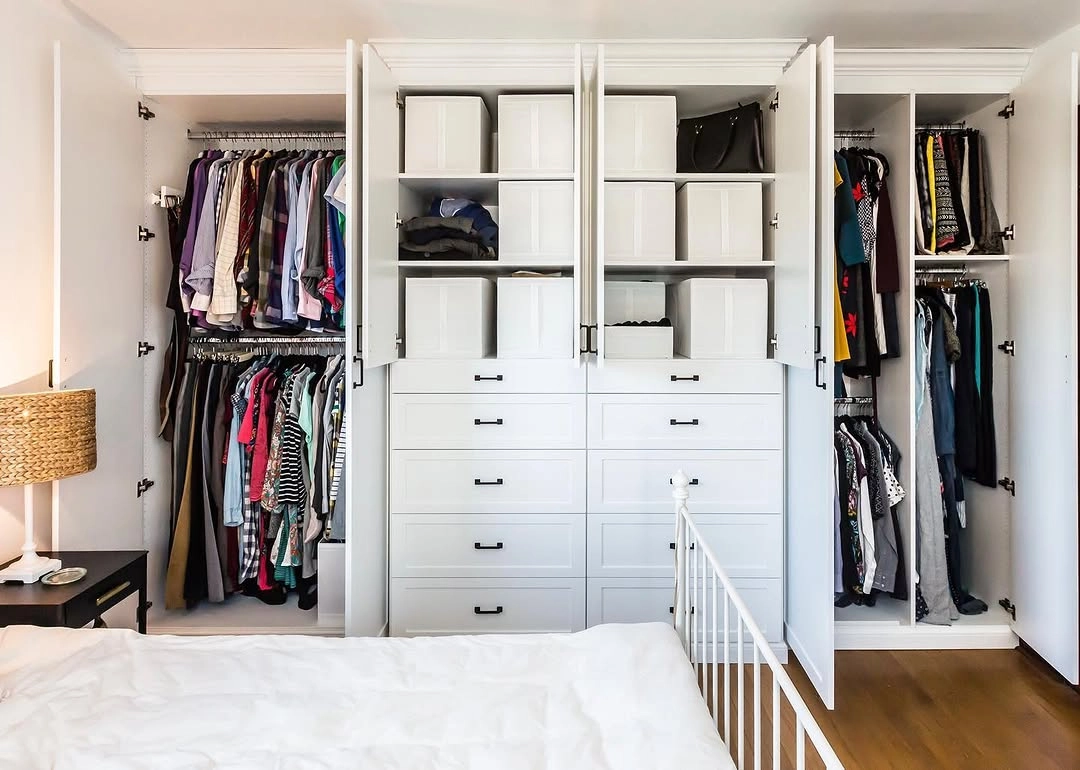
Photo: @closetsbydesign on Instagram
Fix 6: Turn a whole wall into the closet
A bedroom wall of built-in wardrobes with hanging clothes, white storage boxes, and drawers is the nuclear option, and sometimes it is the right one. When the closet is a cupboard and the wardrobe is the room, stop fighting the cupboard and build the wall.
Problem 2: You can’t find anything
You own the shirt. You saw it last Tuesday. It is in the closet somewhere, under something, behind something else. Finding things is storage too, and it is the half most closets skip.
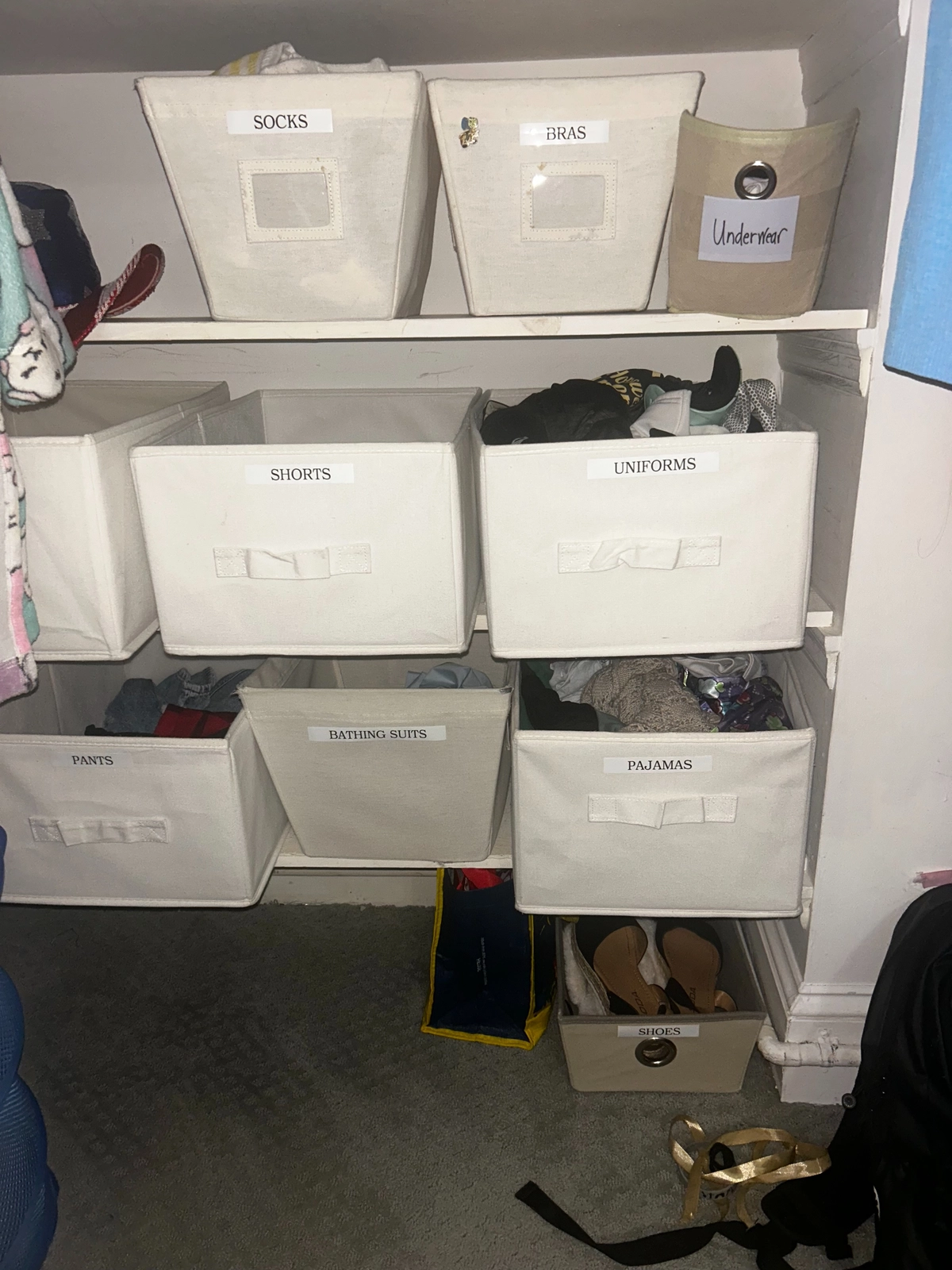
Photo: @iorganizeeverything on Instagram
Fix 7: Label the small stuff or lose it
Labeled fabric bins for socks, shorts, uniforms, pajamas, and shoes turn a lived-in closet into a filing cabinet. The labels are the system: without them the bins are just boxes, with them you stop opening five bins to find one pair of socks.
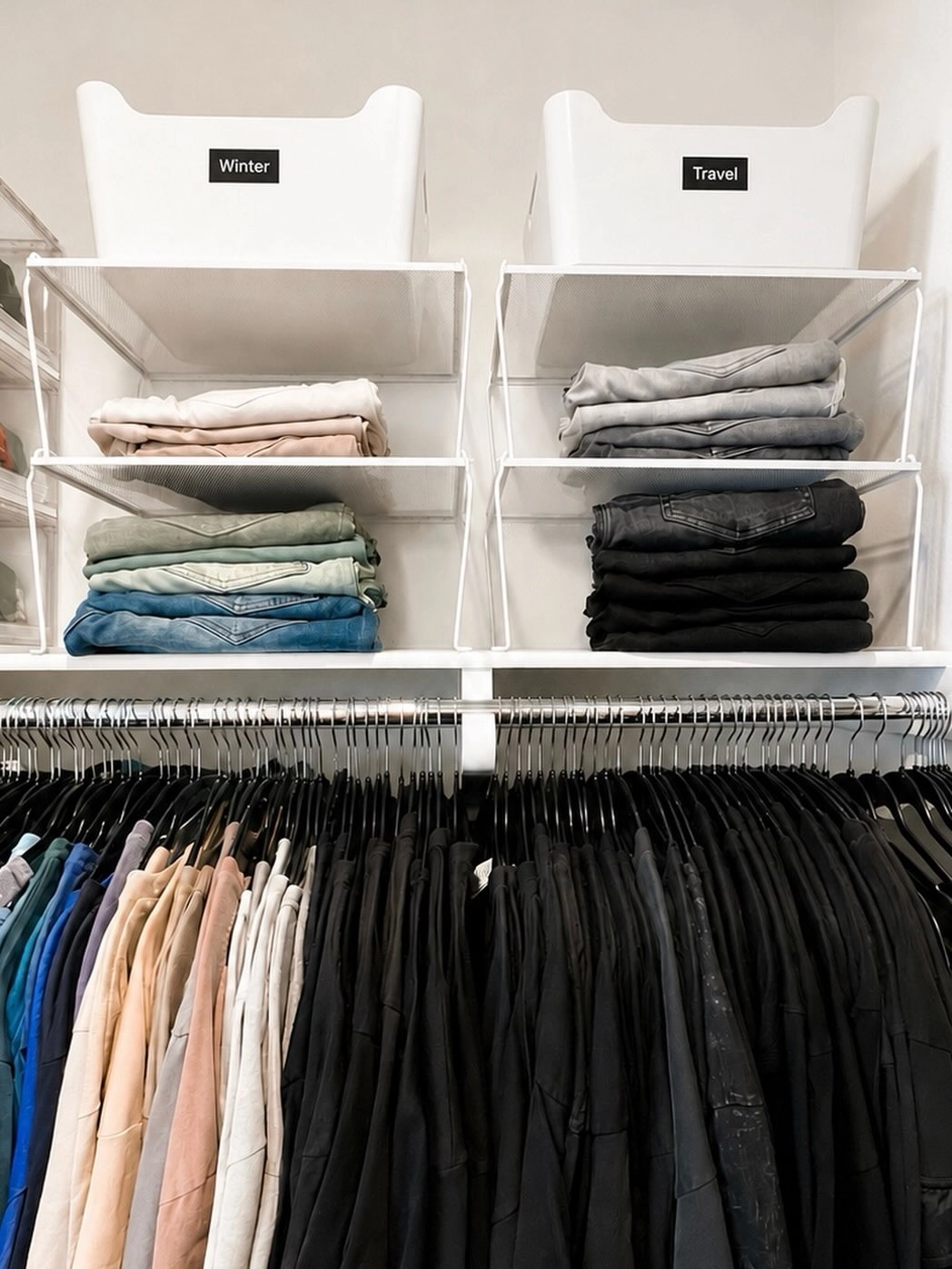
Photo: @1artsyorganizer on Instagram
Fix 8: Winter and Travel live in their own bins
Bins labeled Winter and Travel sit above jeans folded by color, with hanging clothes below. The labels do two jobs at once: they tell you where things are, and they tell you what does not belong in this season. Swap the bins twice a year and the closet resets itself.
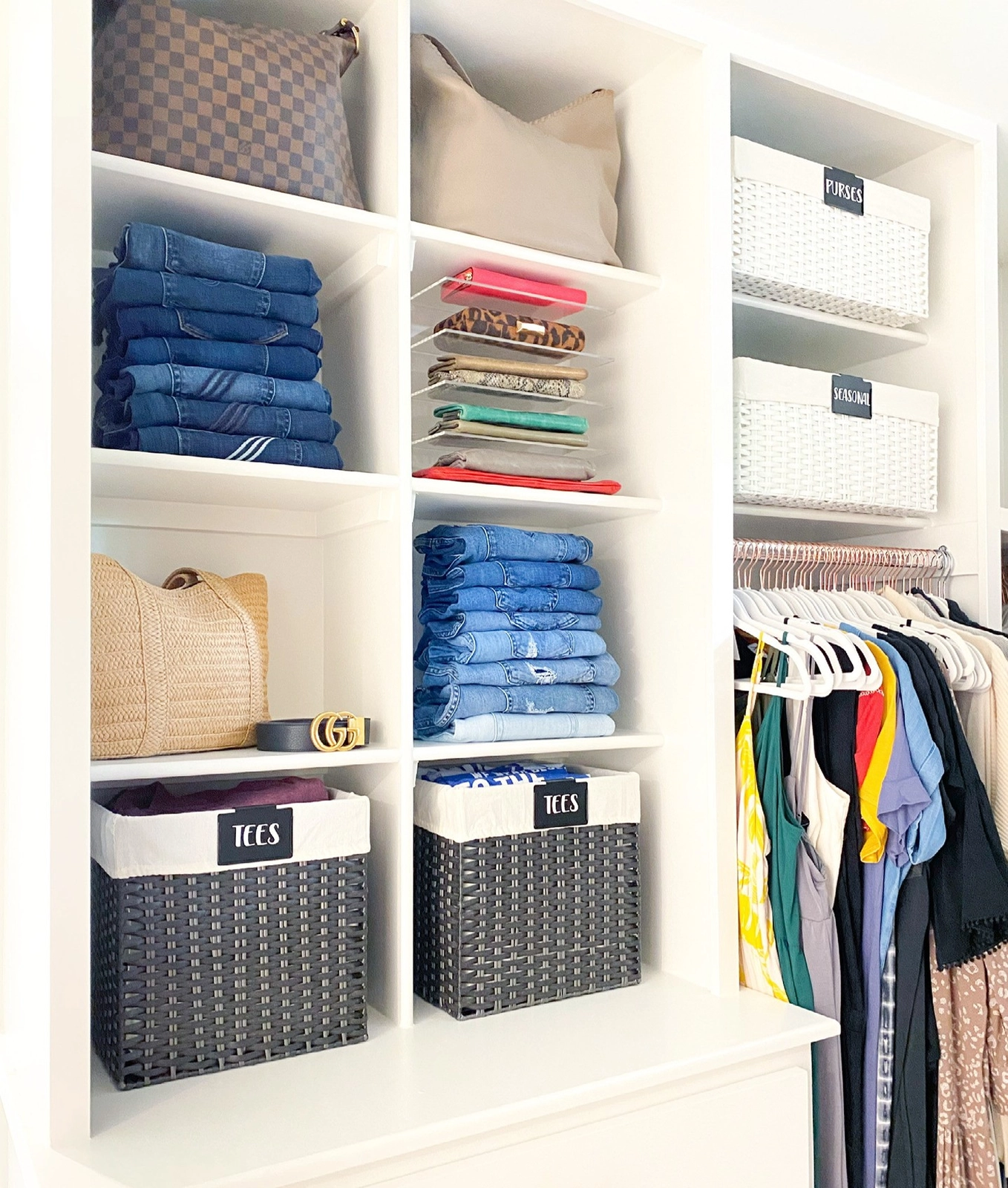
Photo: @organize_prioritize on Instagram
Fix 9: One basket per category, no exceptions
Folded jeans, handbags, and baskets labeled TEES, PURSES, and SEASONAL share one white cubby closet, and nothing in it is mixed. One category per basket is the whole rule. Break it once and the basket becomes a junk drawer with a label on it.
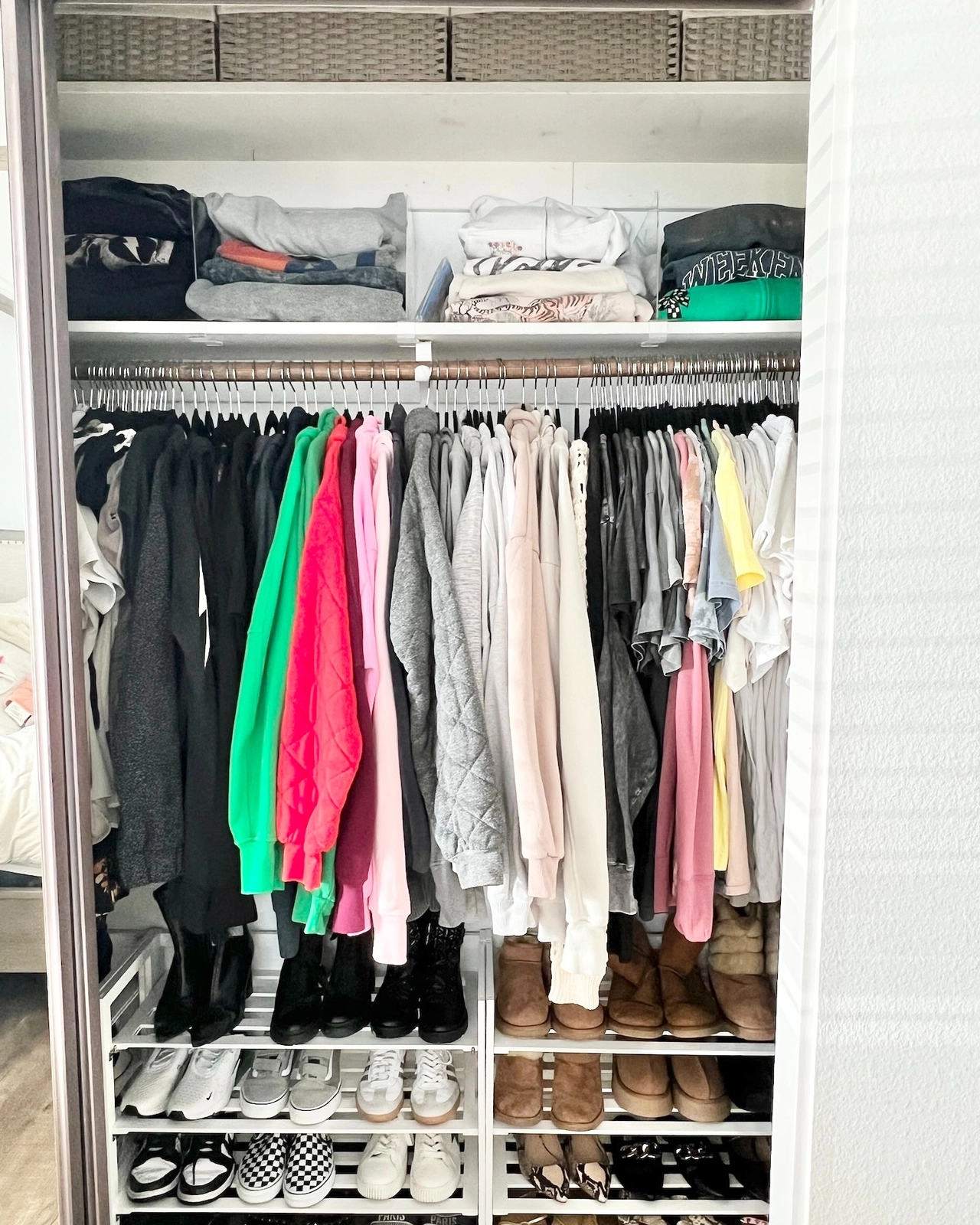
Photo: @beeorganizedsfbay on Instagram
Fix 10: Hang by color and stop hunting
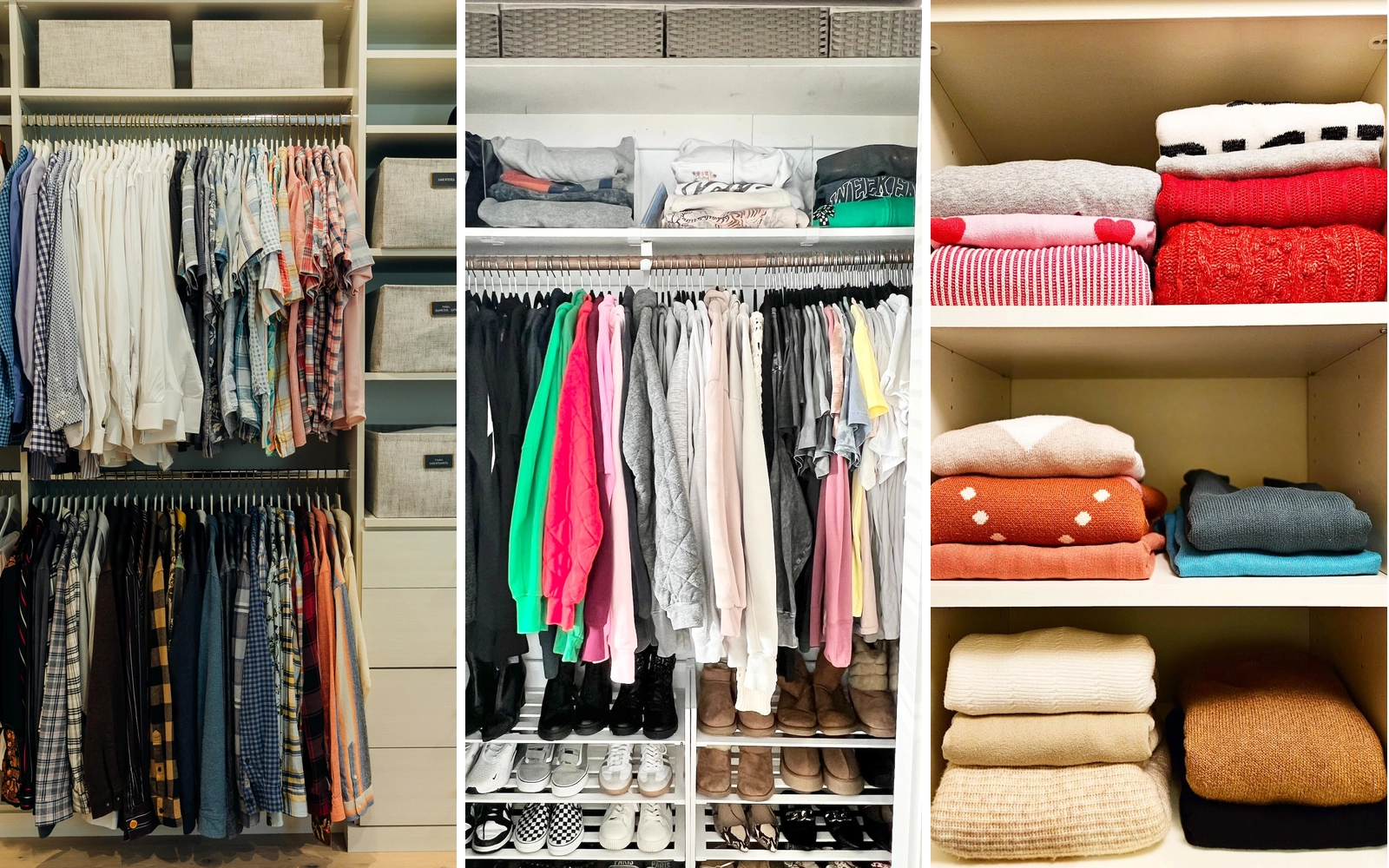
A reach-in closet with clothes hung by color, folded tops, woven baskets above, and shoe racks below reads like a shop rail because it is organised like one. Color order costs nothing and saves the morning hunt; your eyes find the blue shirt before your hands do.
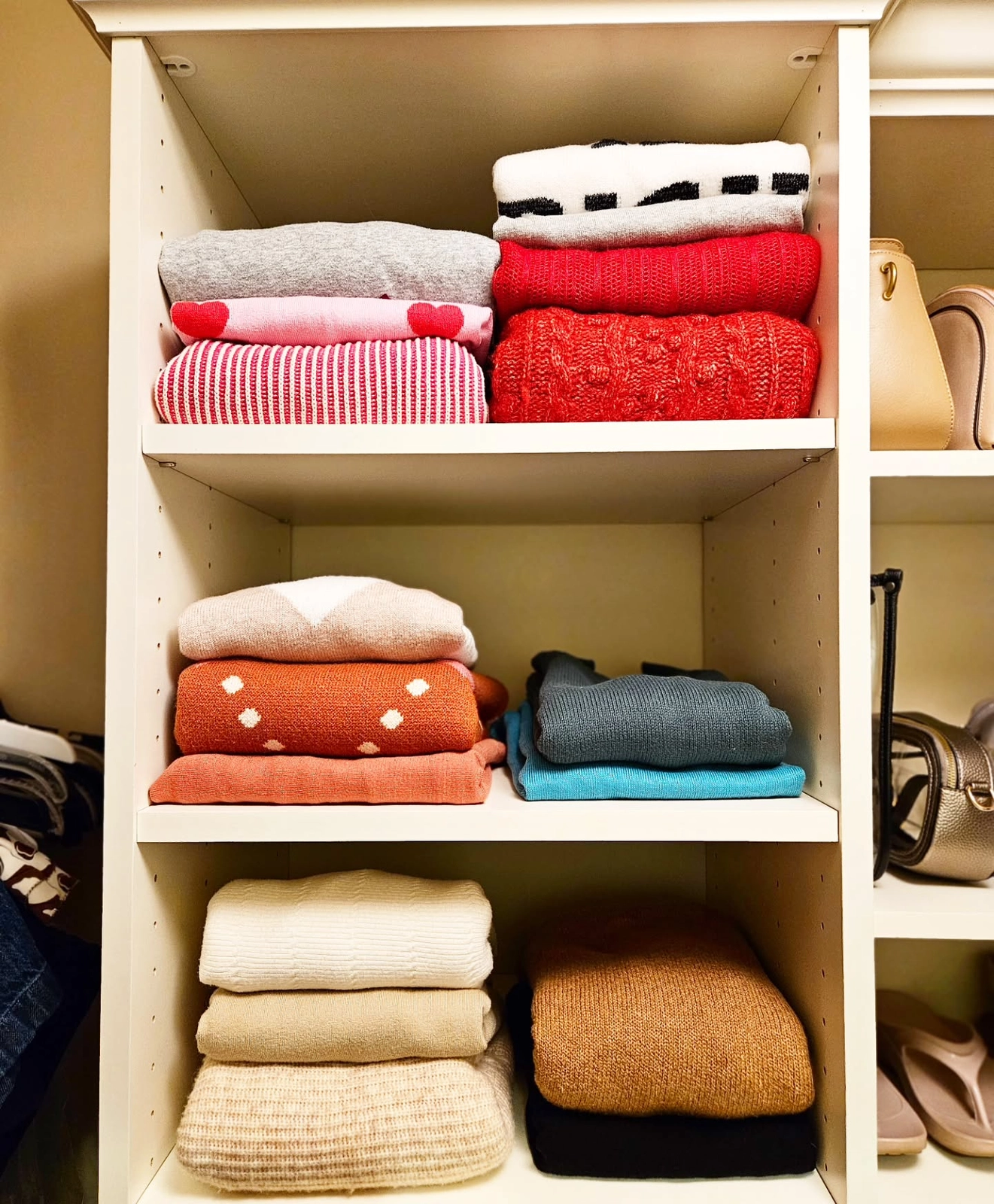
Photo: @edit_with_brit on Instagram
Fix 11: Fold by color and the shelf reads itself
Cubbies of color-sorted folded sweaters prove the same trick works flat. Red with red, cream with cream, and the shelf tells you what you own at a glance. It also tells you when you own four of the same sweater, which is useful information.
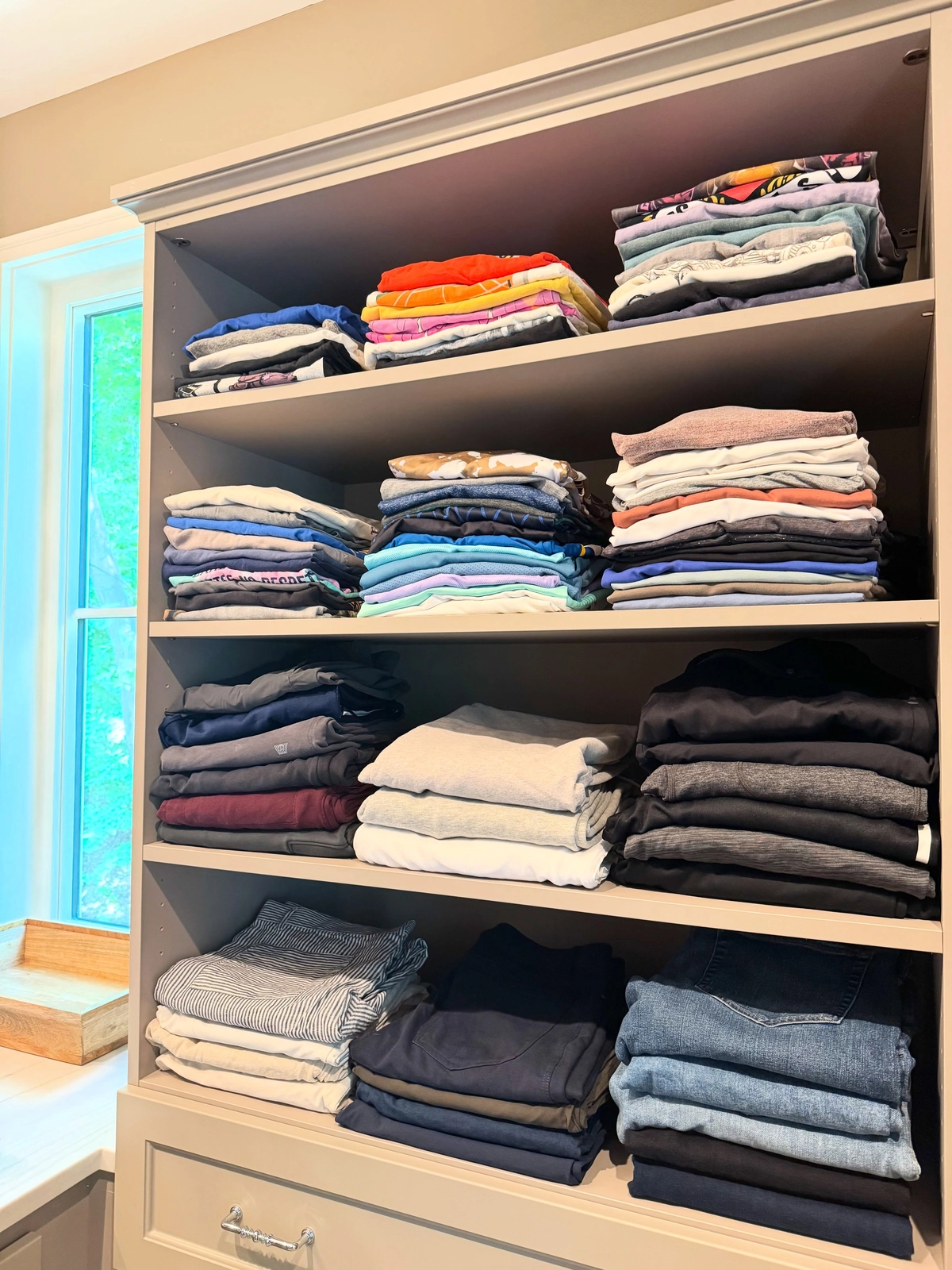
Photo: @janiesorganizingandmore on Instagram
Fix 12: Stacks with a job each
Open shelving with folded t-shirts and jeans stacked above drawers works because every stack has one job: one stack, one category, one height. Stacks fail when they grow sideways into each other, so keep them short enough to lift without the whole pile coming down.
Problem 3: Shoes everywhere
Shoes are the closet’s cockroaches: they multiply in the dark, they live on the floor, and they are always in the way. The fix is to give them a home off the floor, and these six are the best homes we found. If shoes are your whole problem, our shoe storage guide goes deeper on this one room.
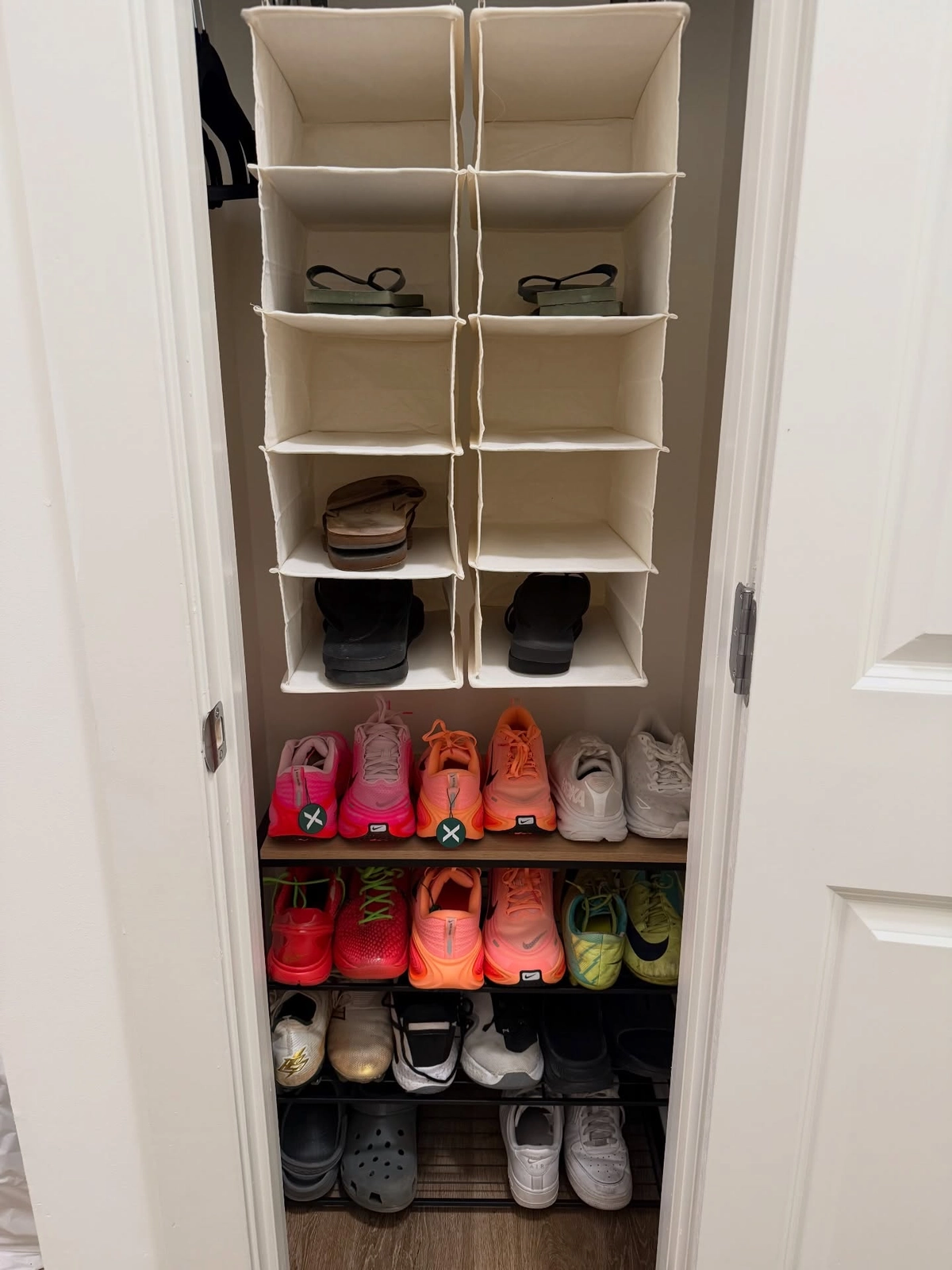
Photo: @mom_ease on Instagram
Fix 13: Give shoes their own cubbies
Hanging shoe cubbies with a sneaker rack below turn a closet wall into a shoe shop. Every pair has a slot, which means every pair has a place to go back to, and that is the part that matters. Shoes on the floor never go back; shoes in cubbies do.
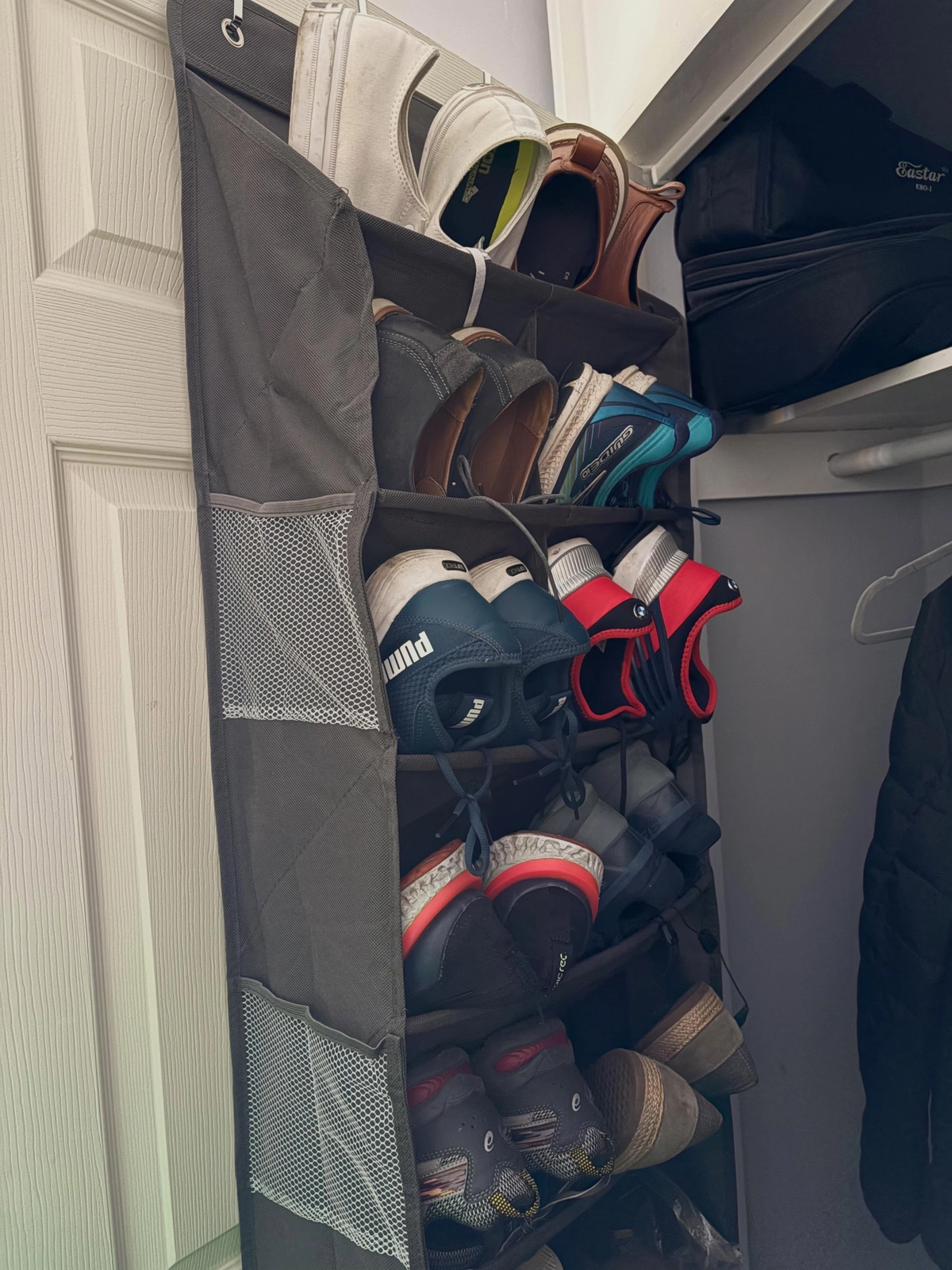
Photo: @kats.life747 on Instagram
Fix 14: The door is a shoe rack
An over-the-door shoe organizer holds a dozen pairs on space that was doing nothing at all. It is the cheapest fix in this list and the most underused: the back of the door is a whole wall you already own, and it needs no drilling.
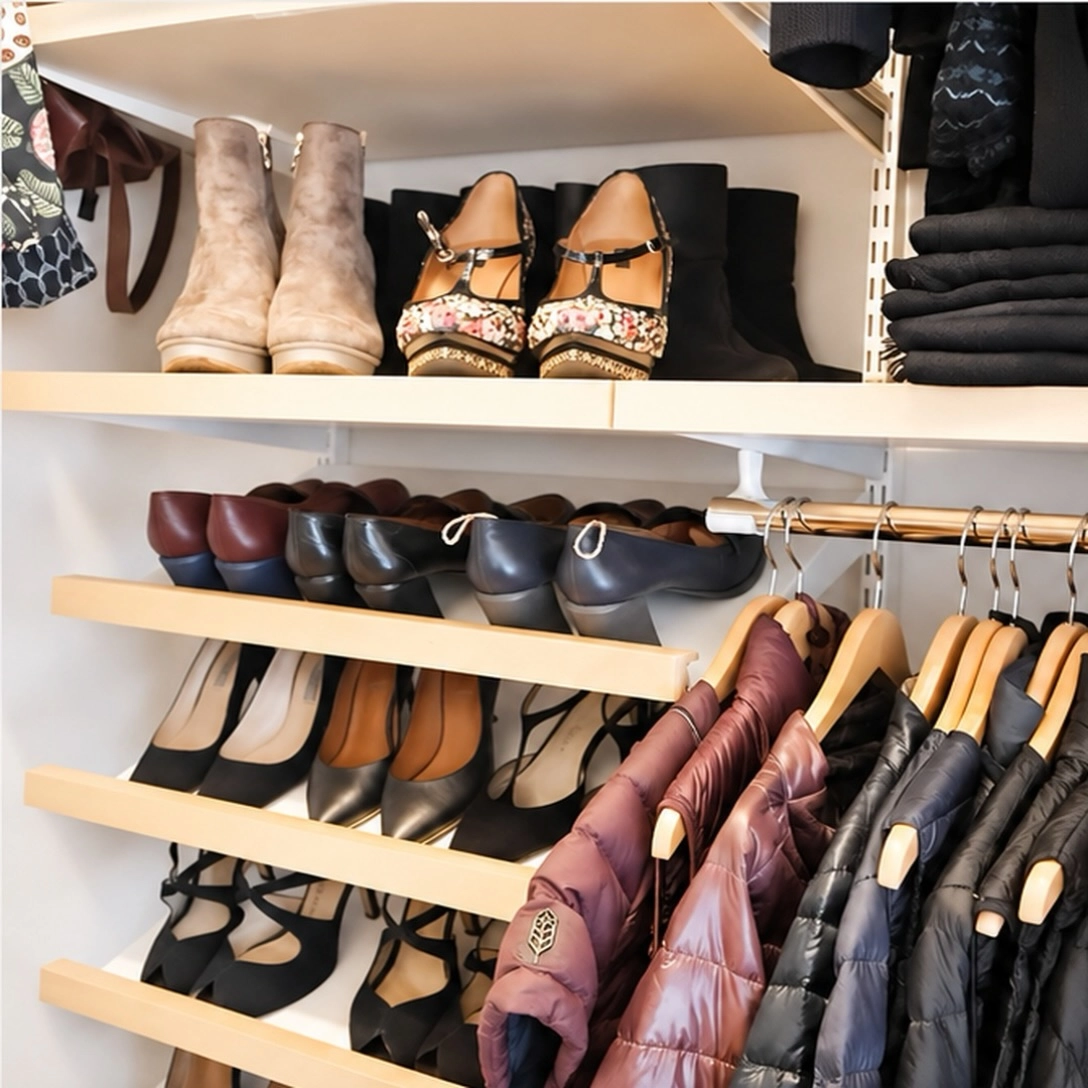
Photo: @theaestheticorganizer on Instagram
Fix 15: Wood shelves, one pair per slot
A walk-in closet with wood shelves of organized footwear shows what happens when shoes get real shelving instead of the floor. One pair per slot, heels together, boots upright. It looks like a shop because shops solved this problem decades ago.
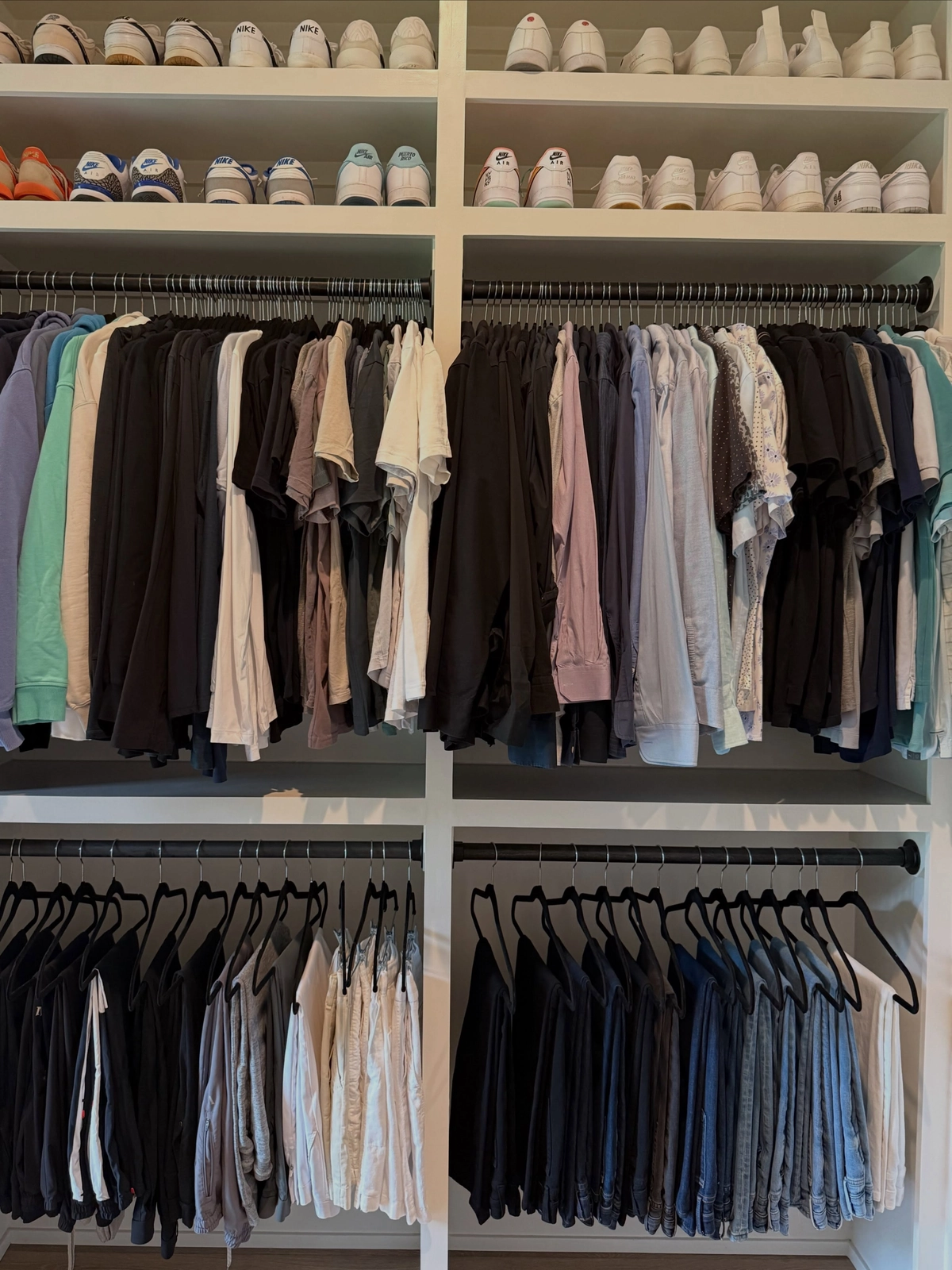
Photo: @nashvilleneat_holly on Instagram
Fix 16: Sneakers go up high
A built-in closet with a sneaker wall on the upper shelves and two levels of hanging below puts the collection where it can be seen and admired instead of tripped over. Sneakers are the one shoe worth displaying; the rest can live lower and quieter.
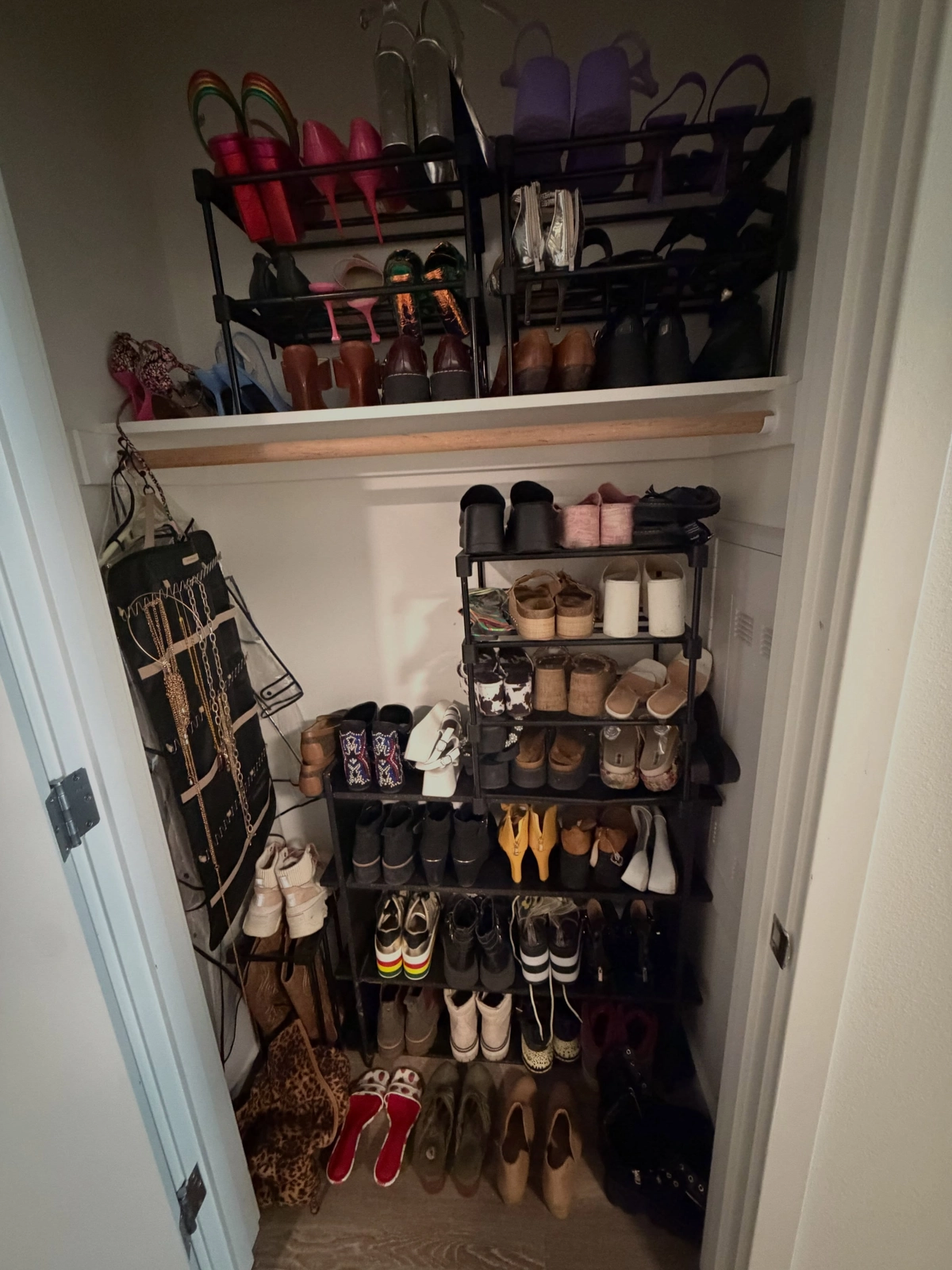
Photo: @a_ladle on Instagram
Fix 17: A rack for every pair, even in a tiny closet
A small walk-in densely packed with shoes on racks and shelves holds more pairs than a closet twice its size, because every inch of wall is a rack. Dense is fine when it is organised; dense and loose is a pile. The racks are the difference.
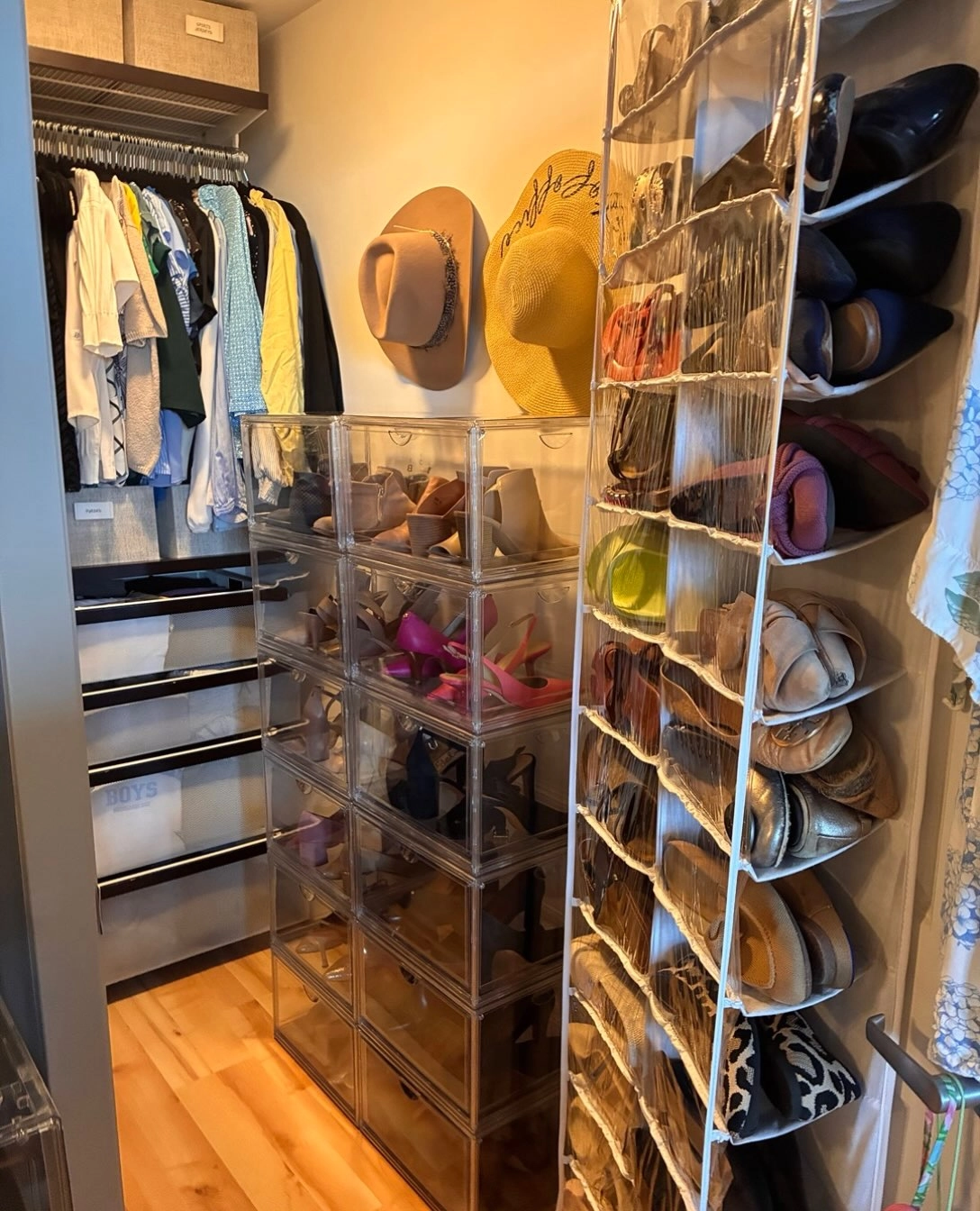
Photo: @northernvirginianeat on Instagram
Fix 18: Clear boxes end the lid-lifting
A tidy walk-in with hanging clothes, bins, and clear shoe boxes solves the box problem: you can see the shoes without opening anything. Opaque boxes are where shoes go to be forgotten. Clear boxes are where they go to be worn.
Three problems down. The last two are the ones that decide whether it stays fixed.
Problem 4: The top shelf is wasted
The top shelf is where things go to be forgotten: the bag from 2019, the box with no label, the thing you will deal with later. It is also the easiest storage in the closet to fix, because it only needs a container and a label.
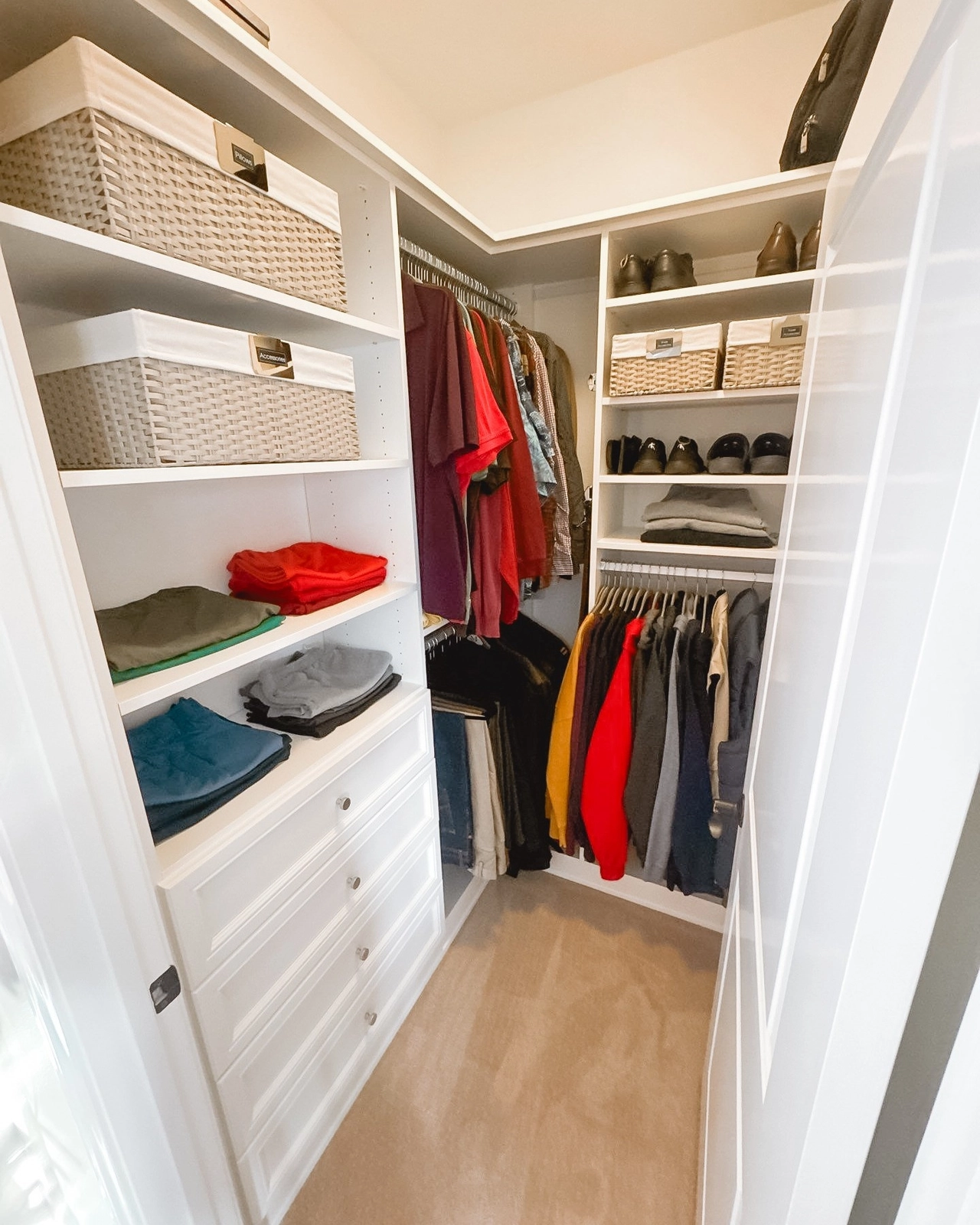
Photo: @simplyluxeorganizing on Instagram
Fix 19: Woven baskets hide the rarely used
A white built-in walk-in with labeled woven baskets on the top shelf, folded clothes, hanging clothes, and shoes below shows the top shelf done right. The baskets hide the rarely used, the labels say what is inside, and nothing up there is a mystery.
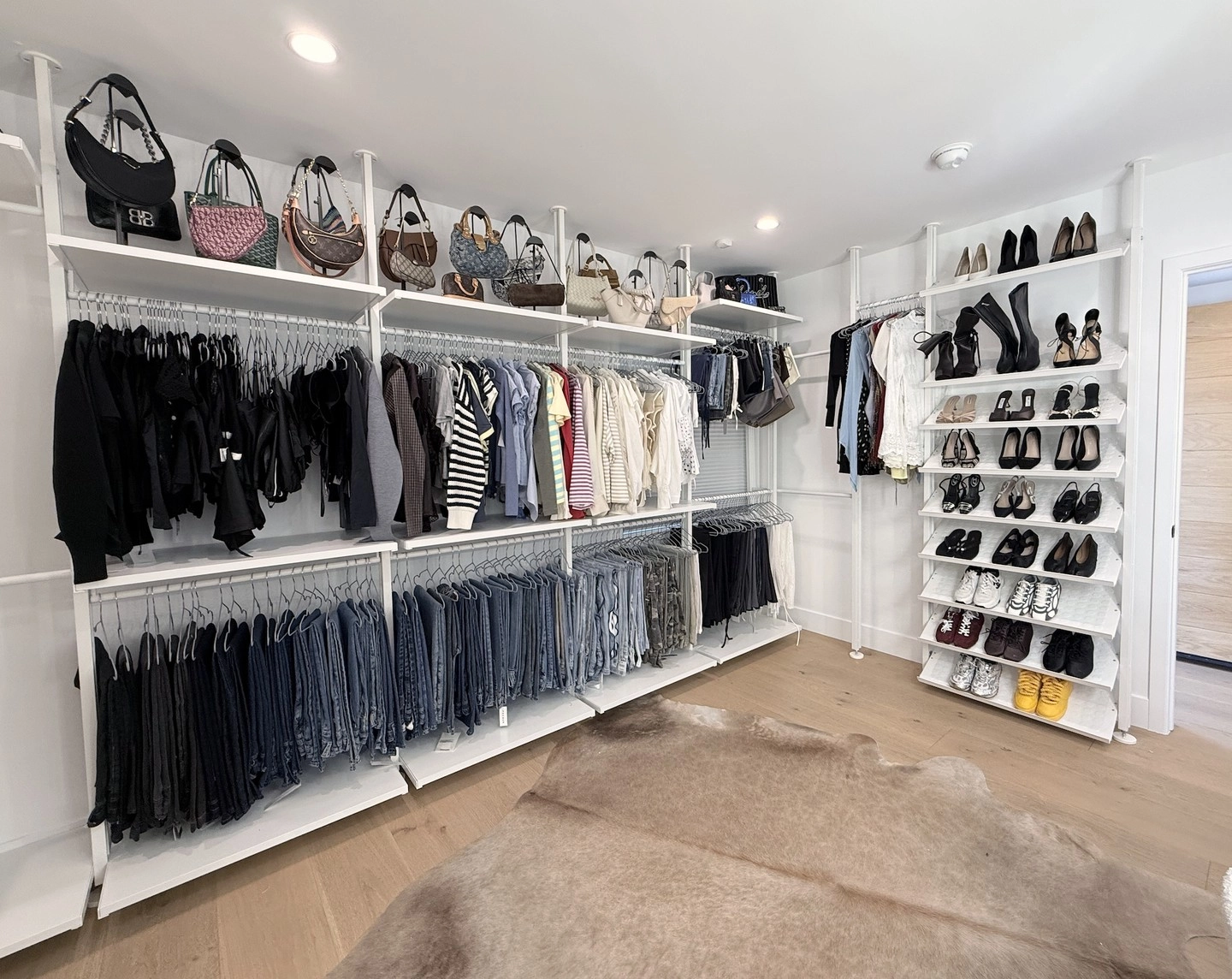
Photo: @composed_living on Instagram
Fix 20: Bags live at the top
A large open walk-in with handbags on the top shelf, hanging clothes, and a shoe wall below puts the bags where they are safe, visible, and out of the way. Bags are top-shelf things: light, rarely grabbed in a hurry, and better seen than stacked.
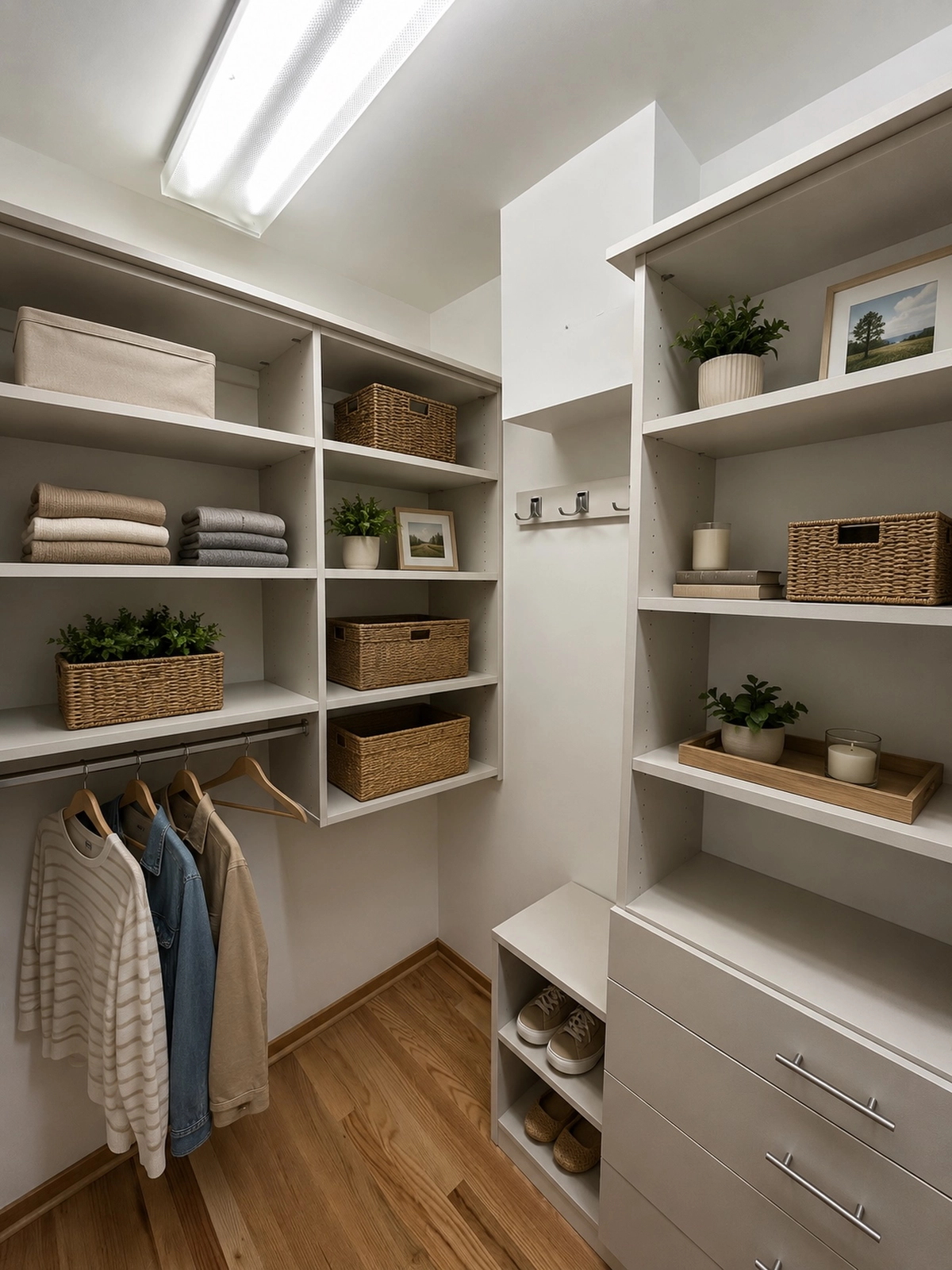
Photo: @calclosetsbyries on Instagram
Fix 21: Baskets up, daily wear down
A walk-in closet system with baskets on the top shelves, folded clothes, hanging shirts, and shoe storage below is the whole closet in one photo. The rule it follows is the rule for every closet: rarely used goes up, daily wear stays down, and nothing lives on the floor.
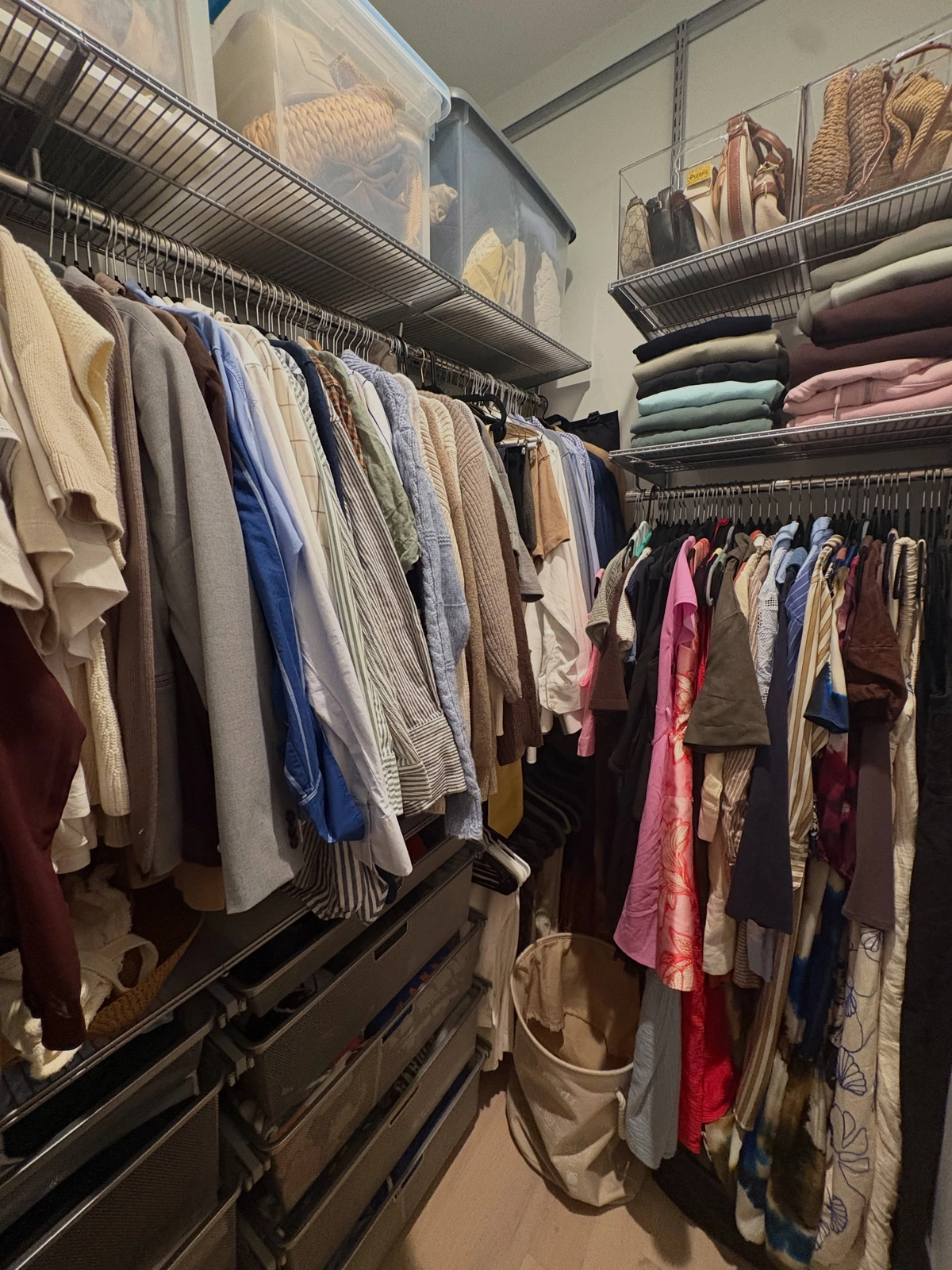
Photo: @beeorganizedboston on Instagram
Fix 22: Clear bins so you can see the season
A walk-in with wire shelving, hanging clothes, drawers, bins, and clear containers on the top shelf makes the season visible. Clear bins are the top shelf’s best friend, because the top shelf is exactly where you forget what you stored. See it, or lose it.
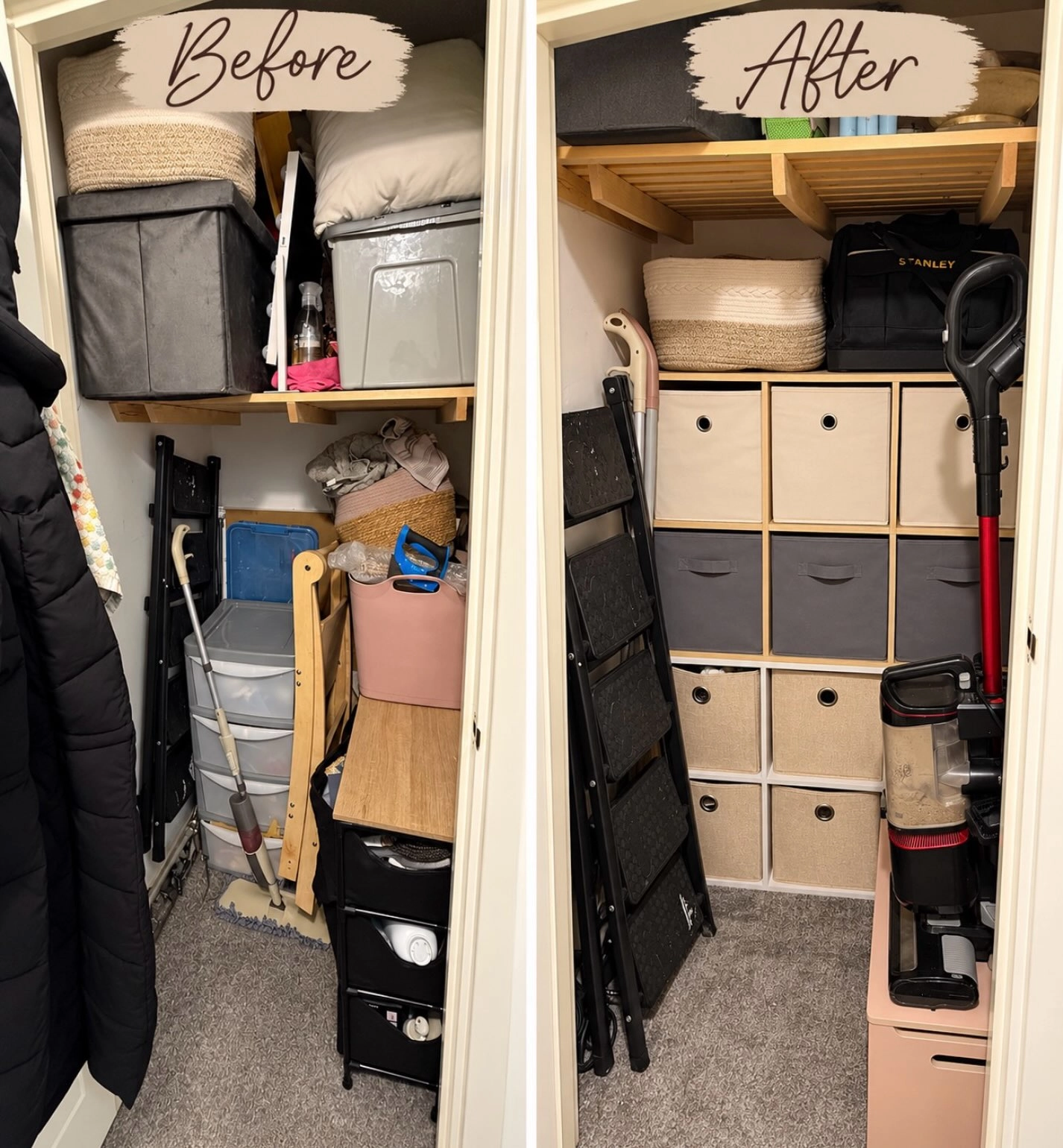
Photo: @gcw.home on Instagram
Fix 23: The before and after is the top shelf
A small storage closet, before and after, with cube bins and shelves: the after is not a bigger closet, it is the same closet with bins doing the work. Cube bins are the top shelf’s training wheels. Start with them, and the rest of the closet follows.
Problem 5: It never stays tidy
You organise it on Sunday and by Wednesday it looks like it never happened. That is not a failure of willpower, it is a failure of the system: if putting things away is harder than dropping them, dropping wins. These five are the systems that make tidiness the easy option. Our bedroom organization guide covers the same Sunday-to-Wednesday problem for the whole room.
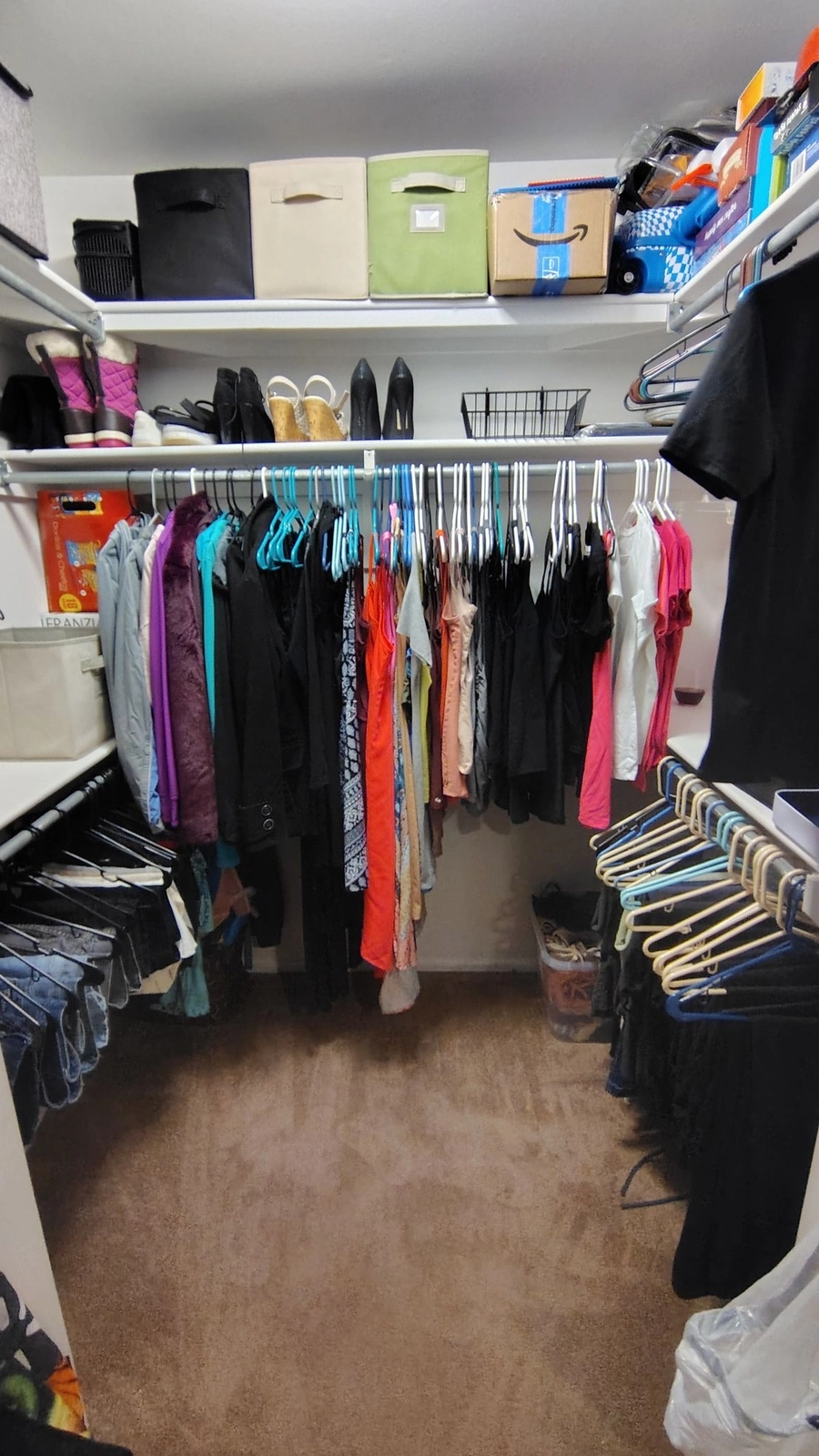
Photo: @maidtoorganizellc on Instagram
Fix 24: Start honest: this is the real closet
A lived-in walk-in closet with hanging clothes, fabric bins, shoes on shelves, and real clutter is where most closets actually start. Not a showroom, not a render, a working closet. Every fix in this list was chosen for a closet like this one, not for a closet like a magazine.
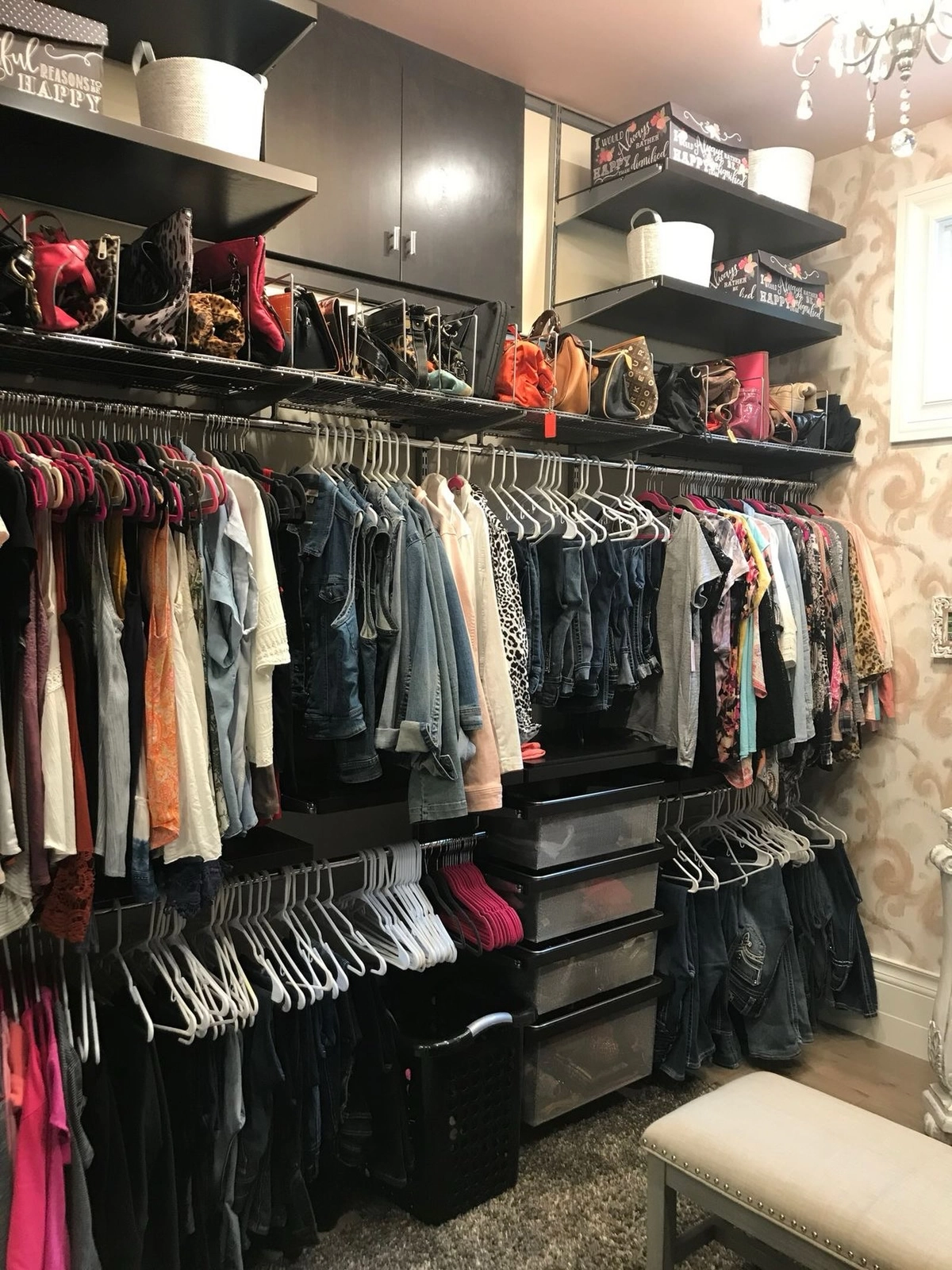
Photo: @muthaclutter on Instagram
Fix 25: A bench makes putting away easy
A lived-in walk-in with two-level hanging, handbags on shelves, storage drawers, and a bench has one secret weapon: somewhere to sit while you put shoes on and sort what stays. Tidiness needs a staging spot. Without one, everything lands on the floor.
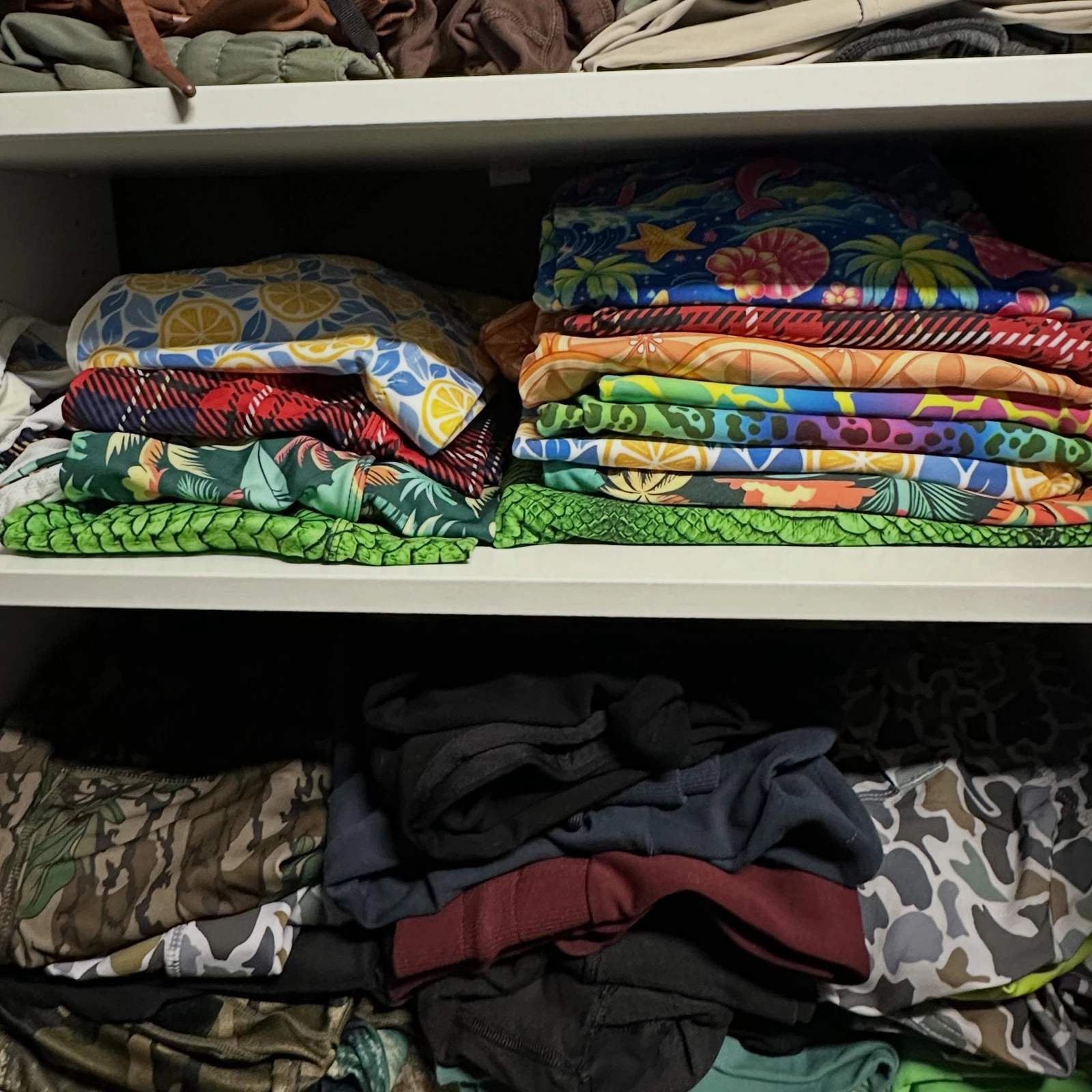
Photo: @pull_up_quick_and_get_whittums on Instagram
Fix 26: Fold it the same way every time
Shelves of neatly folded patterned clothes show the quiet power of a consistent fold. Same size, same stack, same place, every time. The fold is not about neatness for its own sake; it is about stacks that do not collapse when you pull the bottom one out.
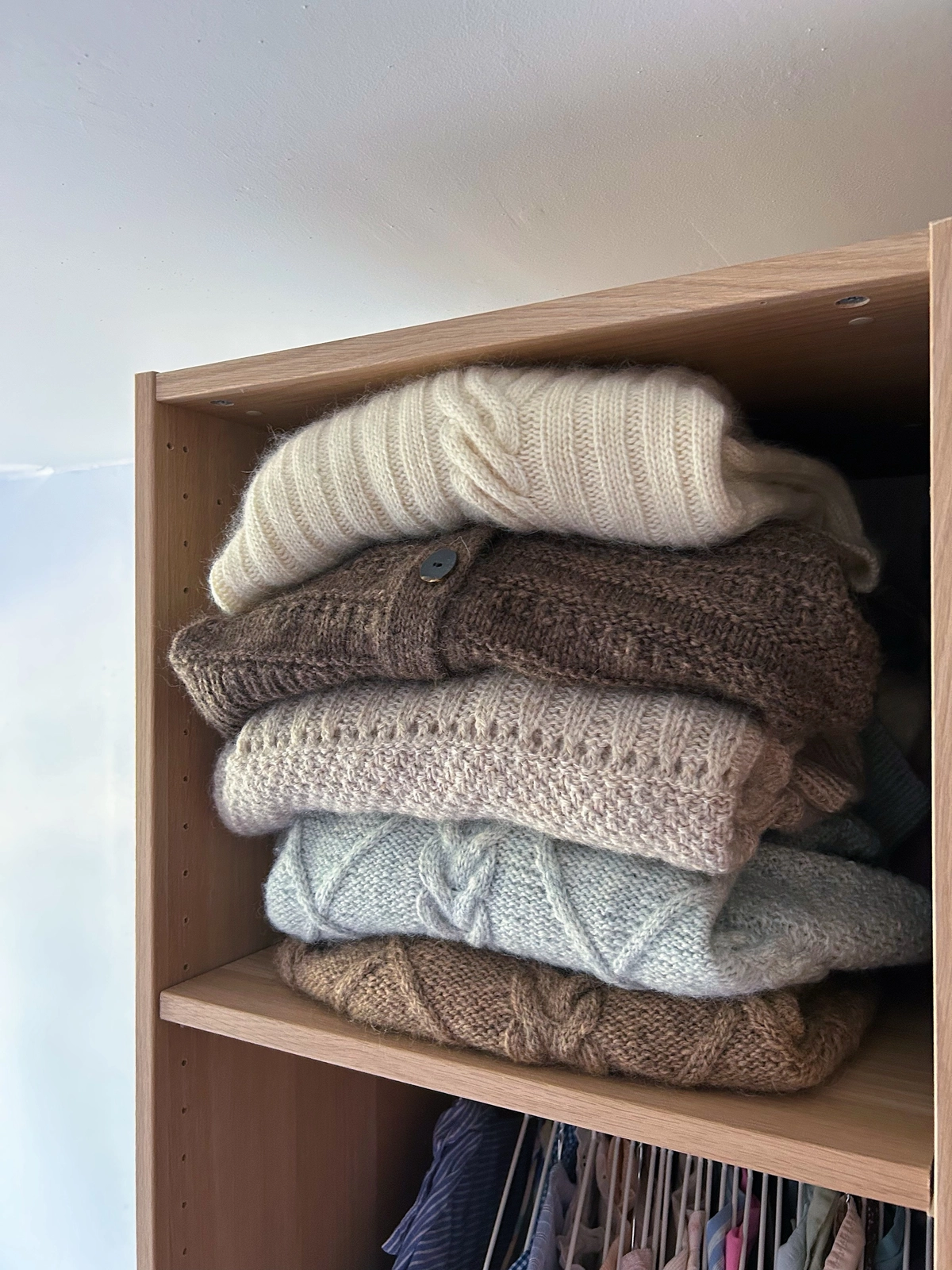
Photo: @knitpit on Instagram
Fix 27: Knitwear gets one shelf and stays there
A closet shelf of folded knit sweaters with hanging clothes below is the simplest system in this list: one shelf, one category, no exceptions. Knitwear should never hang, it stretches, and it should never share a shelf, it gets lost. One shelf, done.
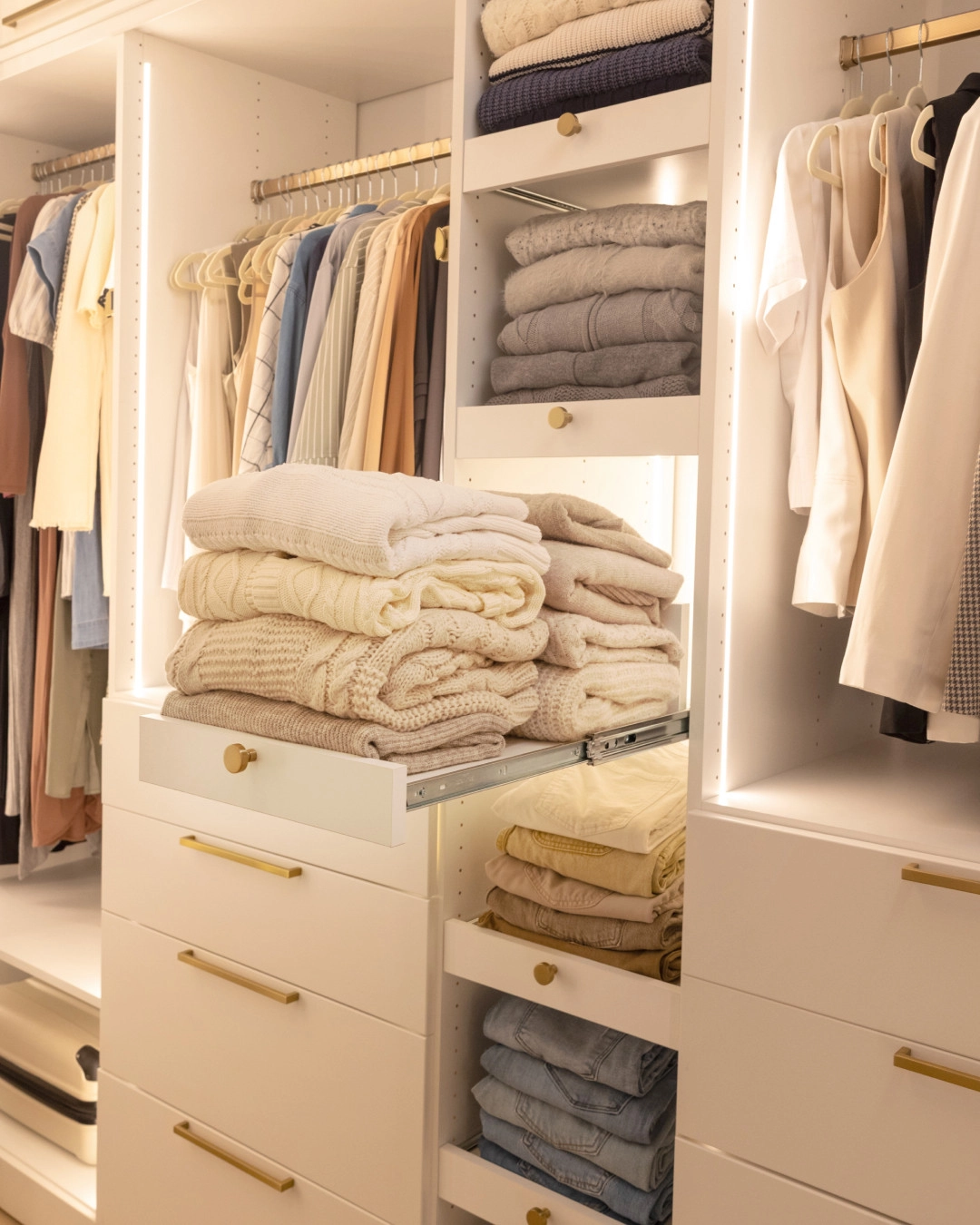
Photo: @inspiredclosets on Instagram
Fix 28: Drawers that pull out get used
A white built-in closet with LED lighting, folded knit sweaters, and pull-out drawers with jeans shows why drawers beat shelves for the daily stuff. A drawer you can pull out gets used; a shelf you have to reach into gets ignored. Light helps too: you cannot put away what you cannot see.
The ten-minute weekly reset
None of this holds without a reset, and the reset is ten minutes, once a week, same time. Shoes back in their slots, one stack re-folded, one bin checked, floor clear. That is the whole routine.
Do it on Sunday night and Monday morning stops being a hunt. Skip it for three weeks and you are back to Problem 1, and that is fine too: the fixes are still here, and they work the second time just as well as the first.