17 Dining Room Wall Decor Ideas, Wall by Wall
Here is what nobody tells you about dining room walls: you read them sitting down. From a chair, your eye level drops to roughly 120 cm, the lower half of every wall does the talking, and anything hung for a standing viewer floats above the conversation like a picture in a hotel corridor. So this list still goes wall by wall, the big wall, the window wall, the narrow wall and the open side, but every idea is placed and sized for the seated view.
The Big Wall
This is the long, uninterrupted stretch, usually behind or facing the sideboard. Seated diners rest their eyes on it for an hour at a time, so it earns the biggest gestures you own.
1. Hang one oversized piece of art
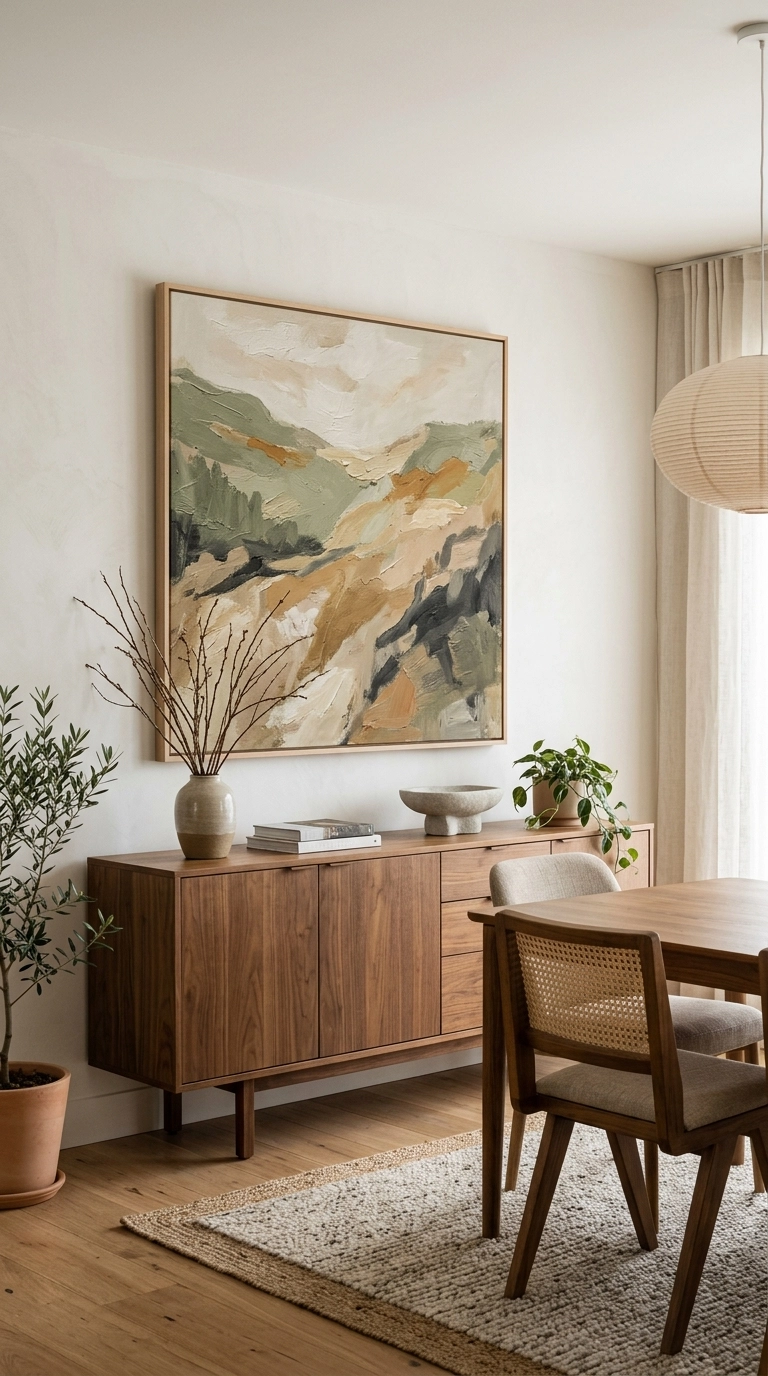
Dinner is served, everyone settles, and this is the wall every gaze lands on between courses. One oversized painting or print, about two thirds the width of the sideboard beneath it, fills that view in a single decision. Hang it with its centre near 120 cm, seated eye level, rather than the standing height galleries use, and it meets your guests’ eyes instead of hovering above their heads. A calm single piece beats a busy cluster on a wall nobody can look away from.
One big piece, hung low enough to talk to, settles the whole wall in one move.
2. Build a grid gallery of matching frames
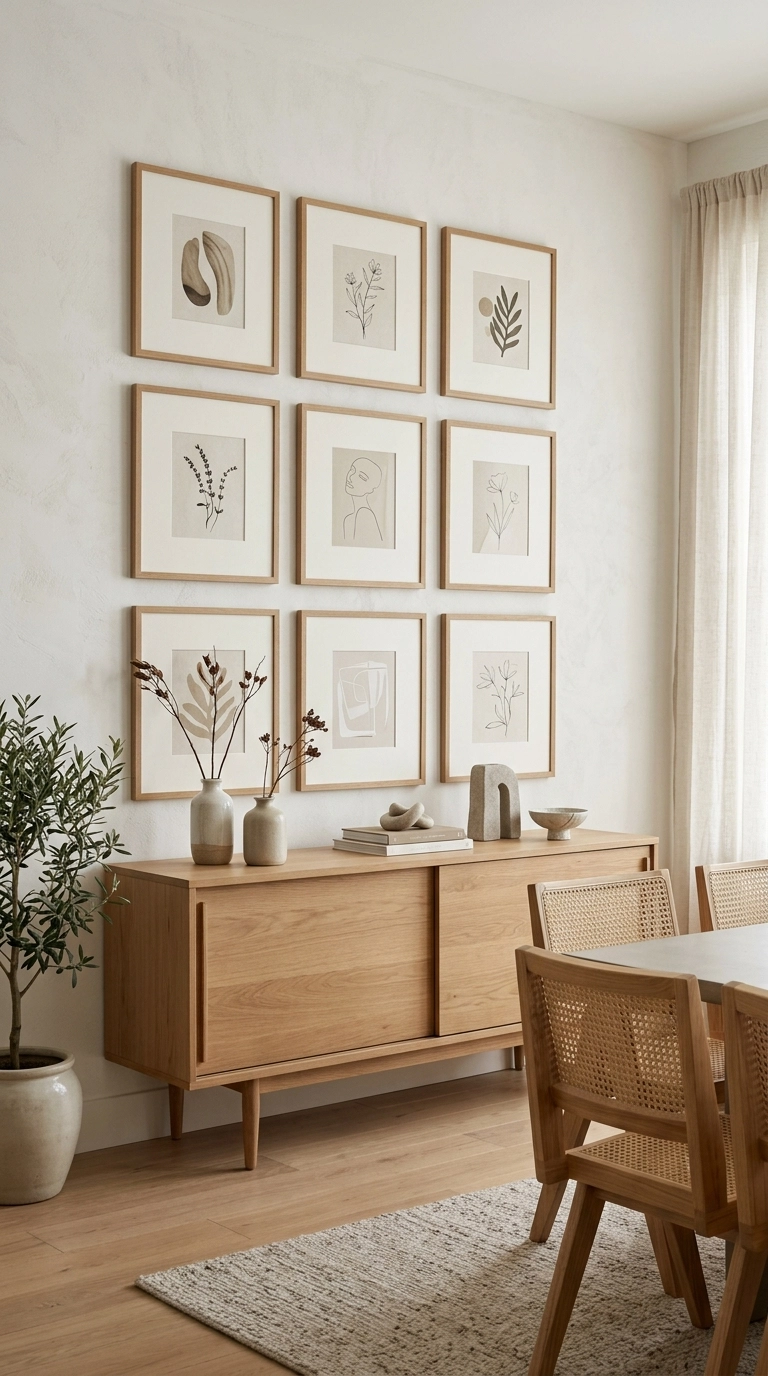
The problem with this wall is usually money: the one huge painting you want costs more than the table did. A strict grid of six to nine matching frames solves it, because from a seated distance the block reads as one large artwork. Keep every gap identical, 5 to 7 cm works, and set the centre of the whole block on the 120 cm sightline, not the centre of each frame. The images inside can be anything, botanical prints, black and white family photos, even pages from a calendar.
Measure the block, mark its four corners, then hang. The grid is one picture, so treat it like one.
3. Hang a plate wall
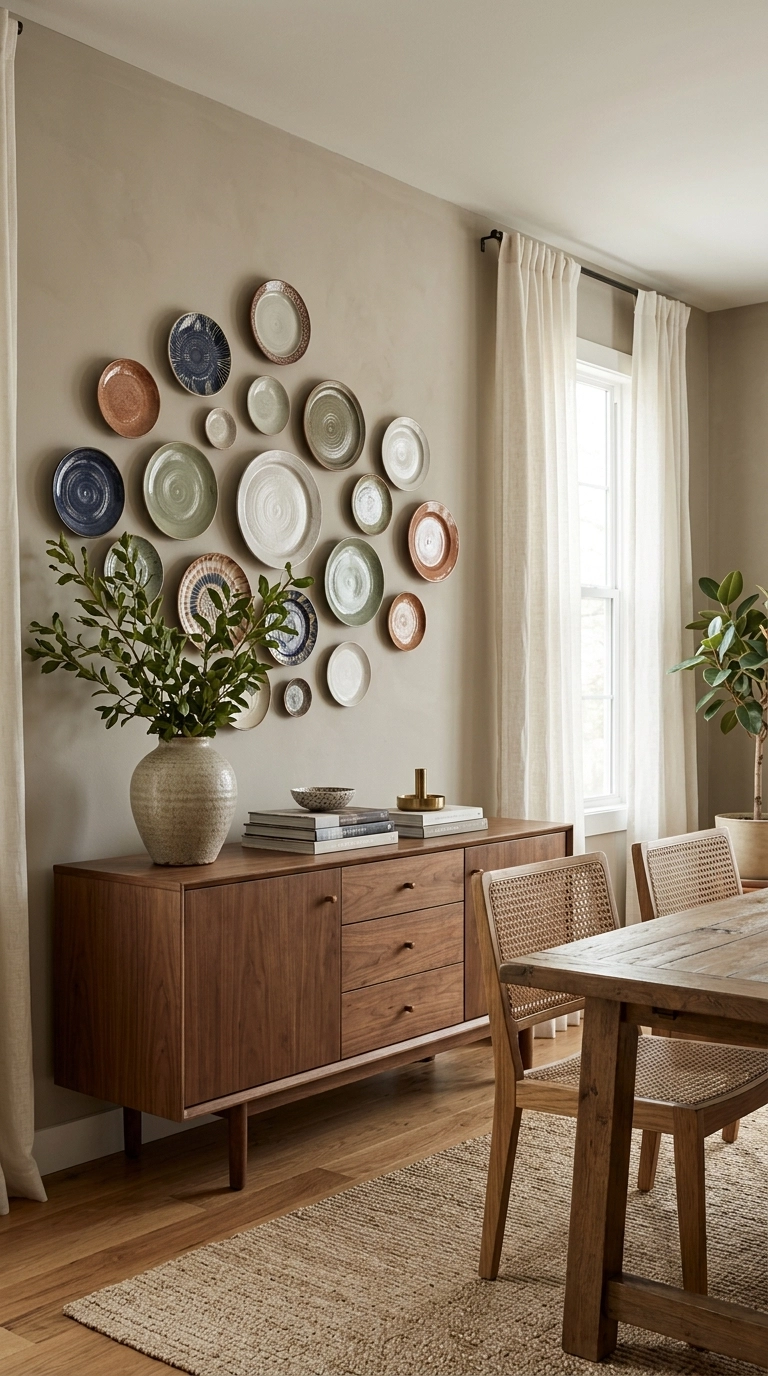
Start with the meal itself: a dining room is full of rectangles, table, sideboard, frames, and a wall of round plates breaks the pattern beautifully. Decorative plates, platters and shallow baskets over the sideboard bring in pattern and circles at exactly the height seated eyes rest. Charity shops and family cupboards are the usual sources, which makes this the cheapest big wall finish in the house. Use spring plate hangers that grip the rim and hide behind the plate, because rails wobble every time a drawer slams.
A plate cluster centred on the seated sightline, roughly 120 cm, feels composed. Centred higher, it feels like storage.
4. Lean the wall on a large mirror
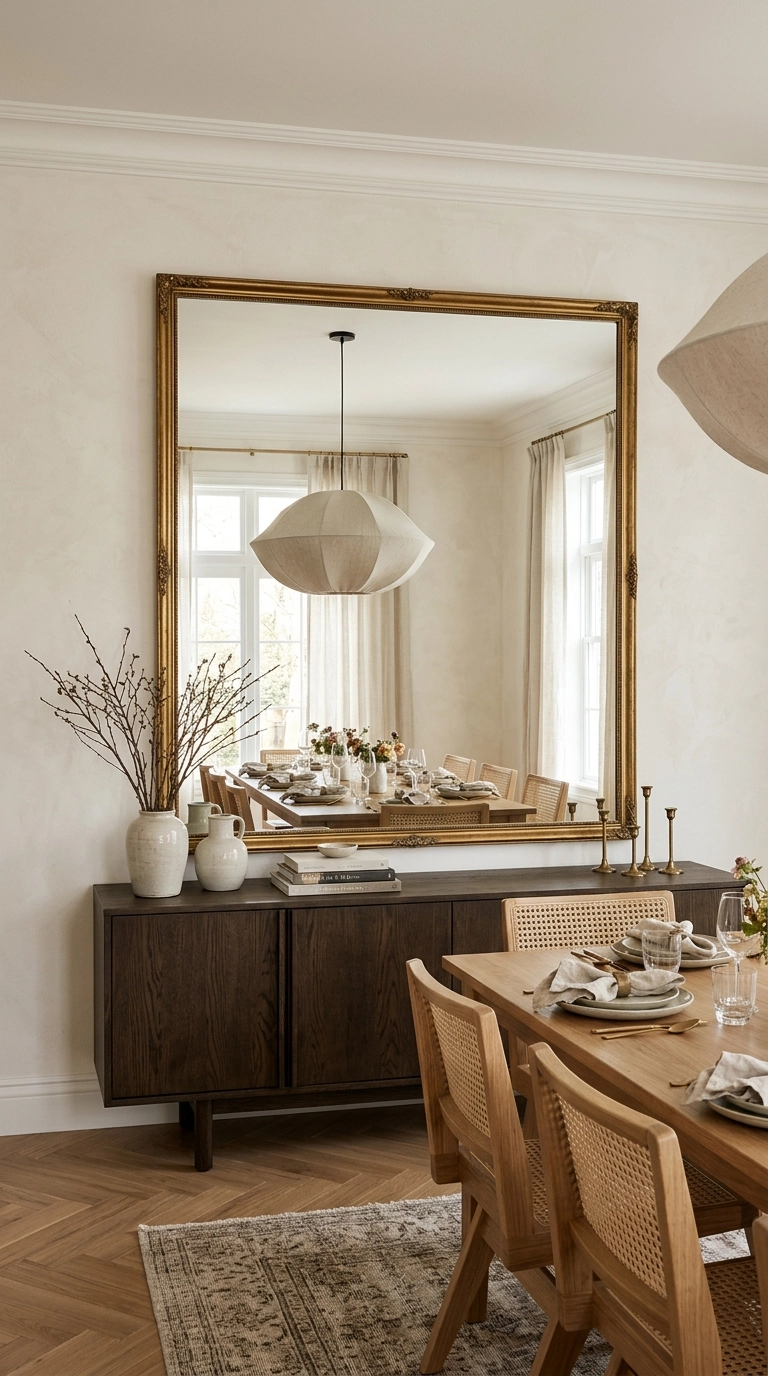
A big mirror on this wall doubles the light from the window opposite and reflects the things worth looking at: the table setting, the pendant glow, the people. The catch is angle. A mirror hung flat shows seated diners whatever sits directly opposite at their height, so sit in every chair before you fix it and check each view. If the reflection is the kitchen counter chaos, shift the mirror or swap the wall. Choose a frame with real presence, because a thin frameless sheet reads as bathroom stock at dining scale.
A mirror is a picture of whatever faces it. Choose the view from the chairs, not from the doorway.
The Window Wall
This wall is mostly glass, so its decor lives in the framing and the edges rather than in anything hung in the middle.
5. Treat the curtains as the wall decor
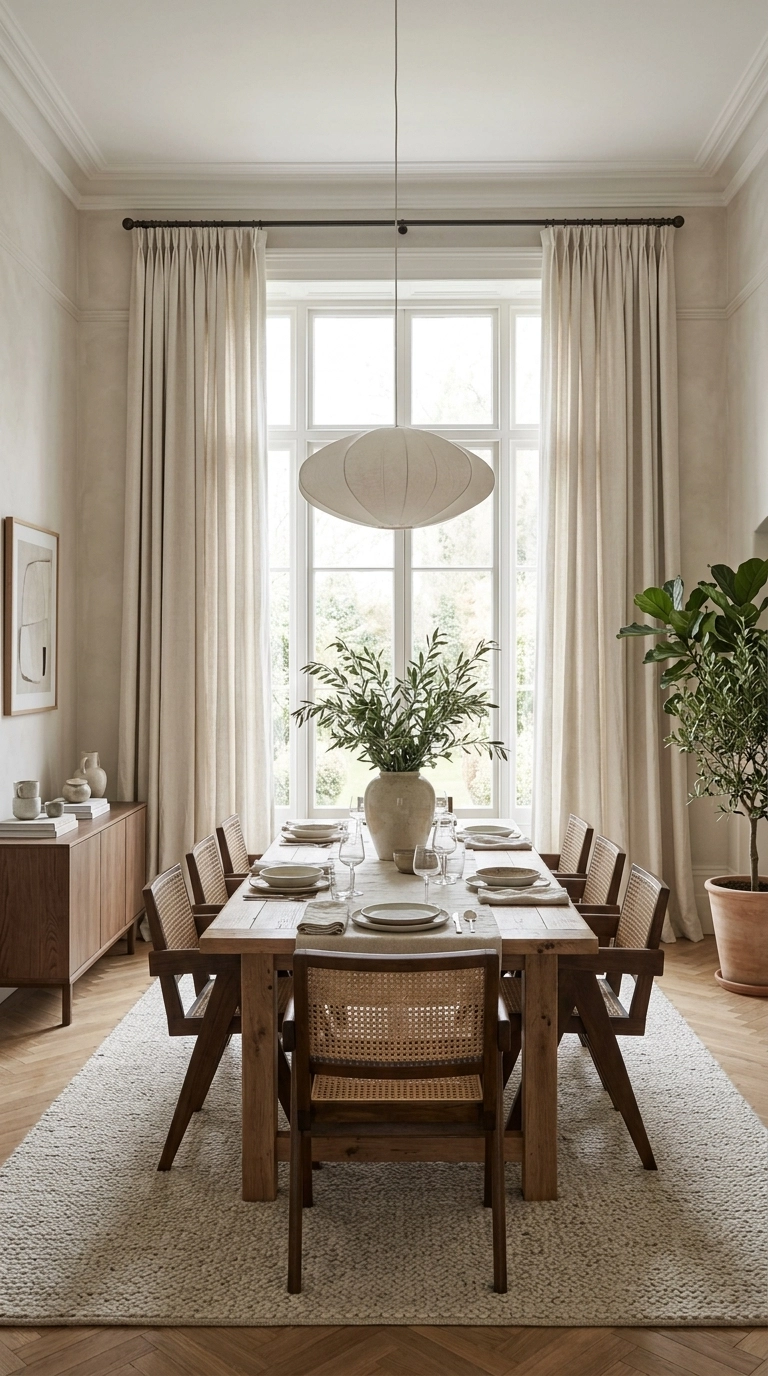
Full height curtains in a colour or weave with real presence turn the window wall into the room’s soft feature, and they start at the sightline: seated, the fabric fills your peripheral view for the whole meal. Hang the rod high and wide so the curtains frame the glass even when open, and let them finish at the floor. It is also a colour commitment at wall scale, the same one colour thinking behind these sage green living room ideas, where a single soft shade carries a whole room. As a bonus, one soft surface absorbs the echo that makes dining rooms clatter.
Curtains are the biggest, cheapest wall colour you will ever hang, and the only one that also softens the sound.
The Hanging Formula
- Centre everything at seated eye level: around 120 cm from the floor to the middle of the piece or the group.
- Above a sideboard or console, leave 15 to 20 cm between the surface and the bottom of the frame.
- Hang grids and groups as one picture: measure the whole block and put its centre on the 120 cm line.
- Keep the space over the table itself empty: the pendant light owns it, and low art fights every centrepiece.
6. Use a patterned Roman blind as the picture
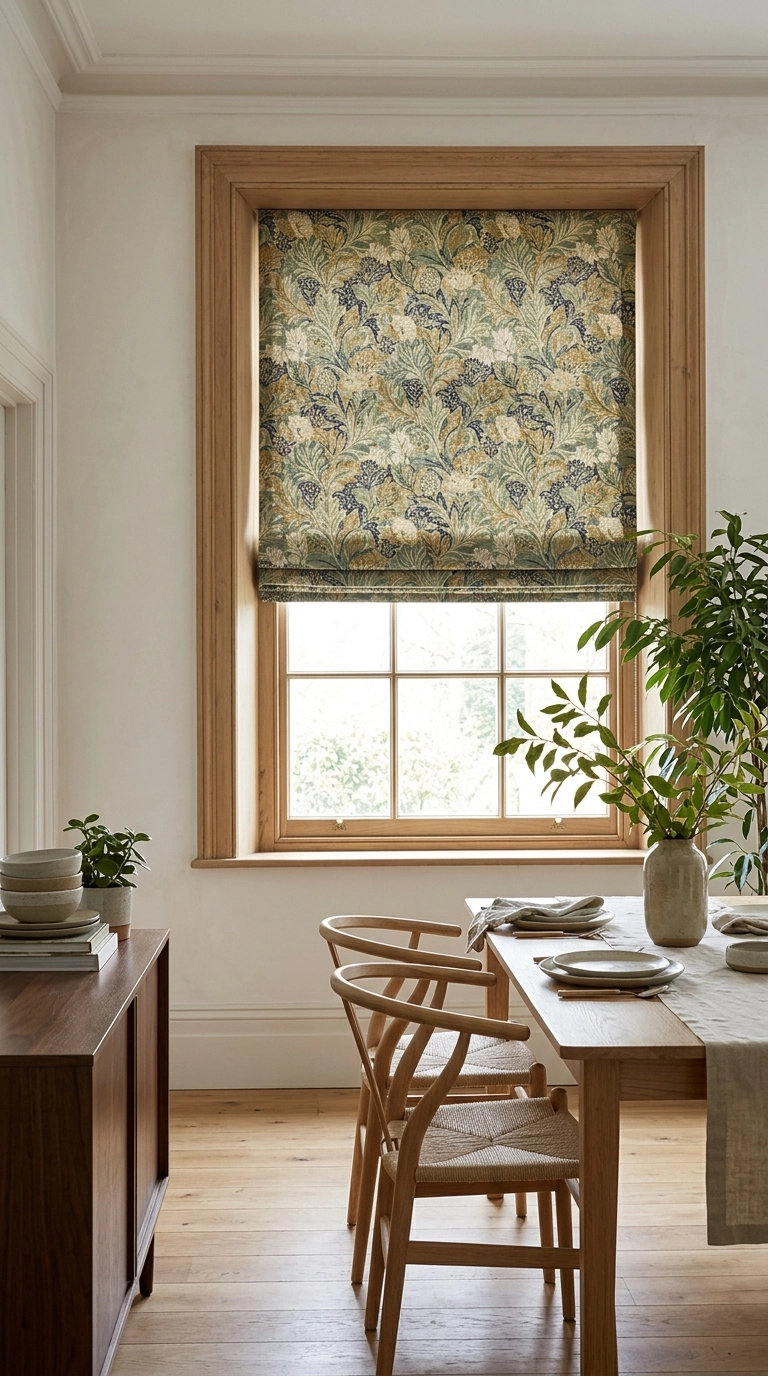
Measure the window from a chair and you will notice a Roman blind sits exactly in the seated sightline, a framed textile picture you look at all through dinner. Where full curtains overwhelm a small room, a blind in a patterned or trimmed fabric does the decorating from inside the glass. Choose a medium scale print, because the pattern repeats over a short drop: tiny prints collapse into stripes when the blind is raised, and very large motifs get cropped by the folds. Lined blinds hang crisper and hold their shape.
A blind is wall art that also works for a living. Pick the pattern at the scale your seat sees it.
7. Hang a wreath or garland in the glass
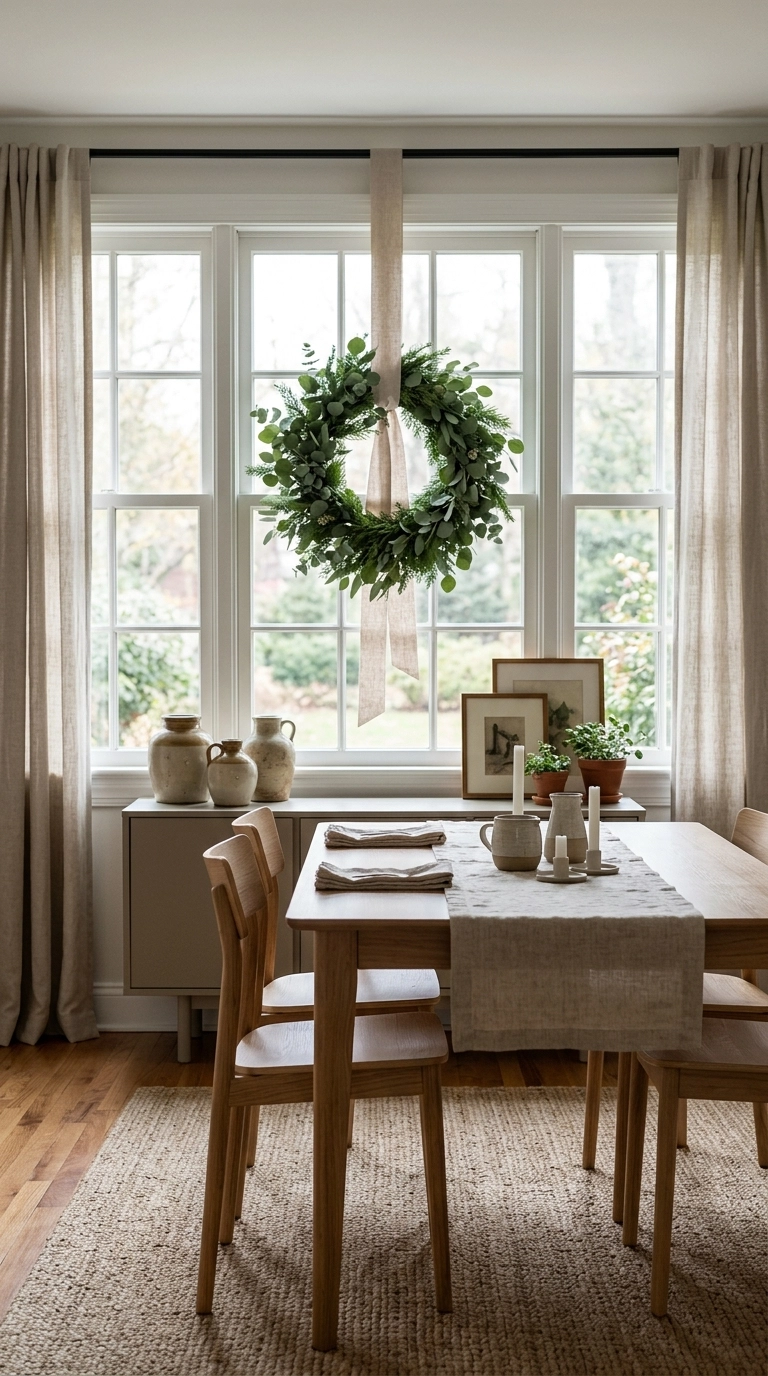
The centre of a dining window lands almost exactly at seated eye level, which makes it prime decorating ground that most rooms waste. A wreath hung there on a ribbon from the top of the frame decorates the glass itself and changes with the seasons, bay and eucalyptus in winter, dried flowers in autumn. Hang it from a small hook on top of the frame rather than a suction cup on the glass, and it will never slide down mid dinner. It is the fastest refresh in this whole list.
Decorate the glass at eye level and the plainest window wall in the house becomes the seasonal one.
The Narrow Wall
The strip between a door and a corner, or between two windows, is too narrow for standard pieces and usually gets left blank, which only makes it look narrower.
8. Stack two prints vertically
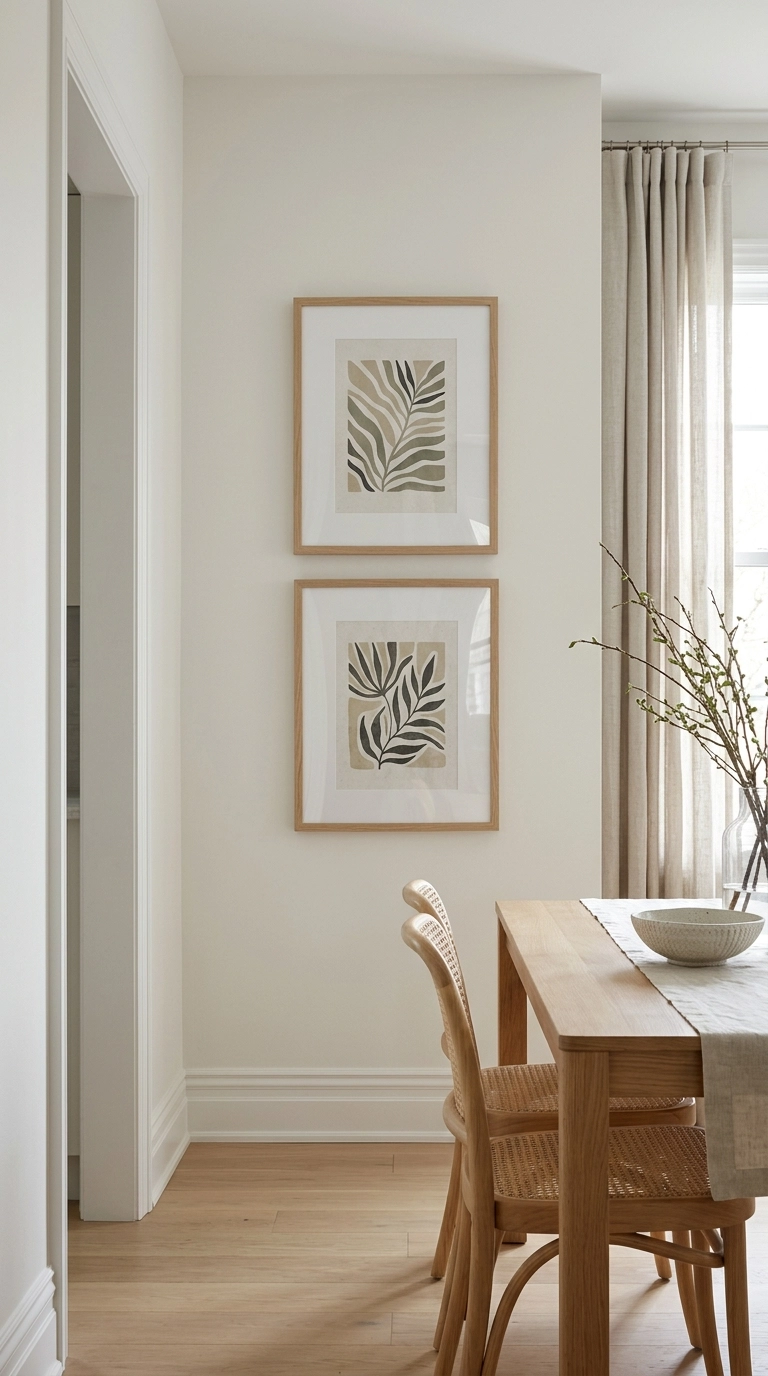
A narrow wall cannot take width, so spend its height instead. Two matching prints hung one above the other, same frame, same mount, related images, read as one tall piece, and the pair should be centred as a single unit on the 120 cm sightline so it talks to the table rather than the ceiling. The vertical pull lifts the whole room from a seated view, making the ceiling feel higher without touching it. Leave a gap of about 8 to 10 cm between the frames, close enough to read as a pair.
Stacked prints use the wall’s height as the feature. Centre the pair, not each print, on your sightline.
9. Fit slim shelves and style them sparsely
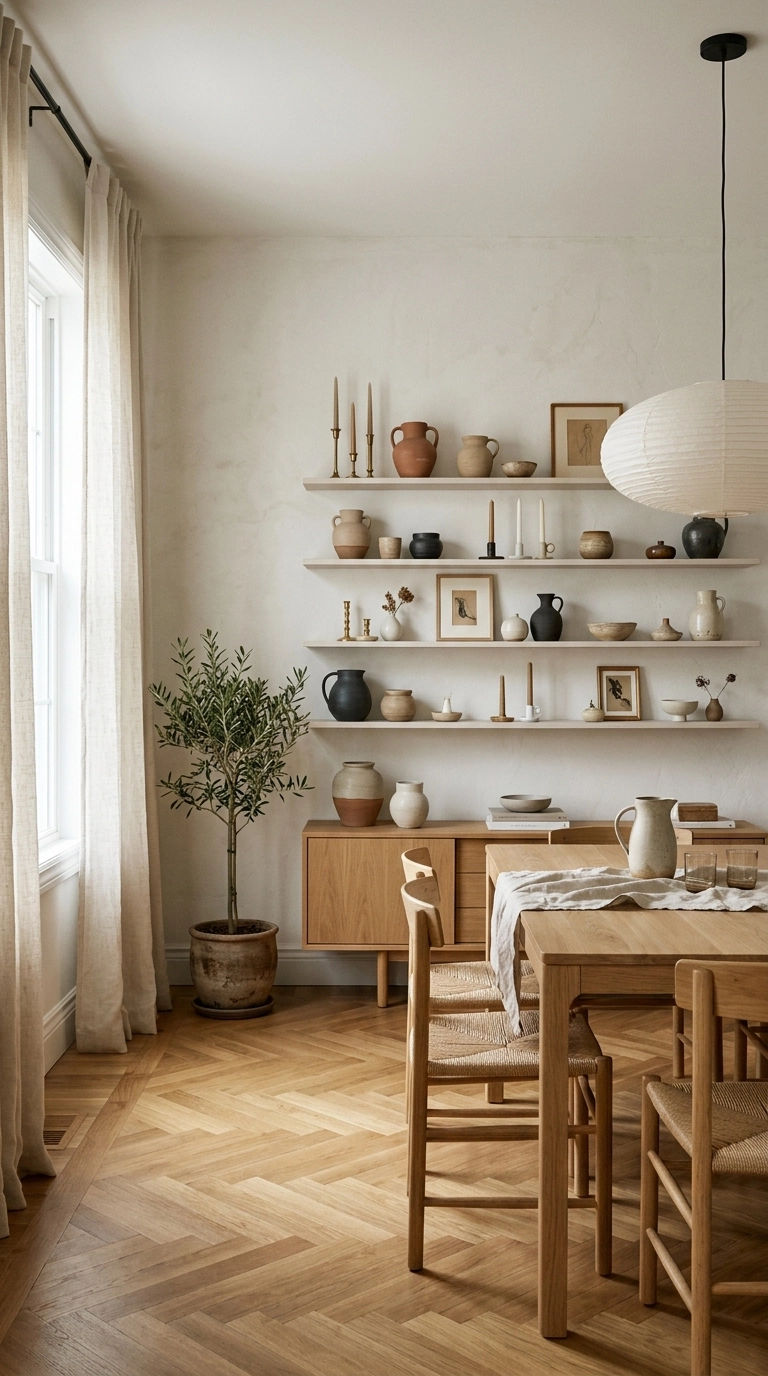
The useful band of a narrow wall runs from about 100 to 140 cm, the zone seated eyes actually scan, so put two slim shelves there and style them like a picture. Shelves 12 to 15 cm deep hold ceramics, candlesticks and a small stack of cookbooks without pushing into the room’s circulation. Keep every piece narrower than the shelf itself, because the moment objects overhang, the wall reads as storage again. Style sparsely: three groupings per shelf, with air between them, beats a full row every time.
Shallow, sparse and at sightline height, shelves decorate. Deep and full, they just store things in public.
10. Hang one tall textile
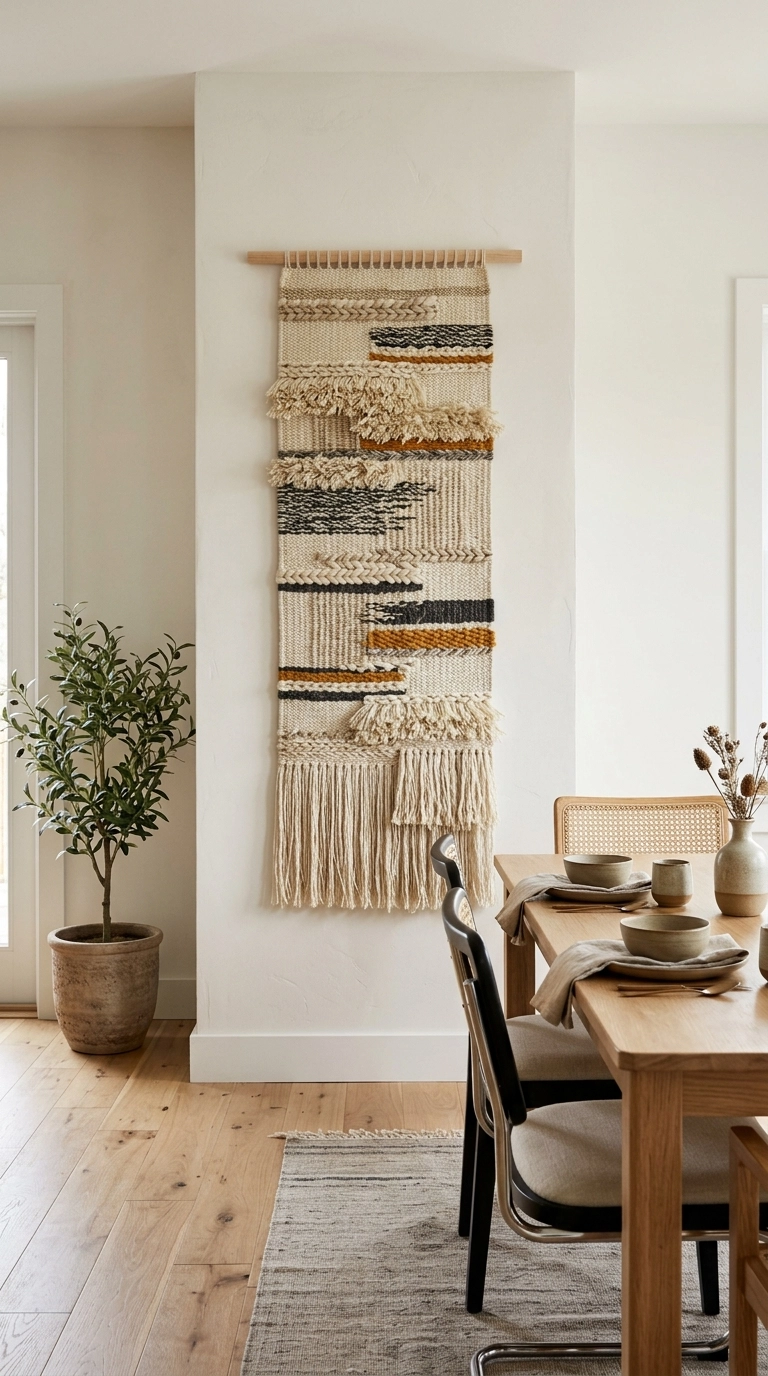
A woven hanging, a narrow tapestry or even a beautiful table runner on a rod gives a narrow wall softness and height in a single piece. Hang the rod high, around 180 cm, and let the textile fall so its visual centre sits near the seated sightline, with the hem clear of the skirting. It weighs almost nothing, so one picture hook holds it, and it brings the sound softening texture that hard dining rooms need. Keep textiles on the narrow wall away from serving traffic, well out of splash range.
One tall textile does what three small frames cannot: it makes a leftover strip of wall feel chosen.
The Open-Plan Side
Where the dining area opens into the living space, there may be no wall to decorate at all. The job passes to the furniture line and to paint.
11. Style the sideboard like a wall
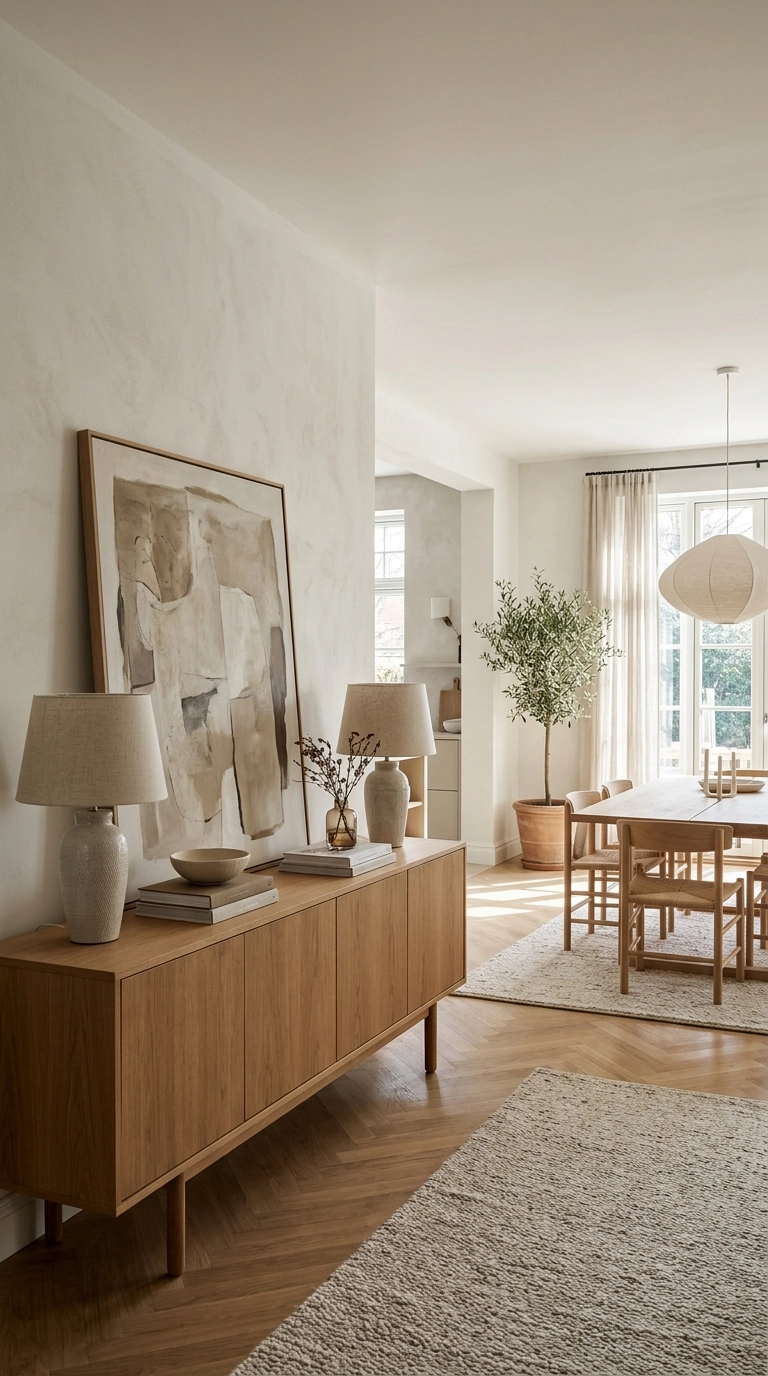
In an open plan room, the sideboard top is your wall, so compose it at seated height: a pair of lamps, one large piece of art leaned against the wall behind, a short stack of books. The leaned art should centre near the usual sightline once you account for the sideboard’s height, which means its middle sits lower than a hung piece would. A thrifted sideboard carries this just as well as a new one, and these dresser makeover ideas turn a tired find into exactly the anchor a dining zone needs. This arrangement is what tells everyone where dining starts.
Lean the art, style the surface, and the furniture line becomes the wall the room forgot to build.
12. Paint a colour block behind the dining zone
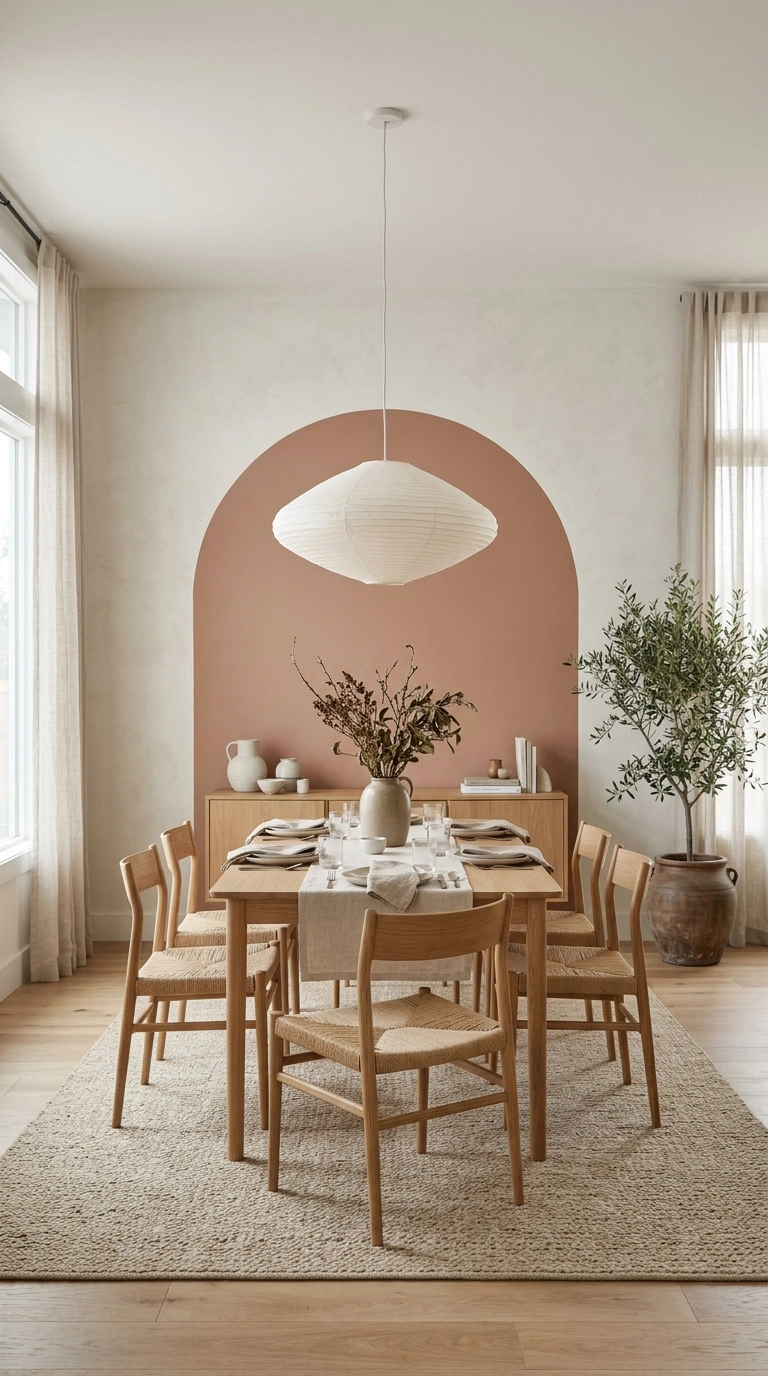
Paint draws the wall that architecture skipped. A rectangle or arch in a tone deeper than the surrounding walls, painted behind the table, gives the dining zone its own backdrop, and from a chair it frames the whole meal like a stage set. Extend the block at least 30 cm beyond the table and sideboard on each side, and run it from the skirting up past the seated sightline to around 200 cm, or it reads as a mistake rather than a feature. It is the cheapest architectural gesture you will ever make.
A colour block works at seated scale: wide enough to frame the table, tall enough to hold the view.
13. Add picture frame moulding to the plain wall
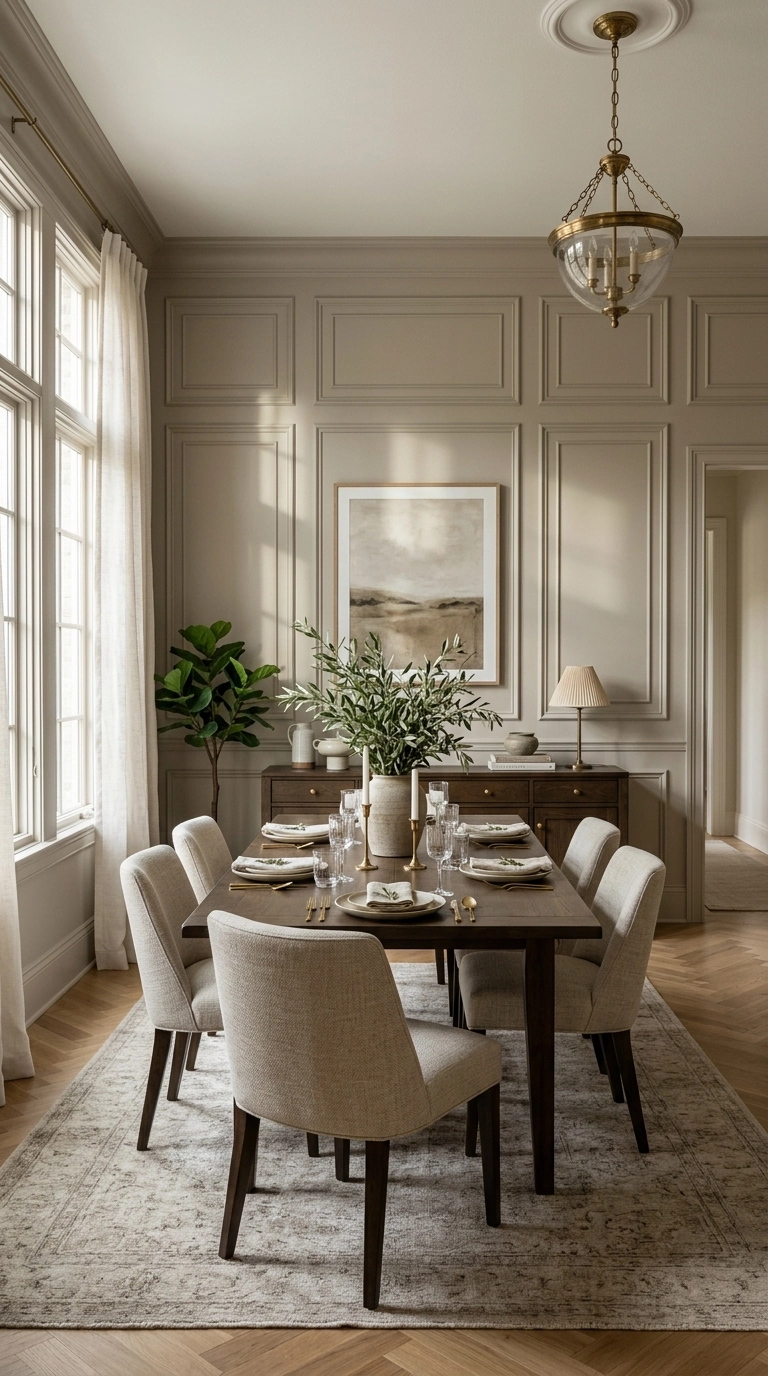
Applied trim rectangles, painted the same colour as the wall, give a blank dining wall architecture and shadow lines without a single picture. Size the panels to the sightline band, with their centres near 120 cm, so the shadows fall where seated eyes rest, and keep the spacing even, because the effect comes from rhythm and raking light, not contrast. Contrasting trim colours look like an error in most rooms. Art or a mirror can still hang inside the panels later, which makes this the most patient idea on the list.
Same colour is the whole point: the decoration is the shadow line, and shadows only show at sitting height.
Myth vs fact: dining wall edition
Myth: dining room art should hang at gallery height, centre around 145 cm.
Fact: galleries are walked through standing. Diners sit for an hour, so the centre that meets their eyes is nearer 120 cm, and art hung at standing height spends the whole meal above the conversation.
Myth: small dining rooms need small pictures.
Fact: small rooms need fewer, larger pieces. One generous piece calms a small wall and gives seated eyes one restful view, while six small frames make the wall busier and the room smaller.
Myth: a gallery wall only works with identical frames.
Fact: identical frames suit a strict grid. A salon style gallery can mix frames freely, as long as the spacing logic stays consistent. One system, applied evenly, is what reads as intentional from the chairs.
Any Wall, When It Is Nearly Right
14. Fit a picture ledge for rotating art
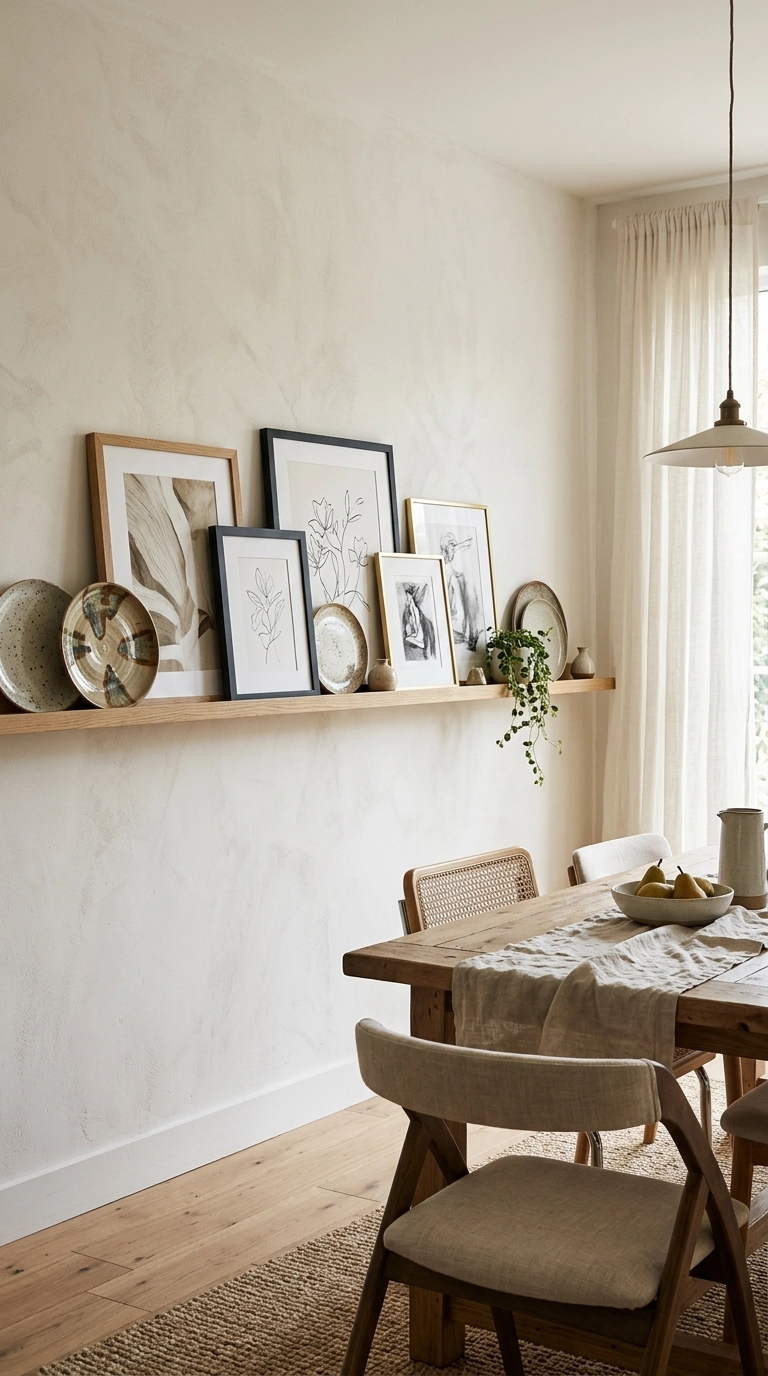
A slim ledge, 8 to 10 cm deep, lets you lean and swap prints, plates and small canvases without drilling new holes, so the room can change with the seasons. Fit it so the leaning pieces centre roughly on the seated sightline, which usually puts the ledge itself around 100 to 110 cm. Overlap each piece slightly over its neighbour, because a row of frames standing apart like a queue looks as awkward as it sounds. Renters and the chronically indecisive both win here.
A ledge at the right height turns indecision into a rotating exhibition, refreshed whenever you like.
15. Let a clock be the anchor
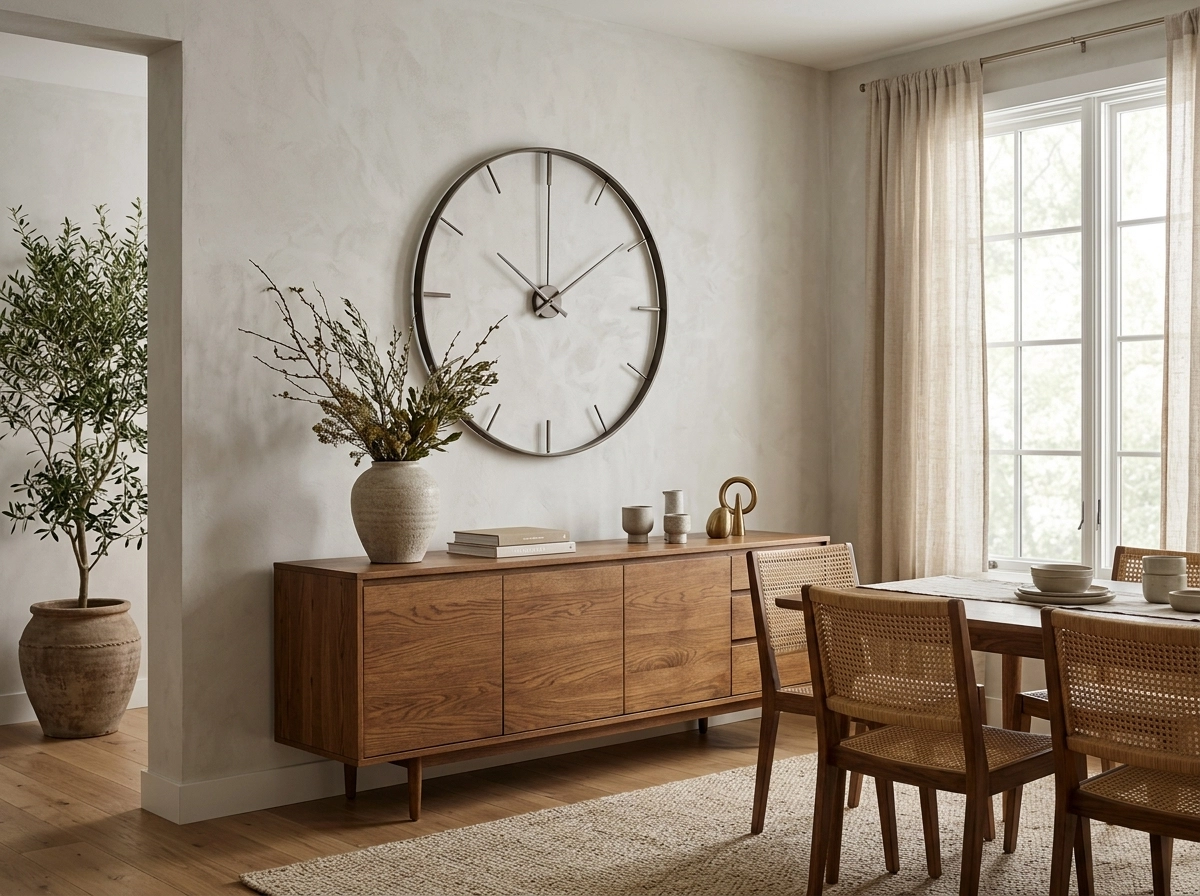
An oversized clock is wall decor that earns its place in a room run by cooking times and arriving guests. Hung with its centre at seated eye level, it reads at a glance from every chair without anyone craning or standing. Be honest about size: under 40 cm across is a kitchen clock, while the dining room version starts at 50 cm and goes up from there. On a kitchen facing wall or above a sideboard it does the visual work of a large picture with none of the choosing anxiety.
A clock centred on the sightline is the hardest working picture in the house. It just happens to tell the time.
16. Cluster woven baskets as a relief wall
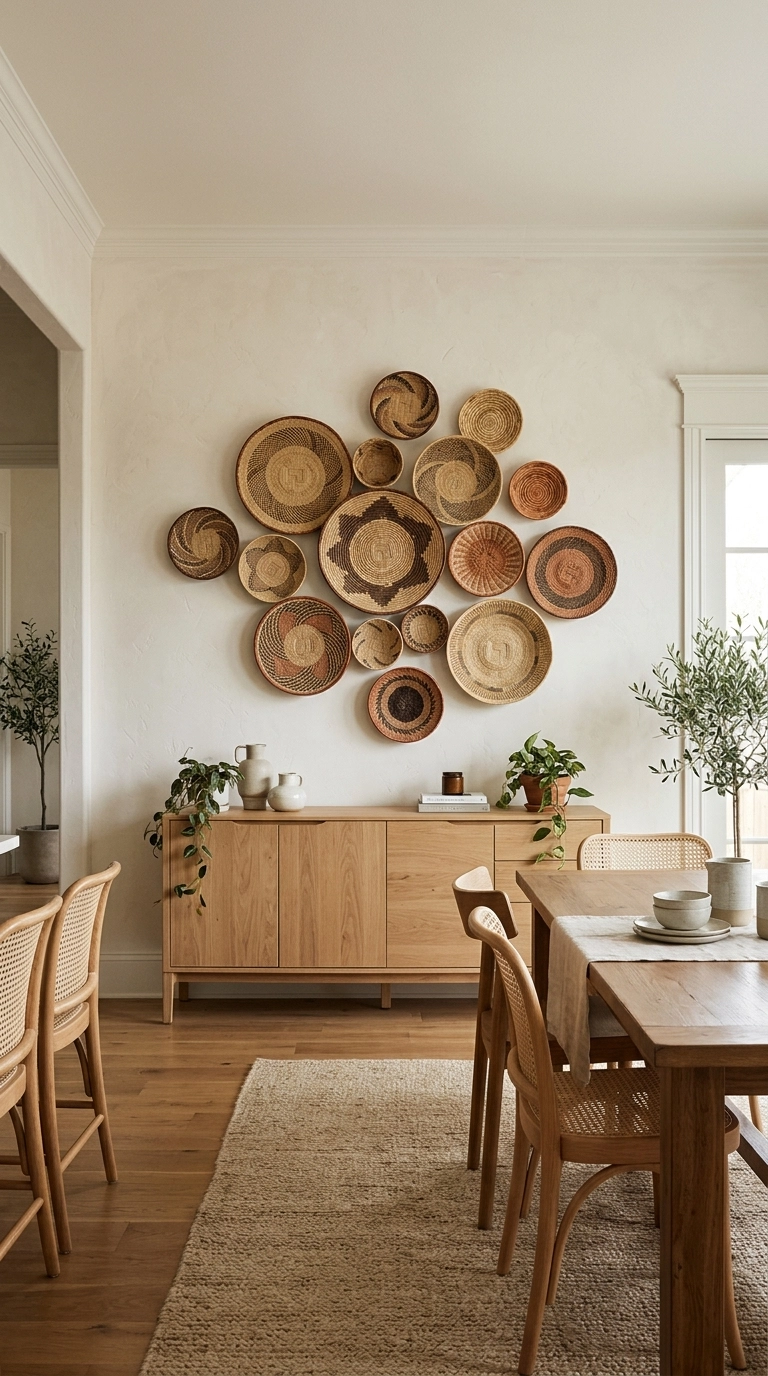
A group of flat woven baskets in mixed sizes brings texture, warmth and pattern to a wall that paint and prints have left cold. Build the cluster so its centre of gravity sits near the 120 cm sightline, with the largest basket slightly off centre and the smallest filling the gaps. Lay the whole arrangement out on the table first and photograph it before a single pin goes in, because baskets are light and hang on single pins, and the photo is your map. From the chairs, the cluster reads as one soft, round artwork.
Compose the cluster at table height on the table itself. If it works flat, it will work on the wall.
17. Keep one hook rail for the seasons

A simple rail or row of hooks on the least seen wall holds the rotating cast: a wreath in winter, a garland for birthdays, dried flowers in autumn. Fit the rail around 150 cm up, so hung pieces drop into the seated sightline band instead of dangling above it or brushing shoulders. The wall stays simple all year and turns festive on demand. One condition: the off season pieces need a labelled box somewhere else, because a hook rail is a display system, not a storage system.
One rail, changed with the seasons, keeps a plain wall in the celebration without storing anything on it.
Now light the candles and sit down in your own dining room, in every chair, one by one. From those seats the walls should meet your eyes where they actually rest, low, warm and unhurried, holding art, reflections and colour at the height of the conversation. That is the whole secret of this room: decorate for the sitters, and the walls quietly do their work all evening.