20 Small Living Room Ideas With a TV That Doesn’t Take Over the Room
A television is the hardest thing to fit into a small living room. It is a big black rectangle, it wants the best wall, and it pulls every chair in the room toward it. Most small rooms end up arranged around the screen like a waiting room, with everything else squeezed in afterwards.
The rooms in this list do it the other way round. The TV is still there, and it is still easy to watch, but it is not running the room. Some are wall-mounted so the floor stays clear. Some are built into a wall of shelving so the screen reads as one panel among many. A few are tucked into corners or side walls, where they free up the main wall for something better. Pick the strategy that matches your room, then steal the details.
Mount it, then float the furniture
Wall-mounting is the single best move in a small room, because it takes the TV off the floor plan entirely. No stand means no footprint, and a floating console underneath keeps the floor visible, which is what makes a room feel bigger. The trick is what goes underneath: something long, low, and closed, so cables and boxes disappear.
Face it with two small sofas instead of one big one
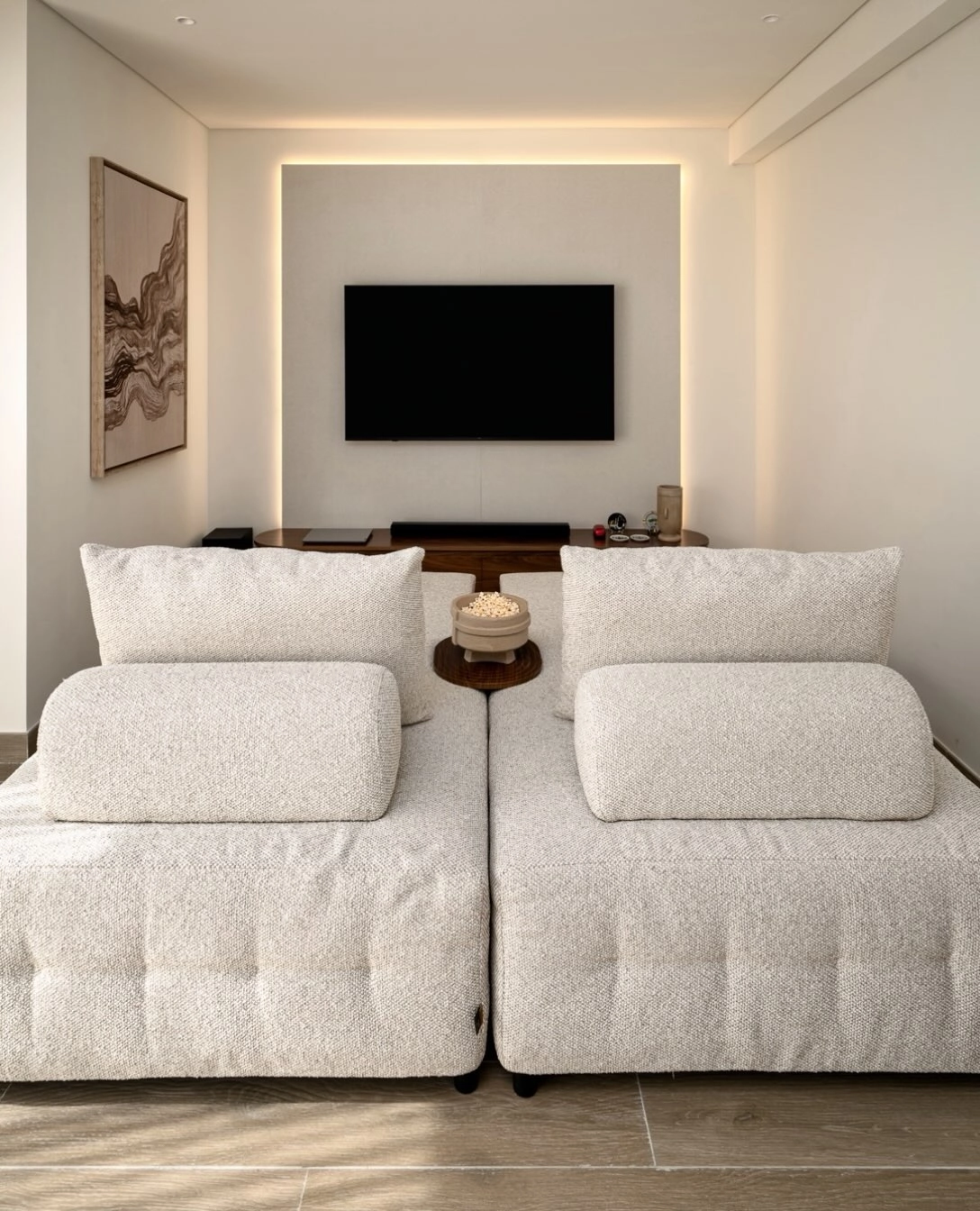
Photo: @antararinteriors on Instagram
Two compact sofas facing the screen do something a single large sofa cannot: they split the seating so the room never feels like a single block of furniture aimed at a wall. In this minimalist room the wall-mounted TV sits on a softly backlit panel, with a low walnut console underneath holding just a soundbar and a few small objects. Nothing competes with the screen, and nothing crowds it either.
If your room is narrow, try this layout before you buy anything new. Two smaller seats are easier to angle, easier to move, and they leave a walkway down the middle. Keep the console lower than the seat cushions and the same width as the TV or a little wider, and the whole wall reads as one calm composition instead of a screen floating over clutter.
Let a cane credenza warm up a plain white wall
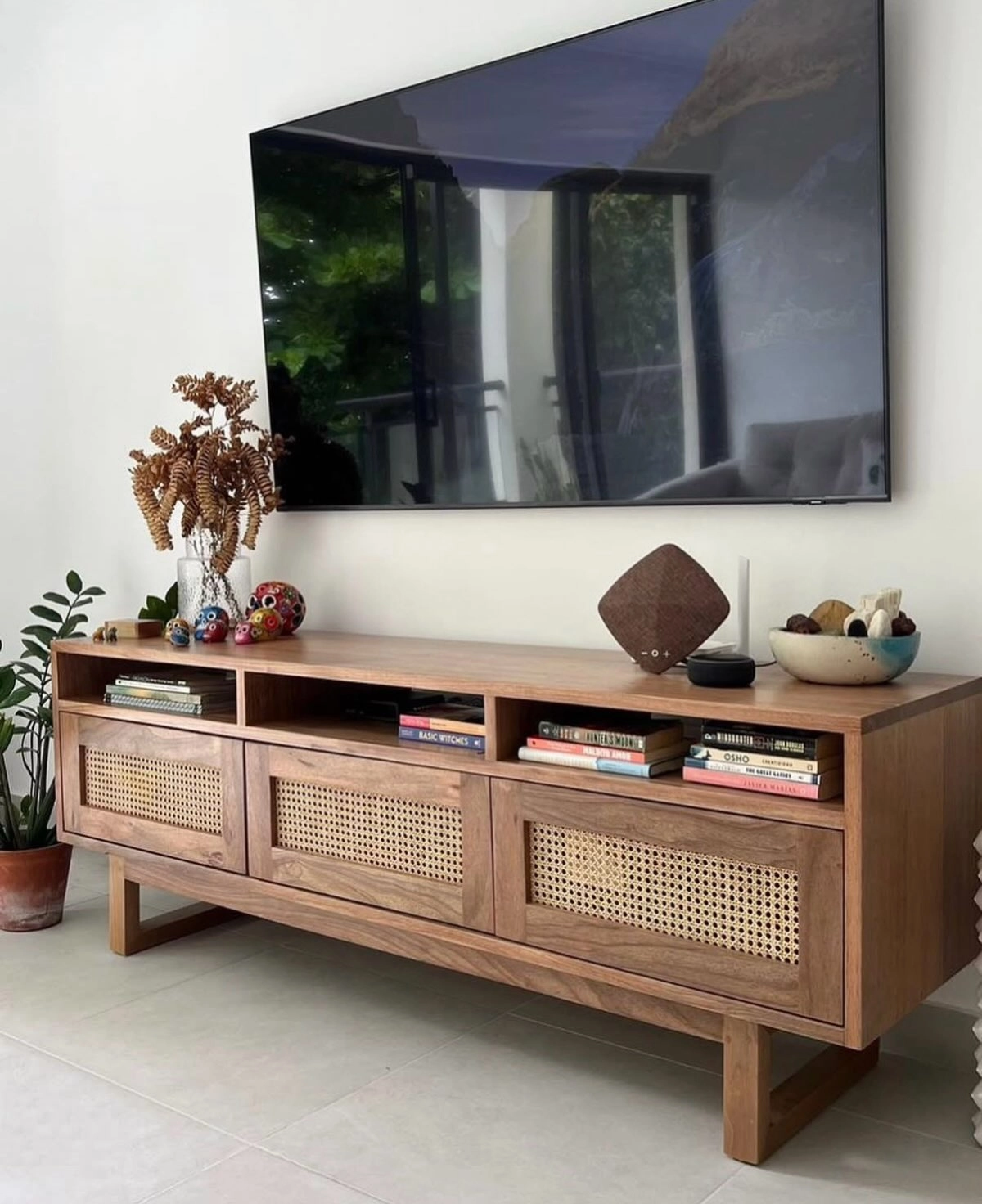
Photo: @nemari.interiors on Instagram
A wall-mounted TV on a bare white wall can look cold, and the fix is not more decoration, it is better furniture. This cane-front credenza brings wood tone and texture to the wall, and its open shelves hold books and a speaker out in the open while the closed doors hide the rest. The screen is large, but the eye lands on the credenza first.
Cane fronts are a small-room secret for another reason: they let remote signals through, so you can close the doors on your boxes and still change the channel. Keep the top of the console mostly clear, one plant and one or two objects, and the TV stops looking like it is perched on a shelf of stuff.
Float a long walnut credenza and add a soundbar
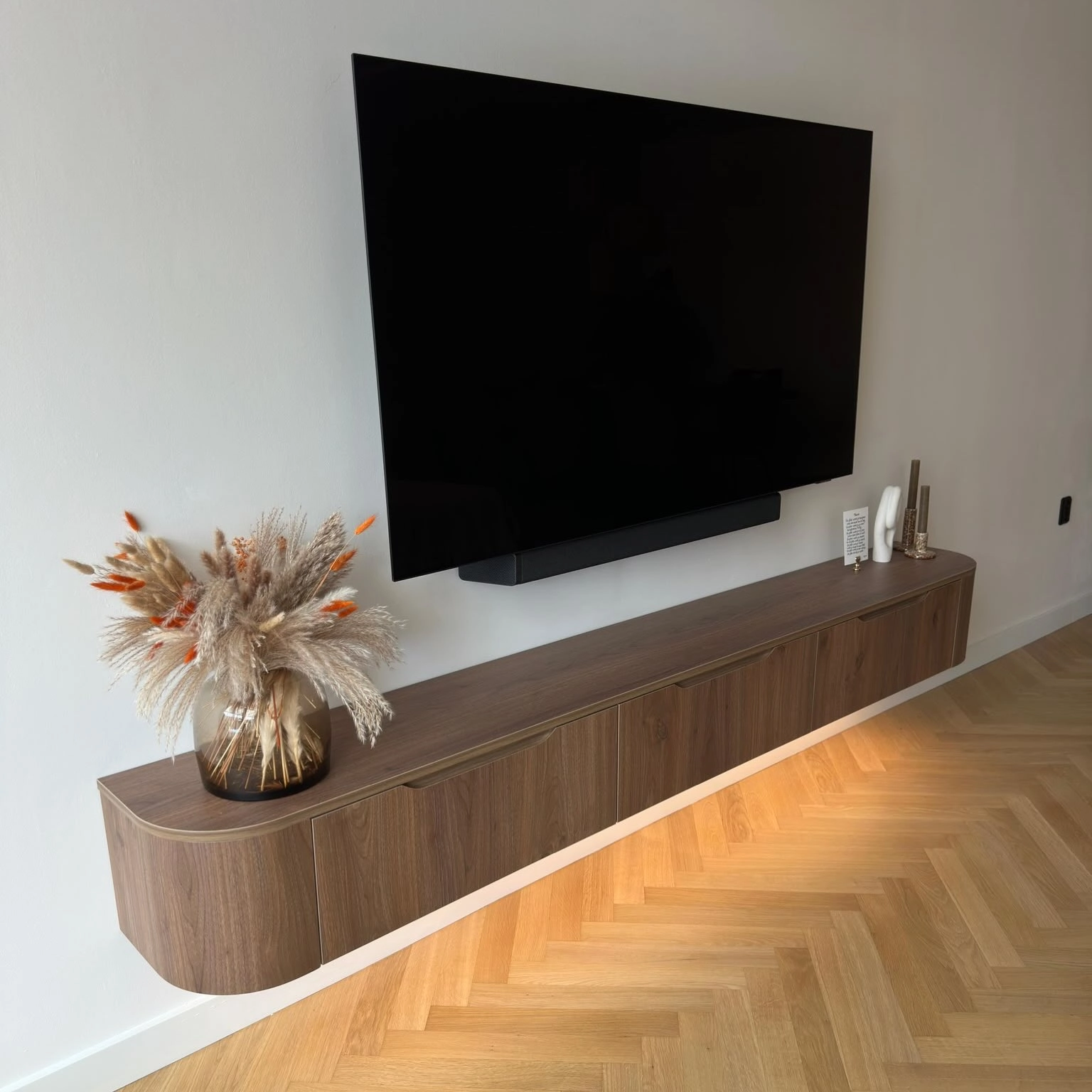
Photo: @studiomeen on Instagram
A floating credenza is the tidiest version of this idea. It hangs on the wall, so the floor runs straight underneath it and the room gains a few visual inches it did not have before. Here the walnut unit runs nearly the full width of the TV, with a soundbar mounted tight beneath the screen, and the herringbone floor does the rest of the talking.
The long shape matters. A console that is shorter than the TV makes the screen look top-heavy, while one that runs wider grounds it. If you are buying new, measure the TV first and add at least a handspan on each side. The pampas arrangement at one end is the only styling, and that restraint is doing a lot of work.
Push the floating console into the corner
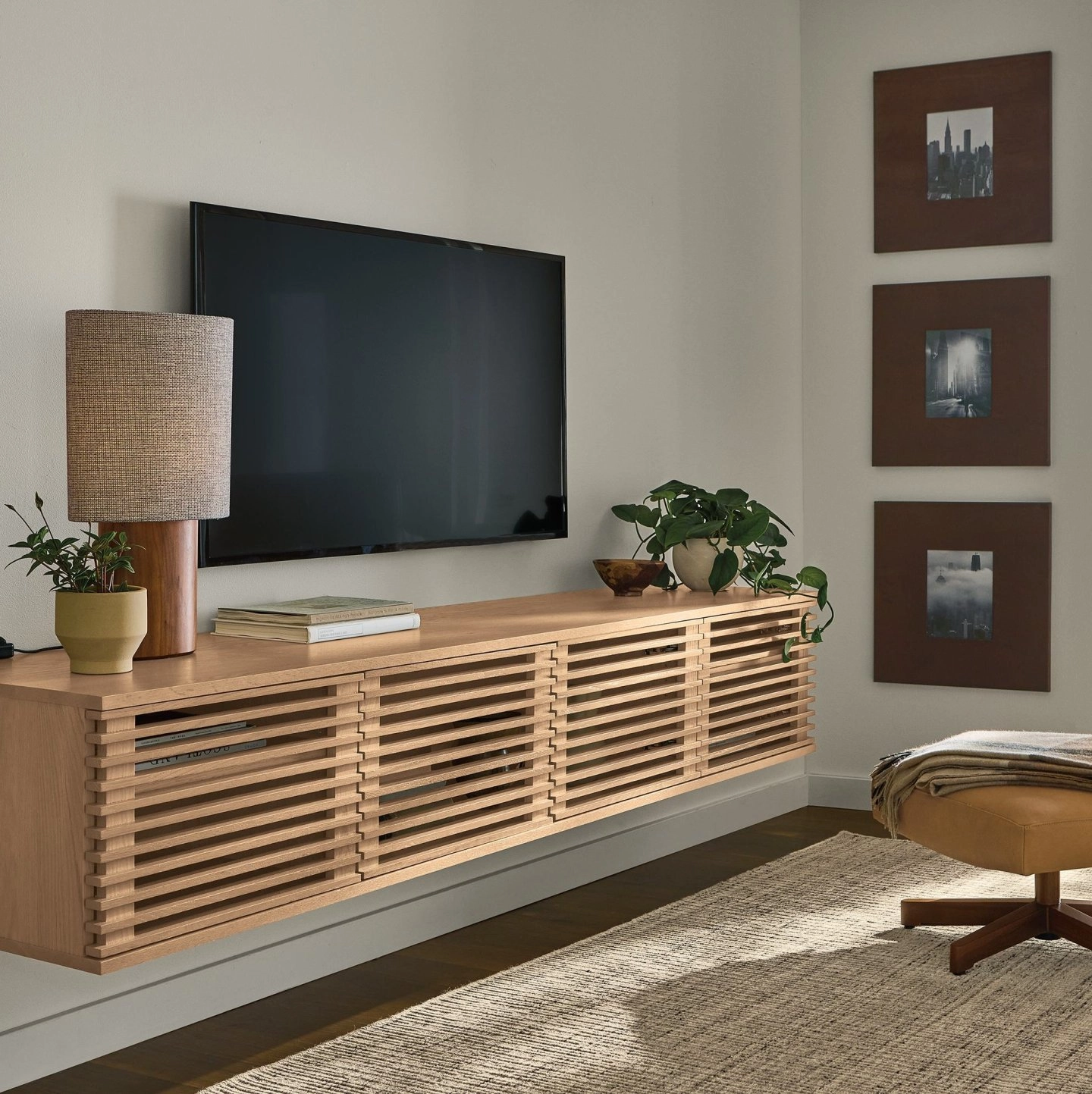
Photo: @roomandboard on Instagram
When the main wall is taken by a door, a window, or a fireplace, the corner is still available, and a floating console turns it into a proper TV spot. This slatted-wood unit wraps the corner, so the screen angles gently into the room instead of fighting for the flat wall. The lamp and plants beside it make it feel like a designed corner rather than a leftover one.
Corner setups work best with a TV that is a size smaller than you think you need. A screen angled across a corner already reads larger because it sits closer to the seating, and the slatted fronts keep the unit from looking like a solid block. Keep the wall beside it simple, a few framed prints at most, and let the corner do its job.
Build a wall around it
If you cannot make the TV disappear, make it one panel in a bigger composition. A media wall spreads the eye across shelving, panels, and lighting, so the black rectangle stops being the only thing on the wall. These five rooms all use the same idea at very different budgets, from a weekend slat wall to full built-in joinery.
Frame it with wood slats and a lit shelving tower
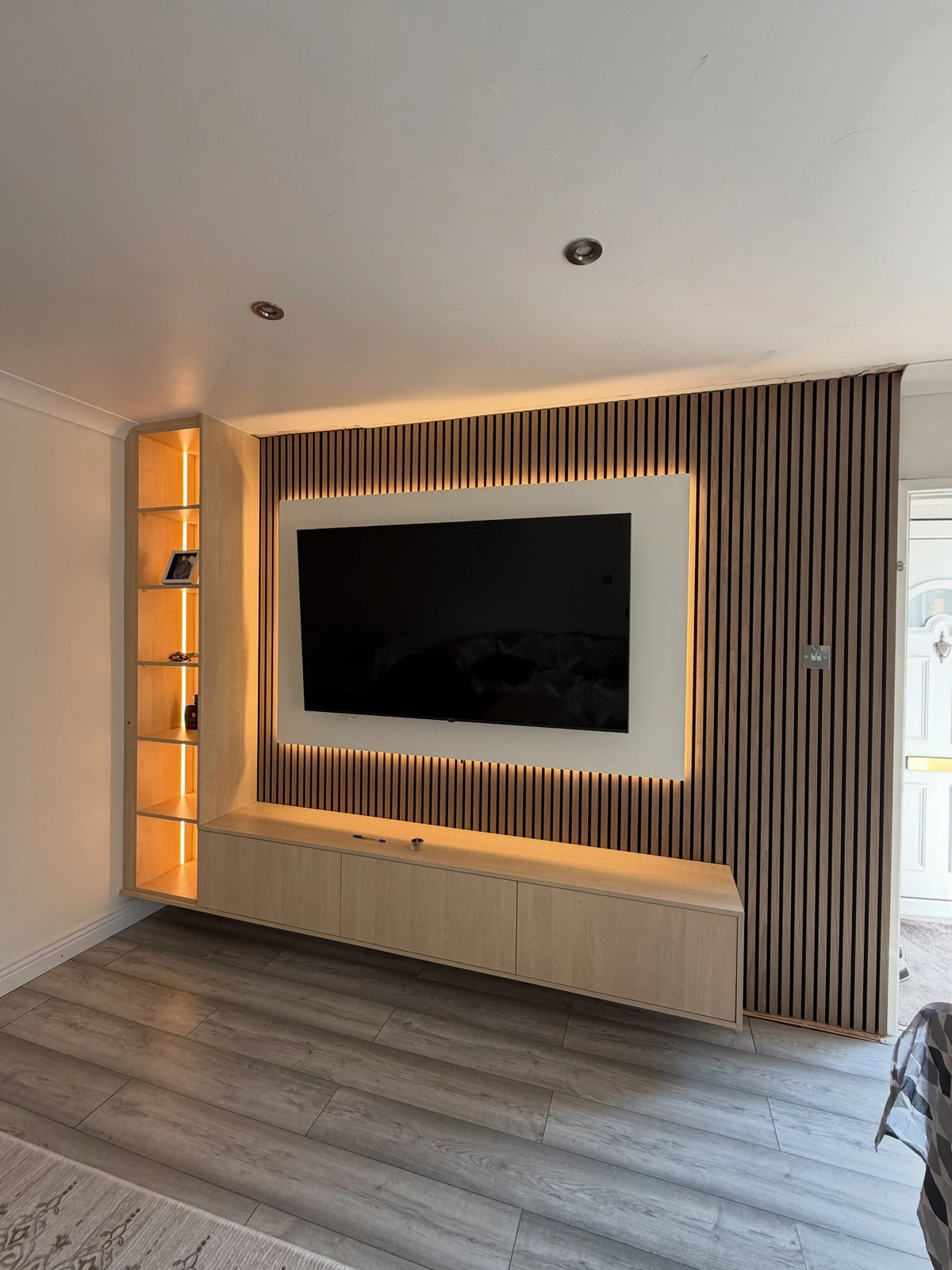
Photo: @gurkiratsing_25 on Instagram
Wood slats are the fastest way to give a TV wall some architecture. Here the slats run floor to ceiling behind a white surround, and a slim lit shelving tower at one end gives the wall a vertical accent that balances the wide screen. The floating oak console underneath closes the composition without touching the floor.
The lighting is doing quiet work here. A warm strip behind the surround and inside the tower makes the wall glow in the evening, so the TV reads as part of a lit feature instead of a dark hole. If you are renting, slat panels come in peel-and-stick versions that give the same rhythm without a single screw in the wall.
Add a strip of LED glow behind a white credenza
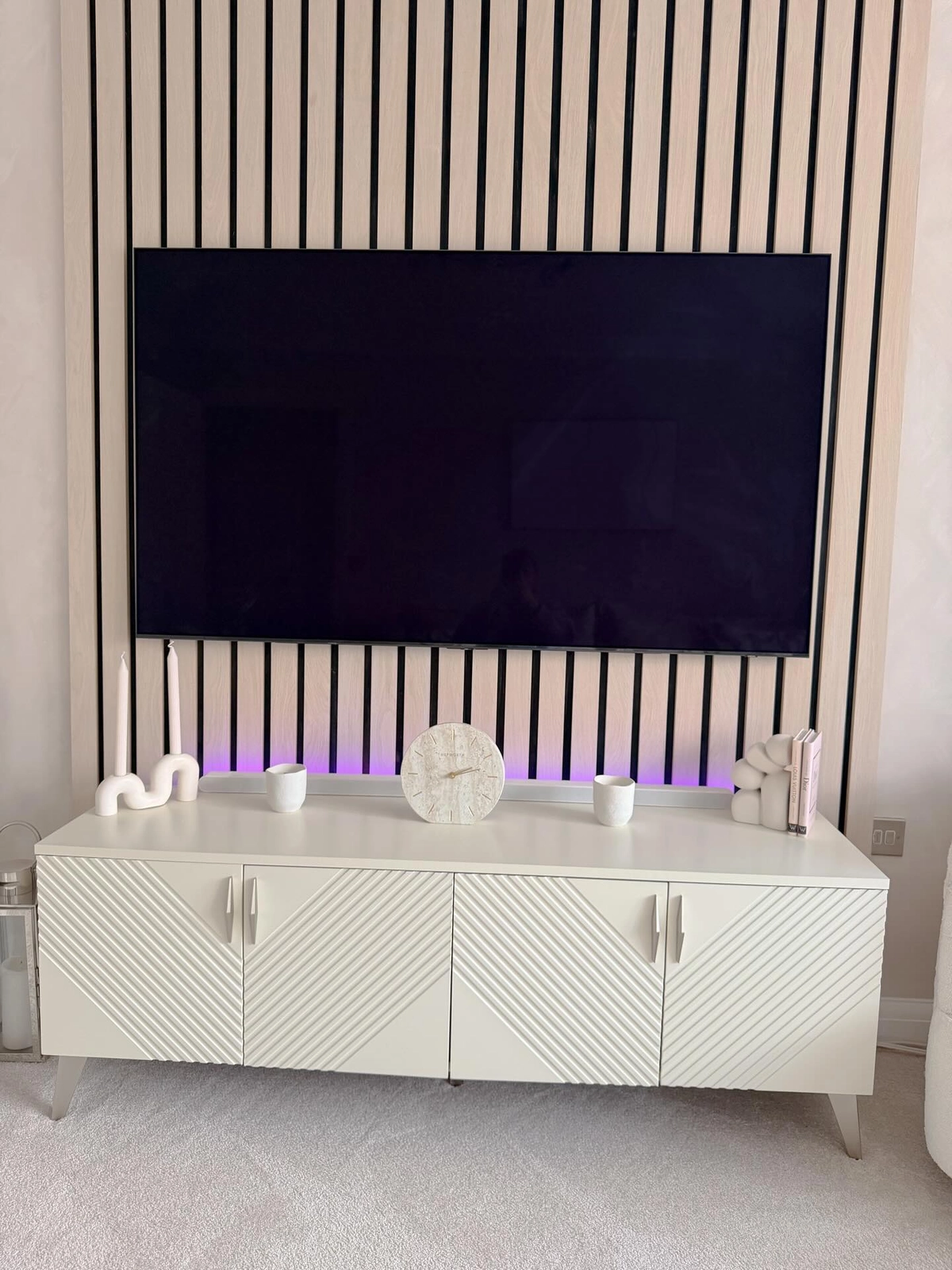
Photo: @homeiswhereheartis8 on Instagram
This is the same slat idea, dressed differently. The slats are pale, the credenza is white with a geometric front, and a purple LED strip glows behind the console after dark. It is a reminder that a media wall does not have to be dark wood and serious: colour in the lighting changes the whole mood of the wall for the price of a strip light.
Keep the console top calm if you try this. Candles, a clock, and a small sculpture are enough, because the LED line is already the decoration. A strip that can change colour is worth the small extra cost: warm white for everyday watching, a colour for movie nights, and off entirely when the room needs to look grown up.
Set it into a built-in wall of open shelves
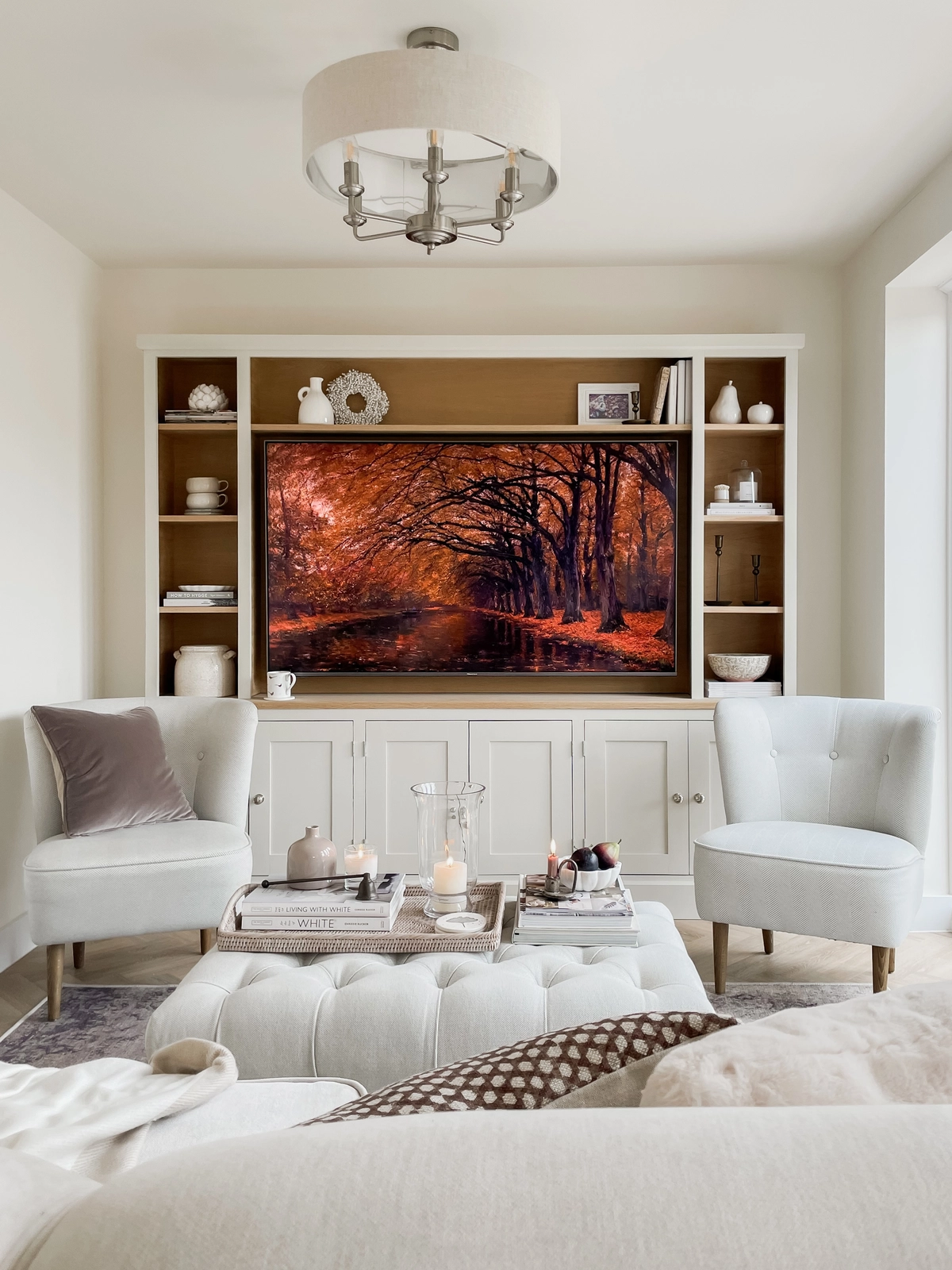
Photo: @thefelicitoushome on Instagram
Built-in shelving is the most finished version of this idea, and the one that hides a TV best in a small room. The screen sits in the middle of the unit, framed by open shelves that hold books, ceramics, and a few personal objects, so the TV becomes one rectangle among many. The two white armchairs in front keep the seating light and symmetrical.
If full joinery is out of reach, fake it: two tall bookcases flanking the TV and a low cabinet bridging them give the same framed effect. Paint everything one colour and the separate pieces read as a single wall. Leave some shelves partly empty, or the wall starts to feel like a shop display instead of a room.
Backlight a panel wall and flank it with lit display shelves
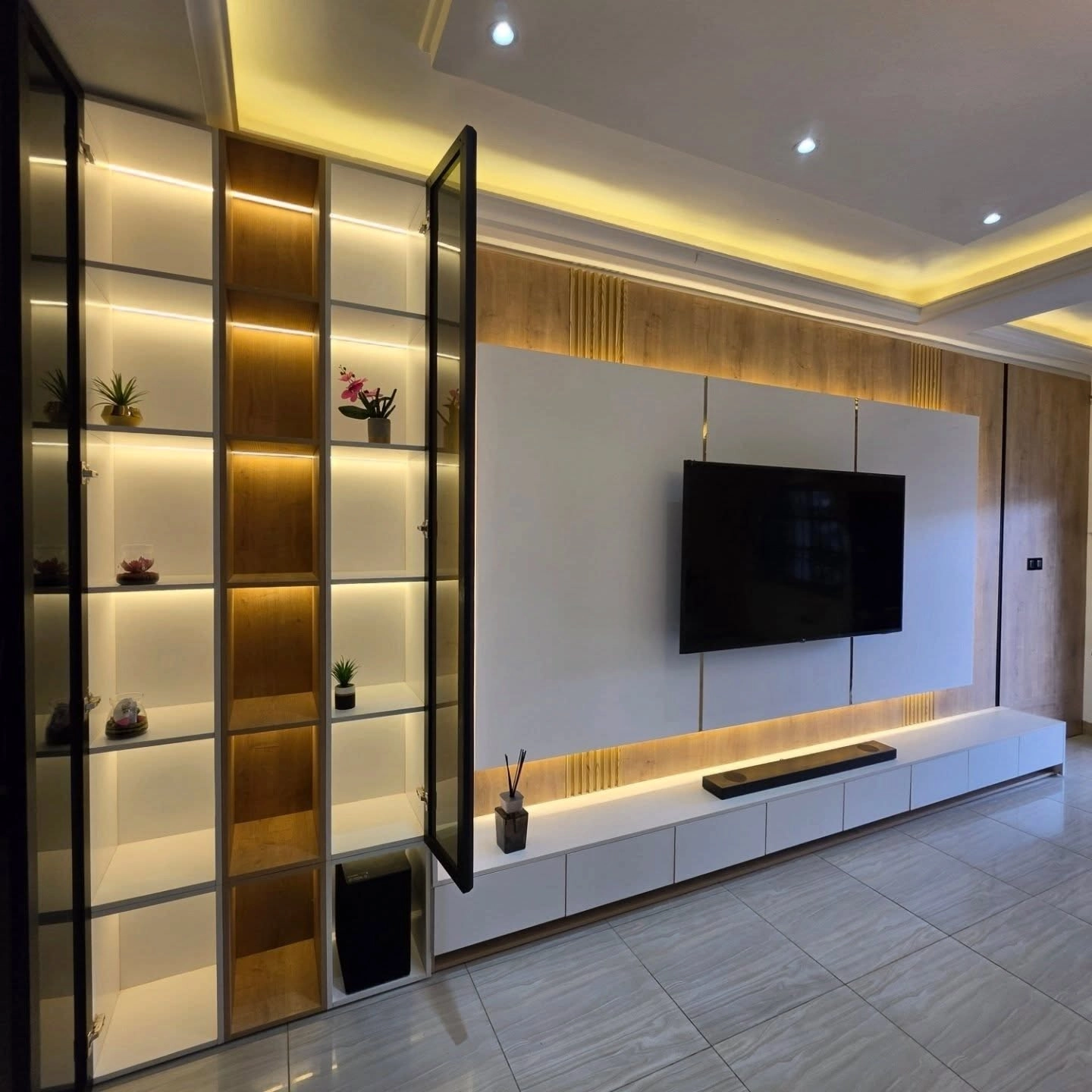
Photo: @sheddydesigns on Instagram
This wall goes further: the TV hangs on a white panel with wood trim and warm backlighting, and glass-front display cabinets with lit shelves stand on either side. It is a lot of joinery, but the idea scales down. The point is balance: the screen in the centre, something lit and vertical on each side, and a long low console tying it all together.
Notice the open cabinet door. Real rooms have a door ajar and a plant that is not perfect, and the wall still looks good. If you are building this, put your prettiest things in the lit shelves and your boxes in the closed console below. The backlight alone makes the TV look intentional after dark, which is when you actually watch it.
Paint the built-ins a colour and let the TV sit inside them
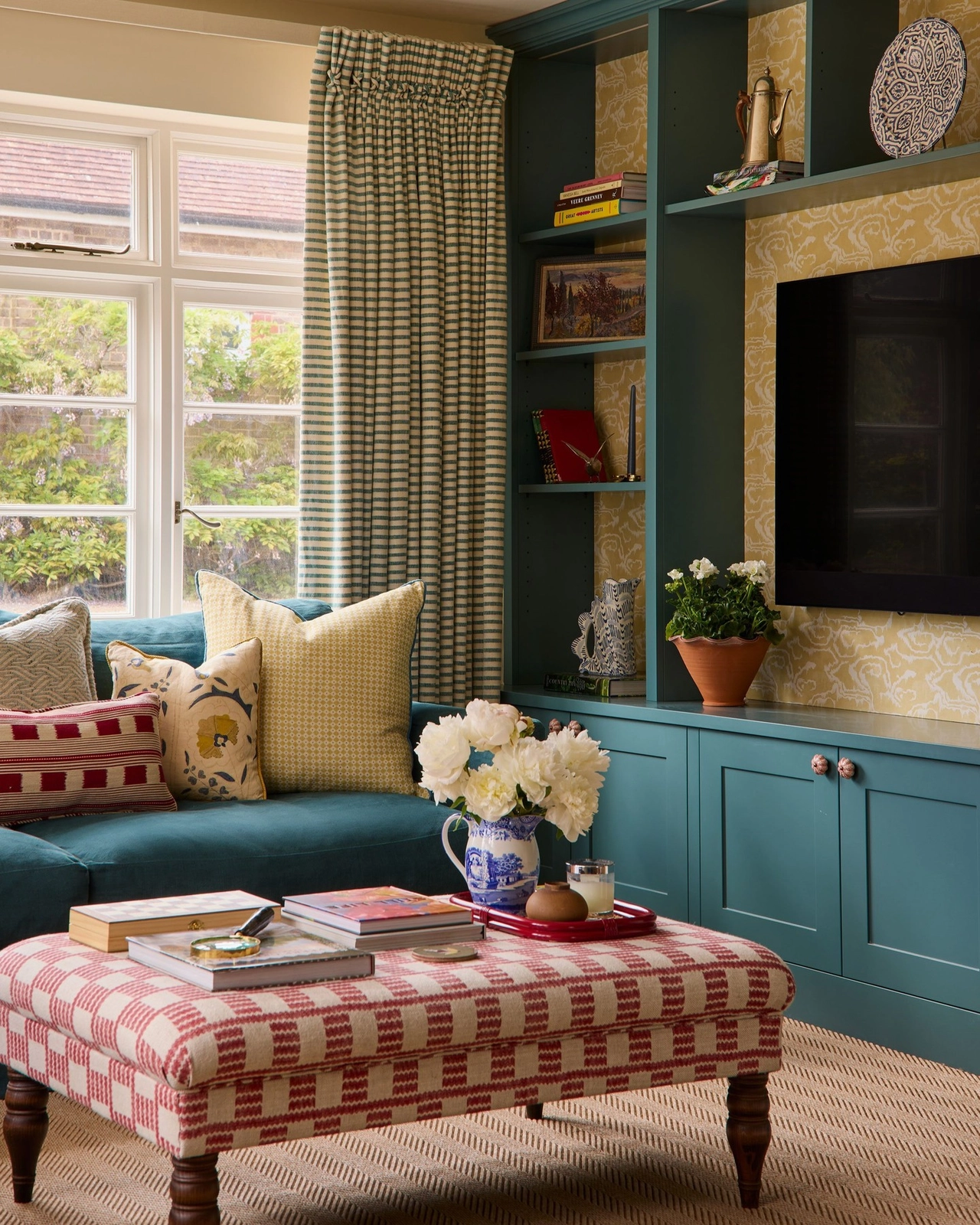
Photo: @thelistbyhouseandgarden on Instagram
Teal shelving on a yellow wallpapered wall is not a shy choice, and that is why it works. The TV is built into the shelving, so it reads as one dark panel among teal doors and yellow pattern, and the teal sofa in front ties the whole scheme together. A bold colour does what white joinery cannot: it makes the wall the feature, not the screen.
If you love this but fear the commitment, paint just the shelving and keep the walls neutral. A single strong colour on the joinery gives the same framing effect, and it is one weekend of painting rather than a renovation. The checked ottoman in front is a good reminder to let one pattern into the room, not five.
TV size rule: sit about one and a half times the screen’s diagonal away from it. At six feet, a 43 to 50 inch TV is right; at eight feet, 55 to 65 inches. A screen that is too big for the distance is the most common reason a small room feels overwhelmed by its TV.
Hide it, or share the wall
Some rooms do not want a TV wall at all. These three ideas either disguise the screen, sink it into the wall, or let it share a wall that already has a job. They are the best options when the TV is the thing you like least in the room.
Use a Frame TV and let it show art when it is off
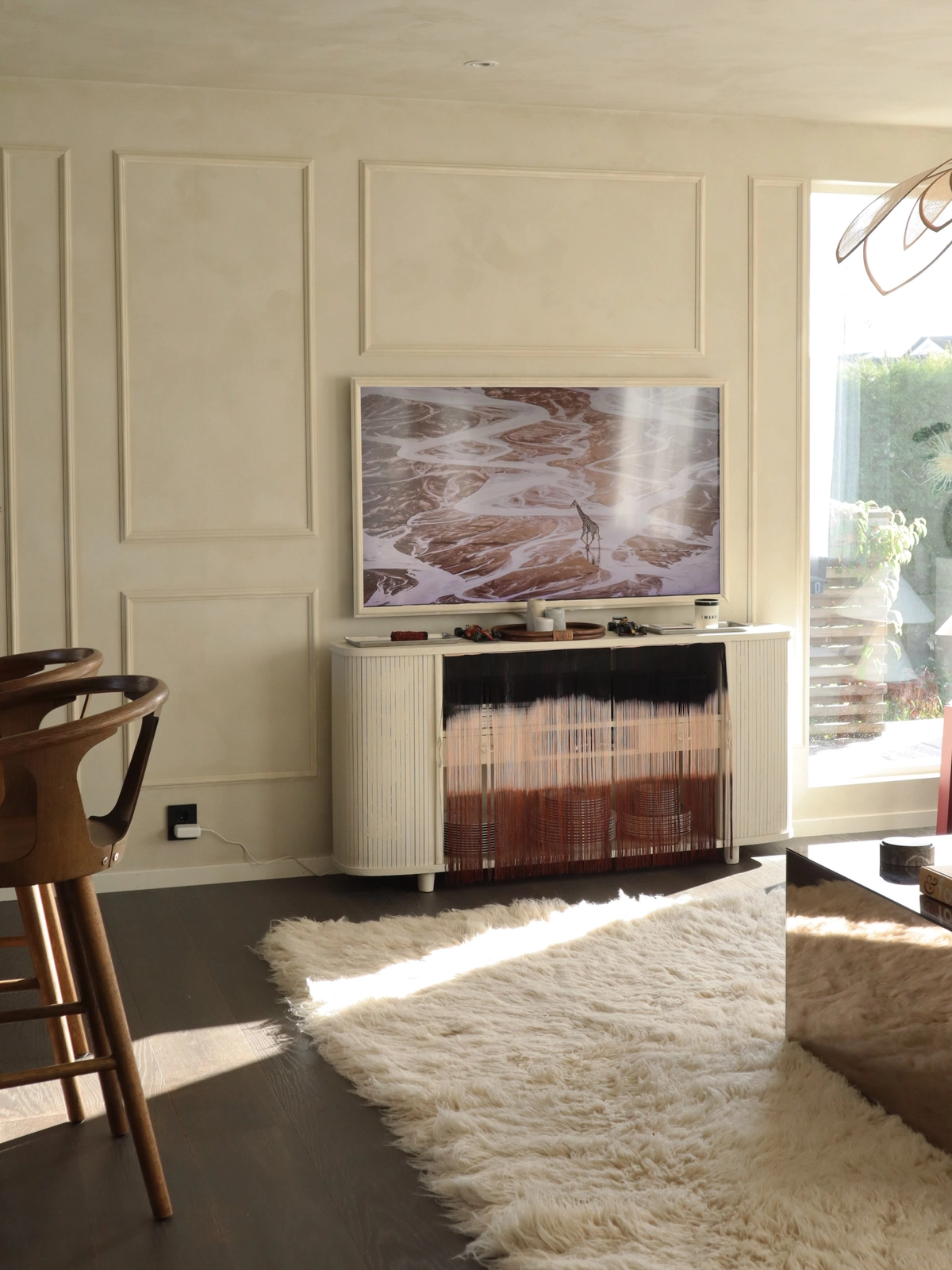
Photo: @pureelisabeth_ on Instagram
A Frame TV is the honest answer to hating a black rectangle. When it is off, this one shows an aerial landscape print, framed and hung on a panel-moulded wall like any other piece of art. The white credenza below it, with its DIY string-curtain front, keeps the whole wall soft and pale, so the screen never shouts.
The panel moulding is the detail that sells it. Without the moulding, a Frame TV still looks like a TV with a picture on it. With it, the wall reads as a gallery wall that happens to move. If a Frame TV is out of budget, a plain TV with a slim wood frame and a screensaver of rotating art gets you most of the way there for a fraction of the price.
Recess it into a shallow niche
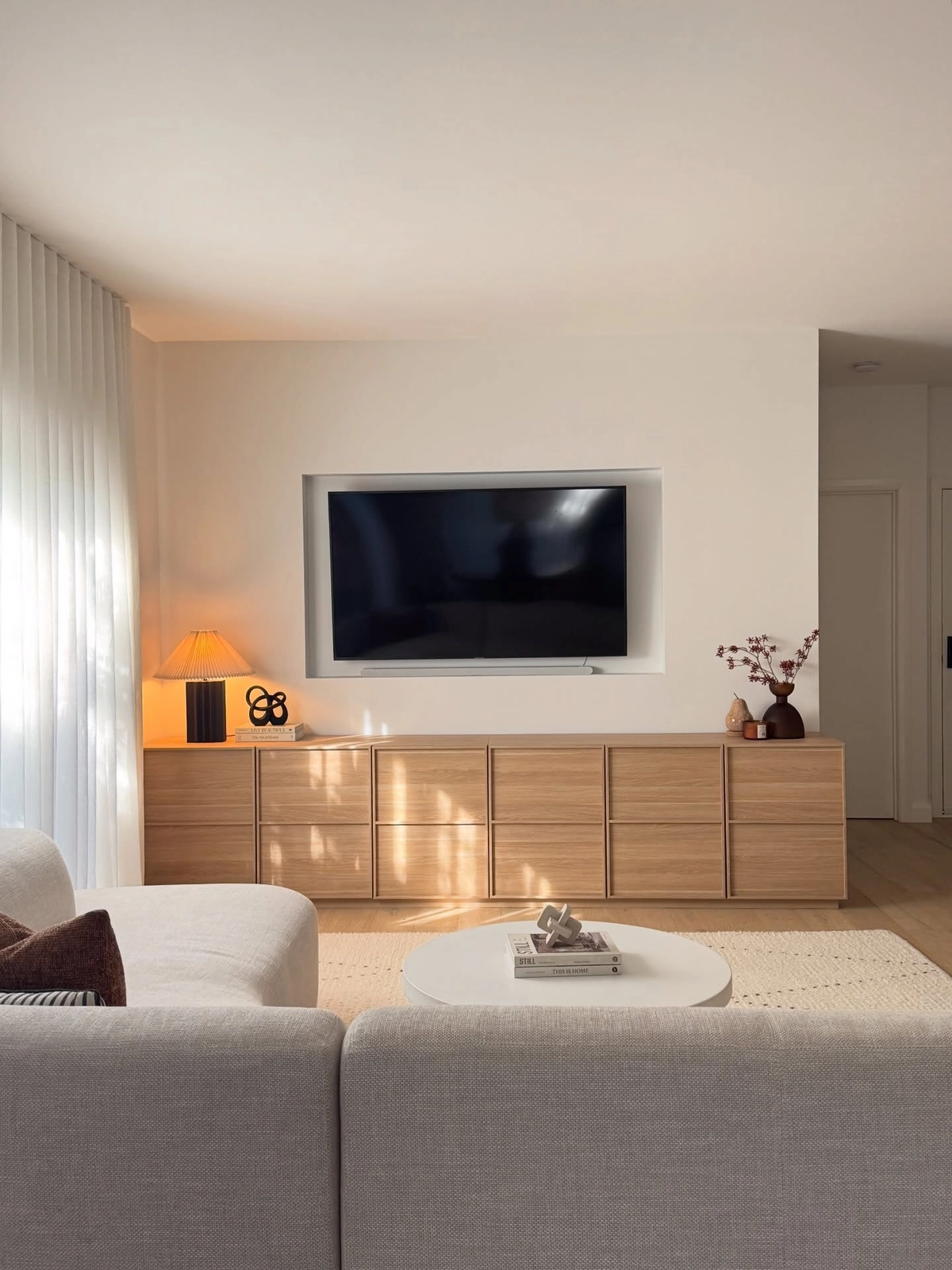
Photo: @maryshomeinspo on Instagram
A shallow recess, just deep enough to hold the screen, turns a wall-mounted TV into a built-in one. Here the niche is framed in white, the TV sits flush inside it, and a long low oak cabinet runs underneath for all the boxes. The grey sofa in the foreground faces it straight on, and nothing about the wall feels busy.
This is a bigger job than hanging a bracket, but a shallower one than most people expect: a false wall of a few inches is enough for most screens, and it gives you a place to hide cables properly. If you are already planning any wall work, adding the niche costs little extra and pays off every time the TV is off.
Put it above the fireplace and use the alcoves
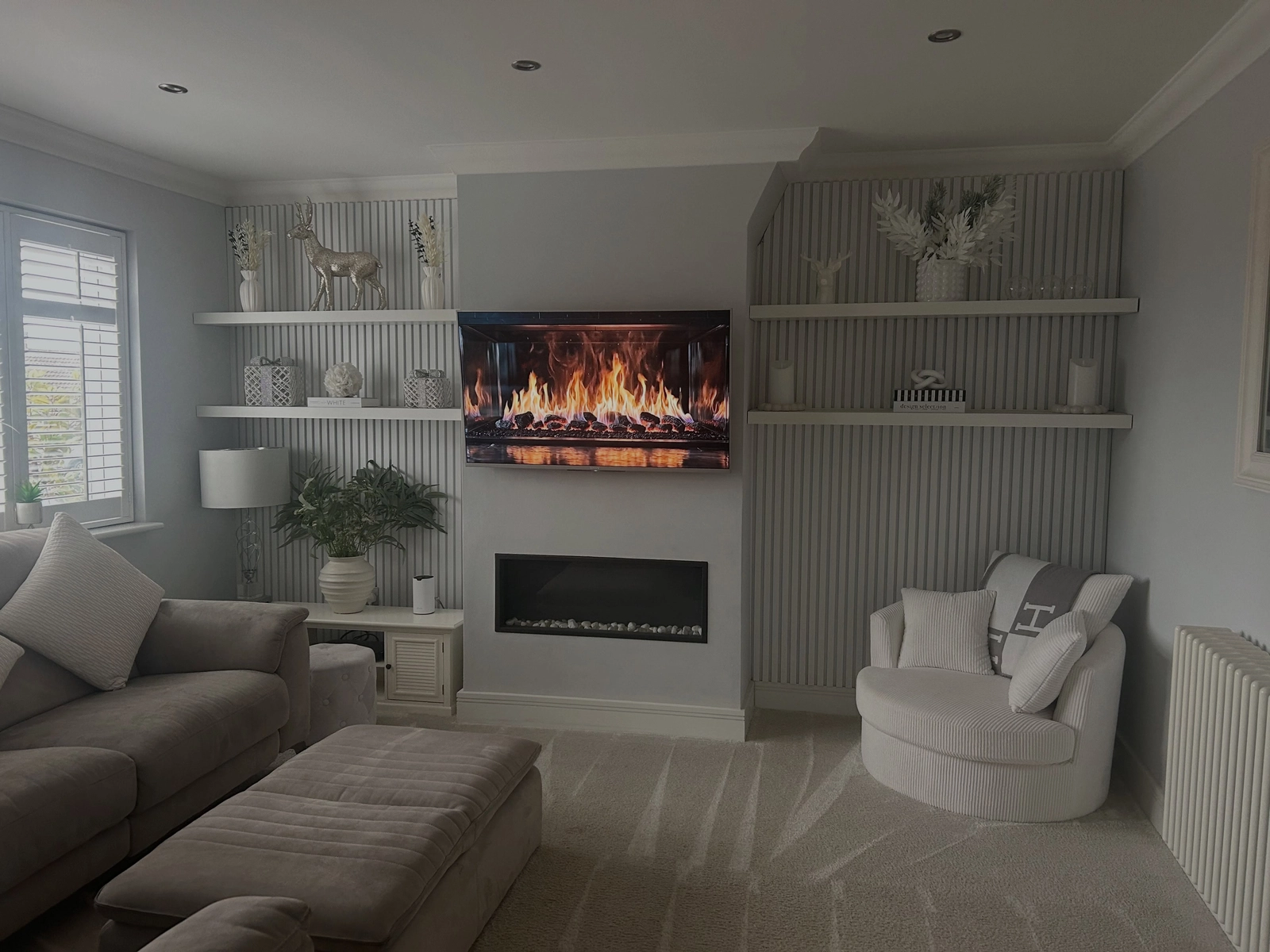
Photo: @healthyhaf24 on Instagram
TV above the fireplace divides opinion, but in a small room it solves a real problem: it puts the two things that want the main wall onto one wall, and frees the rest of the room. Here the TV sits above an electric fireplace, with slatted alcove shelving on both sides holding a few quiet objects. The screen even shows a fireplace scene, which is either a joke or a very committed theme.
The height rule matters more here than anywhere. A TV above a fireplace is often hung too high, and necks notice. Keep the fireplace low and slim, mount the screen as close above it as the heat allows, and tilt it down slightly. If your fireplace is a tall traditional one, this idea is not for you: use a side wall instead.
Use the corner or the side wall
The main wall is not the only wall. In a narrow room, or a room where the main wall belongs to a window or a fireplace, the side wall and the corner are often better TV spots. They also change the seating: instead of a row of chairs facing one wall, the room gets a diagonal or an L shape that feels less like a cinema.
Mount a small TV on the side wall of a narrow room
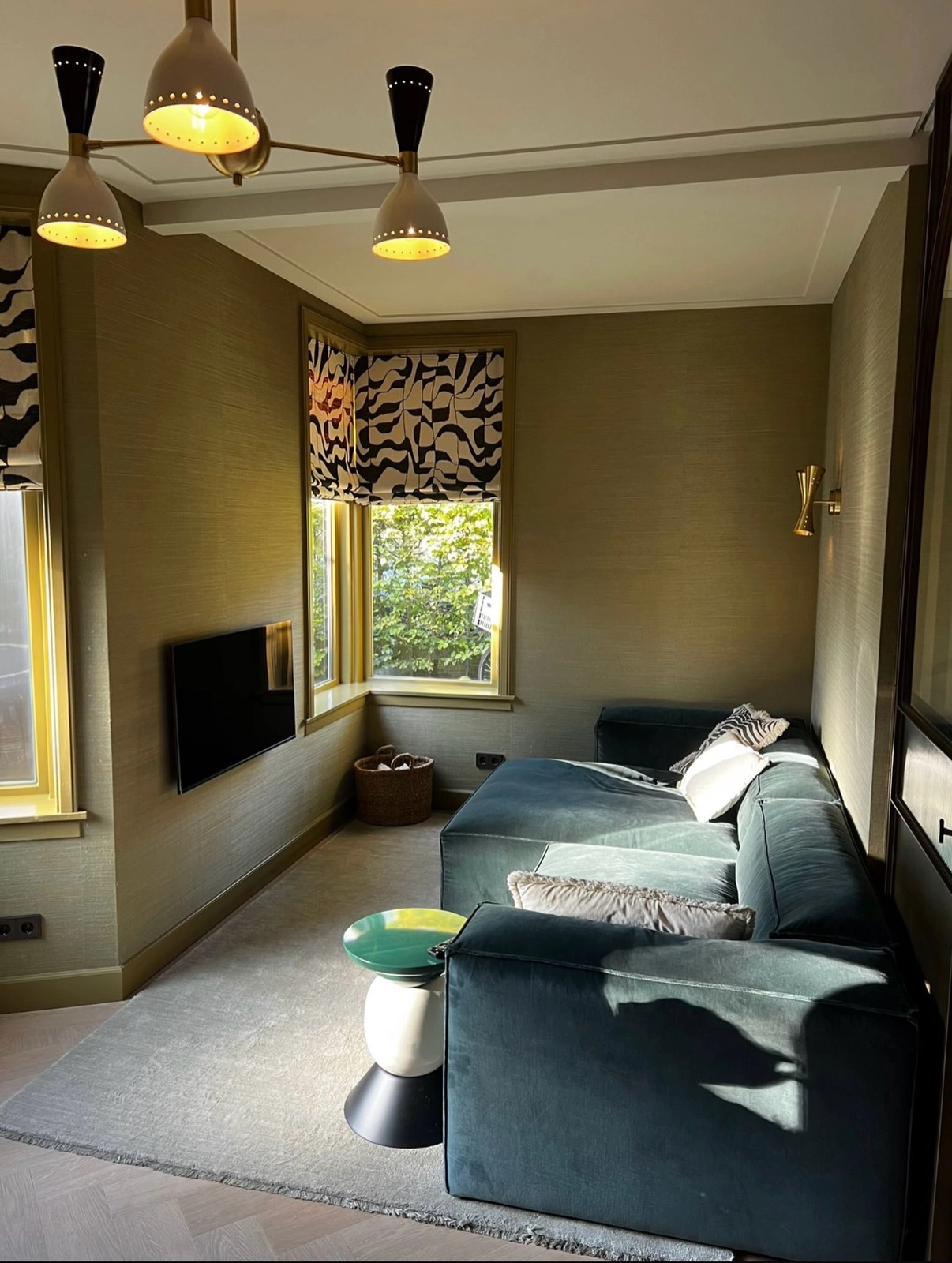
Photo: @catchiihomeware on Instagram
In this narrow room the TV does not face the sofa from the far wall at all. It hangs on the side wall, small and unobtrusive, next to patterned roman blinds, while the teal velvet sectional runs along the opposite wall. The room stays a room first and a viewing room second, which is exactly right for a space this size.
The lesson is about size. A side-wall TV sits closer to the seating than a far-wall one, so it can be smaller and still fill your view. Measure your seating distance before you buy: at six feet, a 43 inch screen is plenty, and a smaller screen on a side wall looks deliberate where a huge one looks like it crashed into the room.
Angle it across the corner on an L-shaped stand
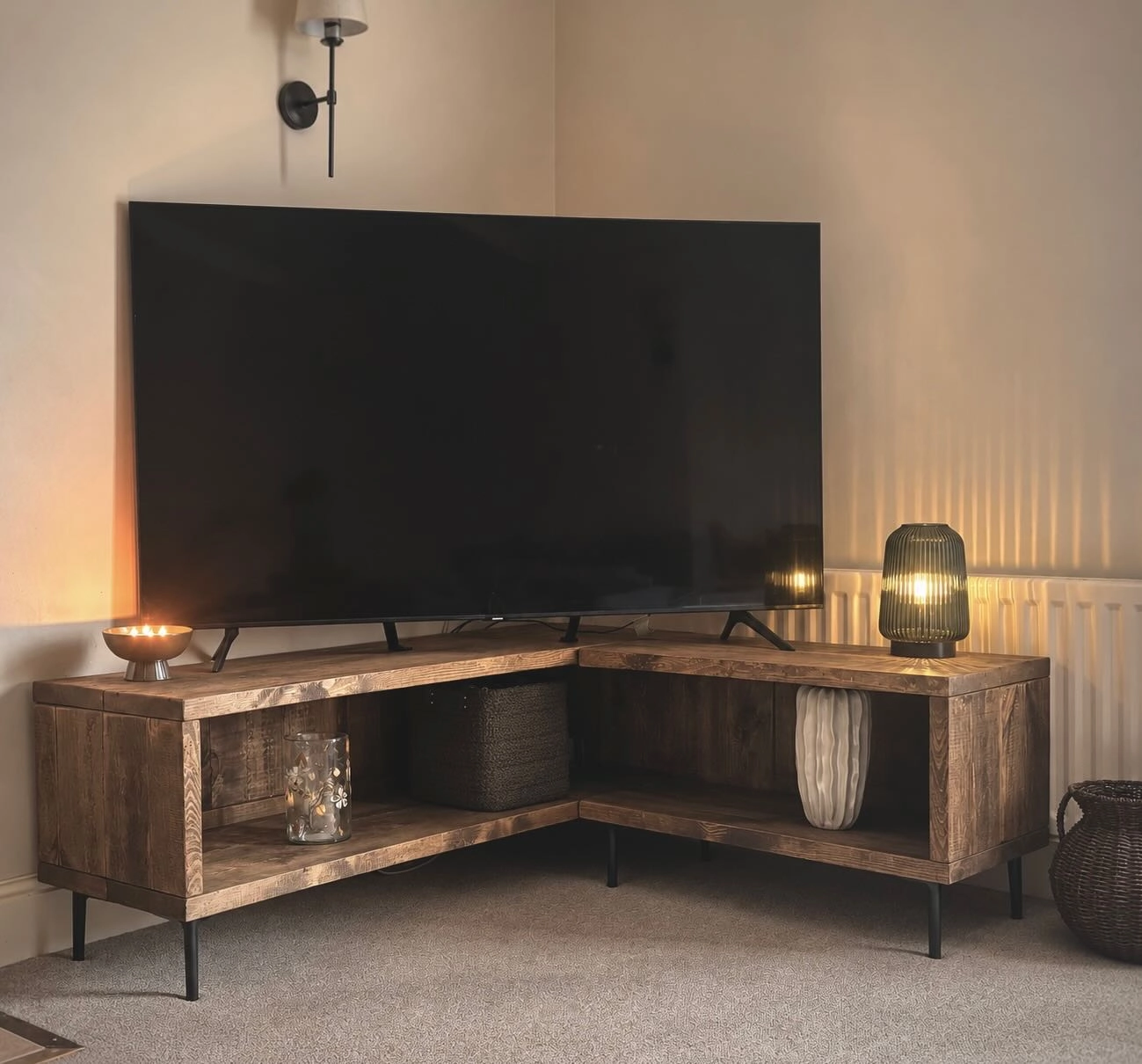
Photo: @loverusticinteriors on Instagram
A corner stand is the oldest trick in this list and still one of the best. This rustic L-shaped unit sits across the corner, so the TV angles into the room and the seating can angle with it. The candle bowl and ribbed lamp on top make the corner feel dressed rather than filled, and the open shelves below hold baskets and a vase.
Corner stands suit rooms where the sofa is already angled or L-shaped, because the screen meets the seating halfway. Keep the stand low and wide rather than tall: a tall corner unit turns the corner into a tower, while a low one keeps the sightlines open across the room.
Let the TV sit off-centre and balance it with a mirror
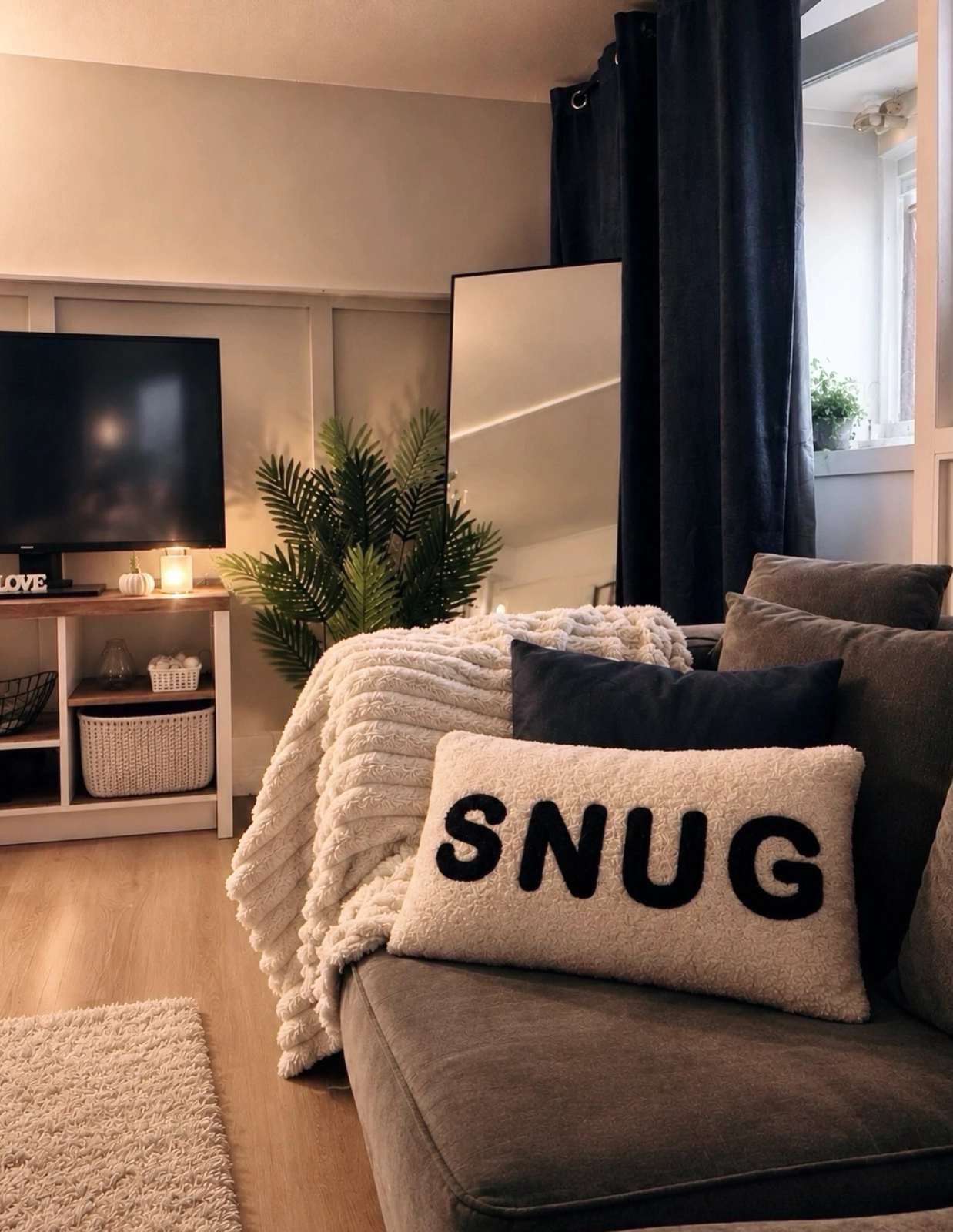
Photo: @laurens_homelife on Instagram
Nothing says a TV has to sit in the middle of its wall. Here it sits on a low open stand at the left, with a tall leaning mirror and dark curtains balancing the right side of the room. The grey sofa faces the screen, but the wall is not a shrine to it: the mirror, the plant, and the chunky knit throw all get their share of attention.
Off-centre placement is the easiest idea on this list to try, because it costs nothing. Slide the stand to one side, put something tall on the other side, and the room instantly feels less like it was designed around a screen. The open stand helps too: baskets and books underneath beat a solid block of black boxes.
Let the console do the work
Sometimes the TV itself is fine and the problem is everything around it: the boxes, the consoles, the cables, the remotes. These last five ideas are about the furniture underneath the screen, and they are the cheapest fixes in the whole list.
Choose a console that stores your other hobby too
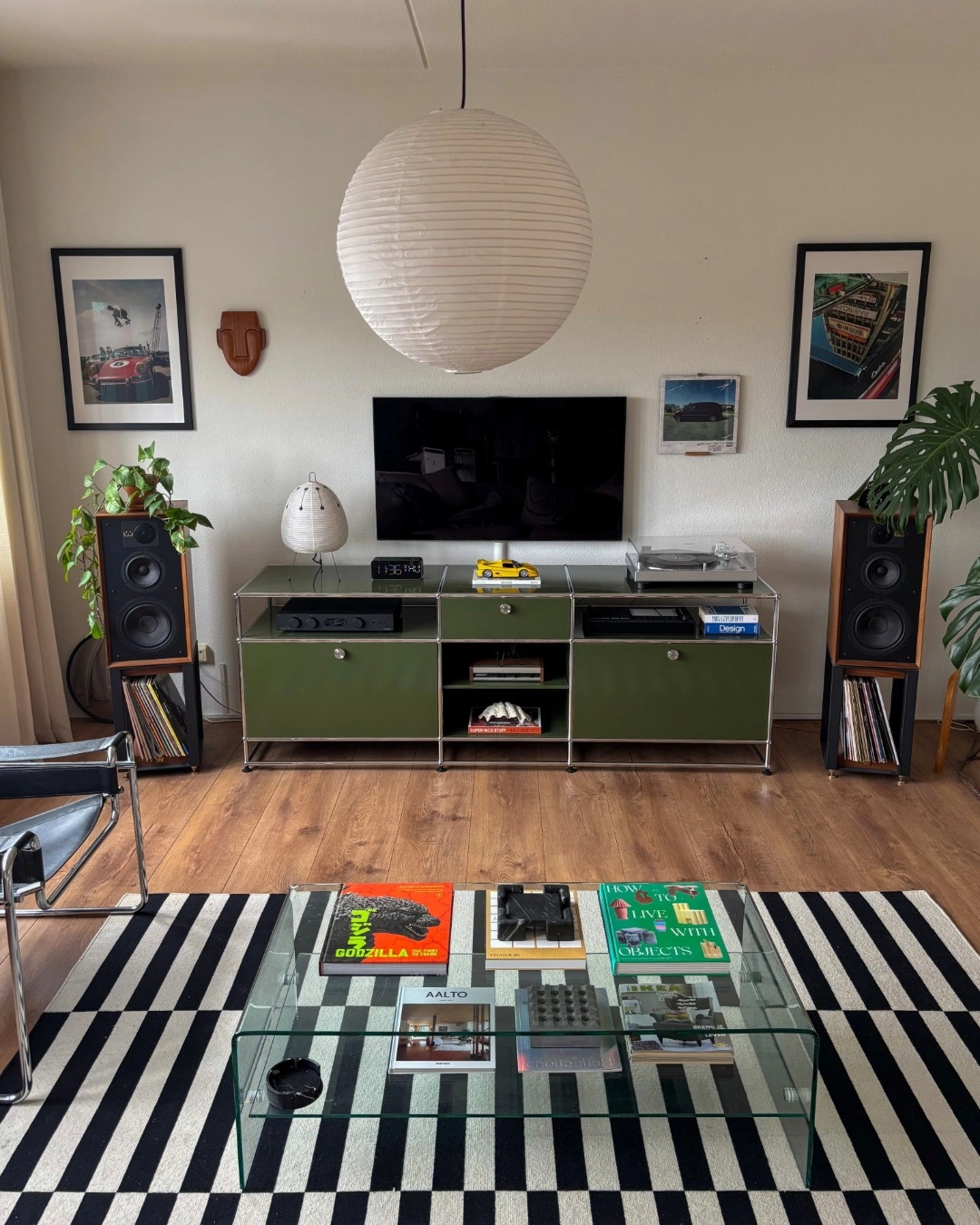
Photo: @usmmodularfurniture on Instagram
This green modular console holds a turntable, an amplifier, and vinyl storage, with floor-standing speakers on either side. The TV is wall-mounted above it, modest in size, and clearly not the only entertainment in the room. That is the point: when the console holds something you love, the TV stops being the whole story.
Modular consoles are a small-room gift because you can add or remove a section as your gear changes. Keep the top mostly clear, a lamp and one small object, and let the units below do the storage. The striped rug and glass coffee table keep the floor feeling open, which matters when the console itself is doing a lot.
Keep the console low so the room stays open
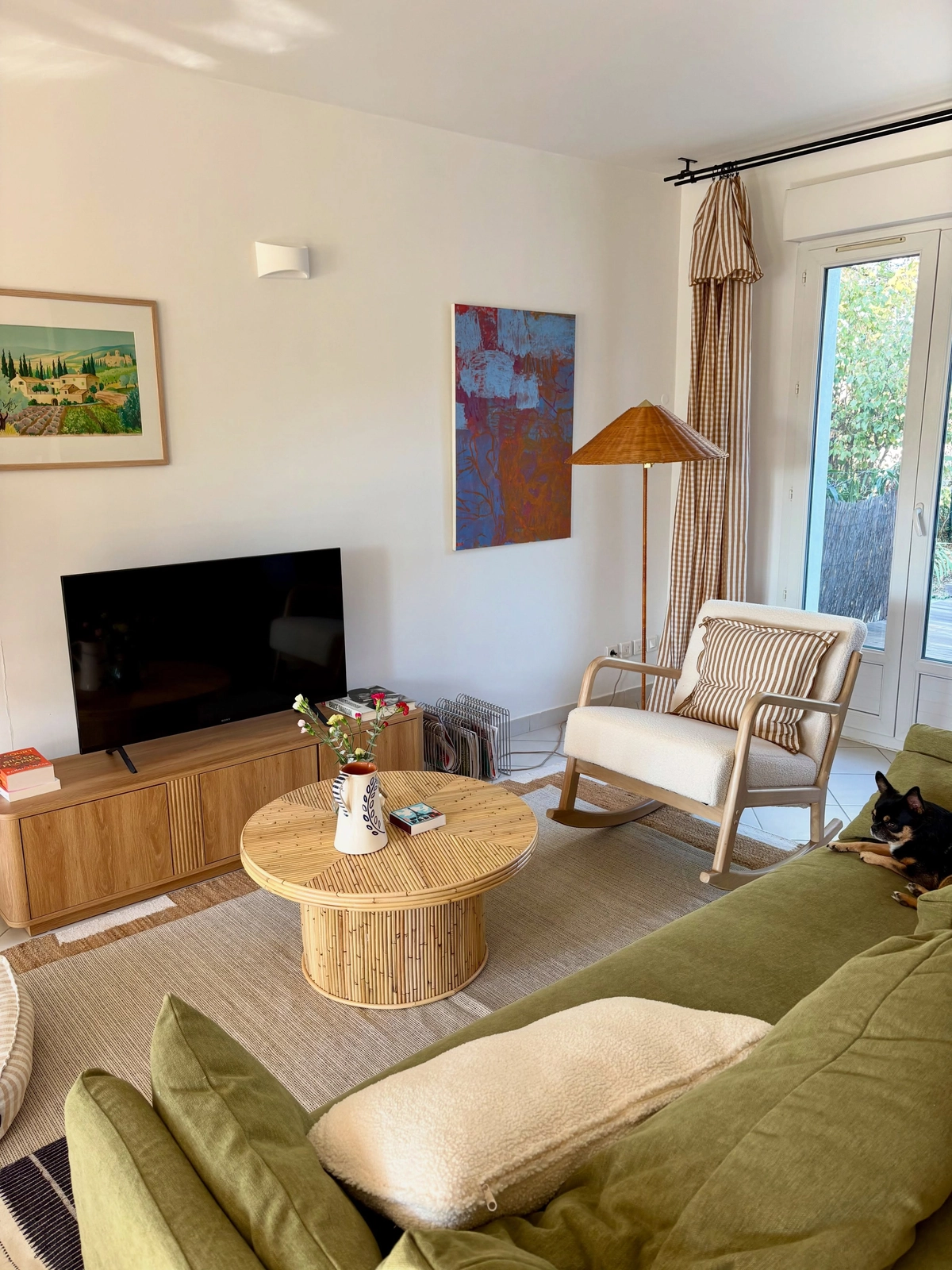
Photo: @the_deco_edit on Instagram
A low oak console is the quietest idea here, and one of the most effective. The TV sits on it at a comfortable height, the olive sofa and rocking chair face it without a wall of furniture between them, and the rattan coffee table keeps the centre of the room light. Nothing is hidden and nothing needs to be, because the console is too low to dominate.
Low consoles suit rooms with big windows or art on the walls, because they leave the upper wall free. If your TV is large, a low console still works: the screen provides the height, and the console provides the calm base. Keep one drawer for remotes and cables, and the top stays clear by itself.
Hang a shelf and some art above a low stand
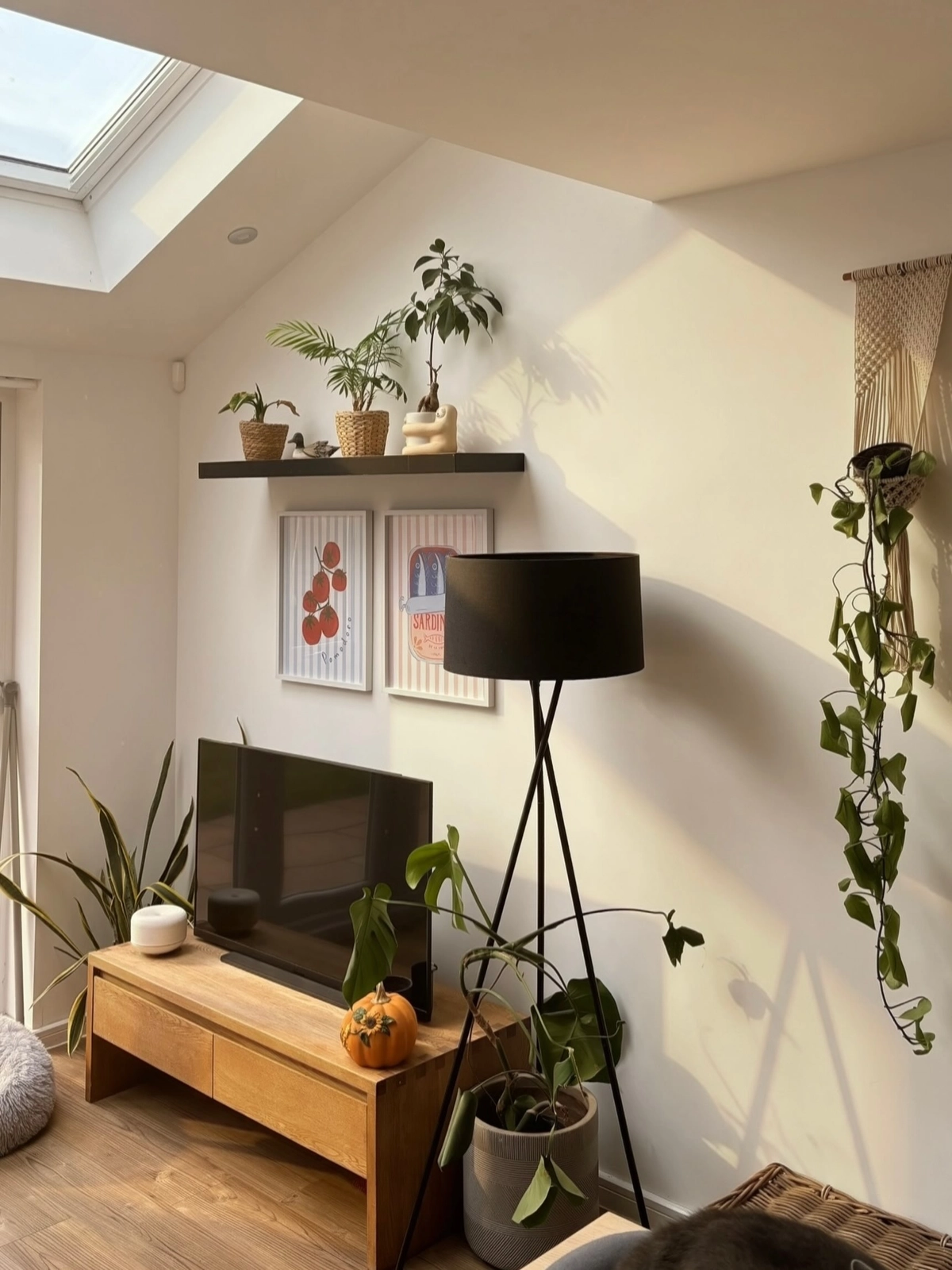
Photo: @acountrysidehome_ on Instagram
If the wall above your TV is blank, a floating shelf and two framed prints fix it for very little money. Here the shelf holds plants and a small sculpture, the prints below it are tomato and sardine illustrations, and the TV on its low wooden stand sits underneath without competing. The whole corner feels collected rather than arranged around a screen.
The rule is simple: art above a TV should be narrower than the TV, or it looks like it is falling off the wall. Two small prints side by side work better than one large one in a small room, and a shelf gives you a place for plants that would otherwise crowd the console. Sunlight helps too, but that part is luck.
Add LED mood lighting and let the room glow
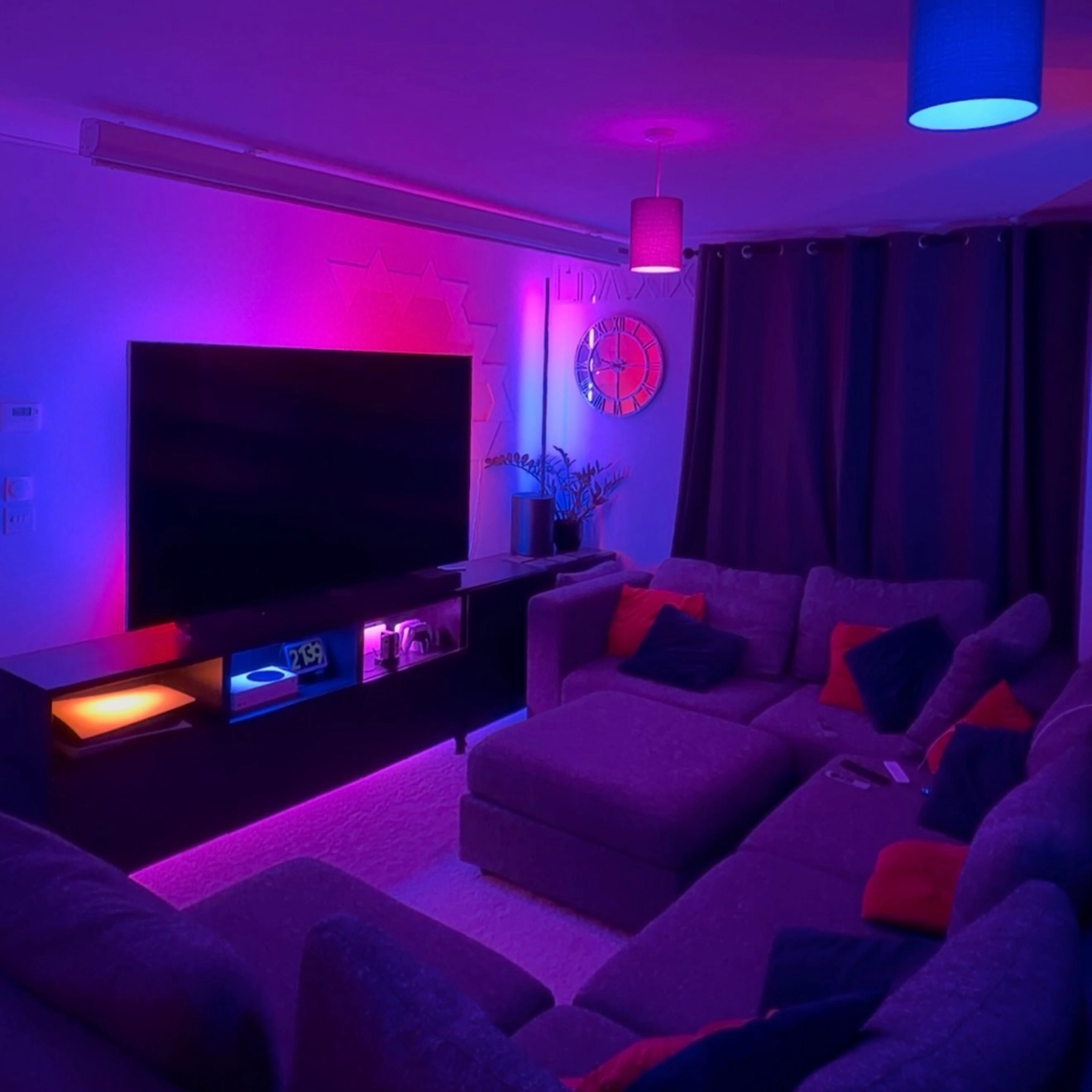
Photo: @ldaxix on Instagram
LED strips behind and beneath a low black console turn an ordinary TV wall into a cinema corner after dark. The purple and blue glow in this room makes the screen feel like part of a lighting scheme rather than a black slab, and the L-shaped sofa wraps around it so the whole room joins in. It is the cheapest transformation on this list.
A strip behind the TV also helps your eyes: a soft glow behind the screen reduces the contrast between the bright picture and a dark room, which is easier on long viewing sessions. Stick with one colour at a time and keep it warm or soft for everyday use. The full nightclub setting is fun for about a week.
Pair the screen with a soundbar on a panelled wall
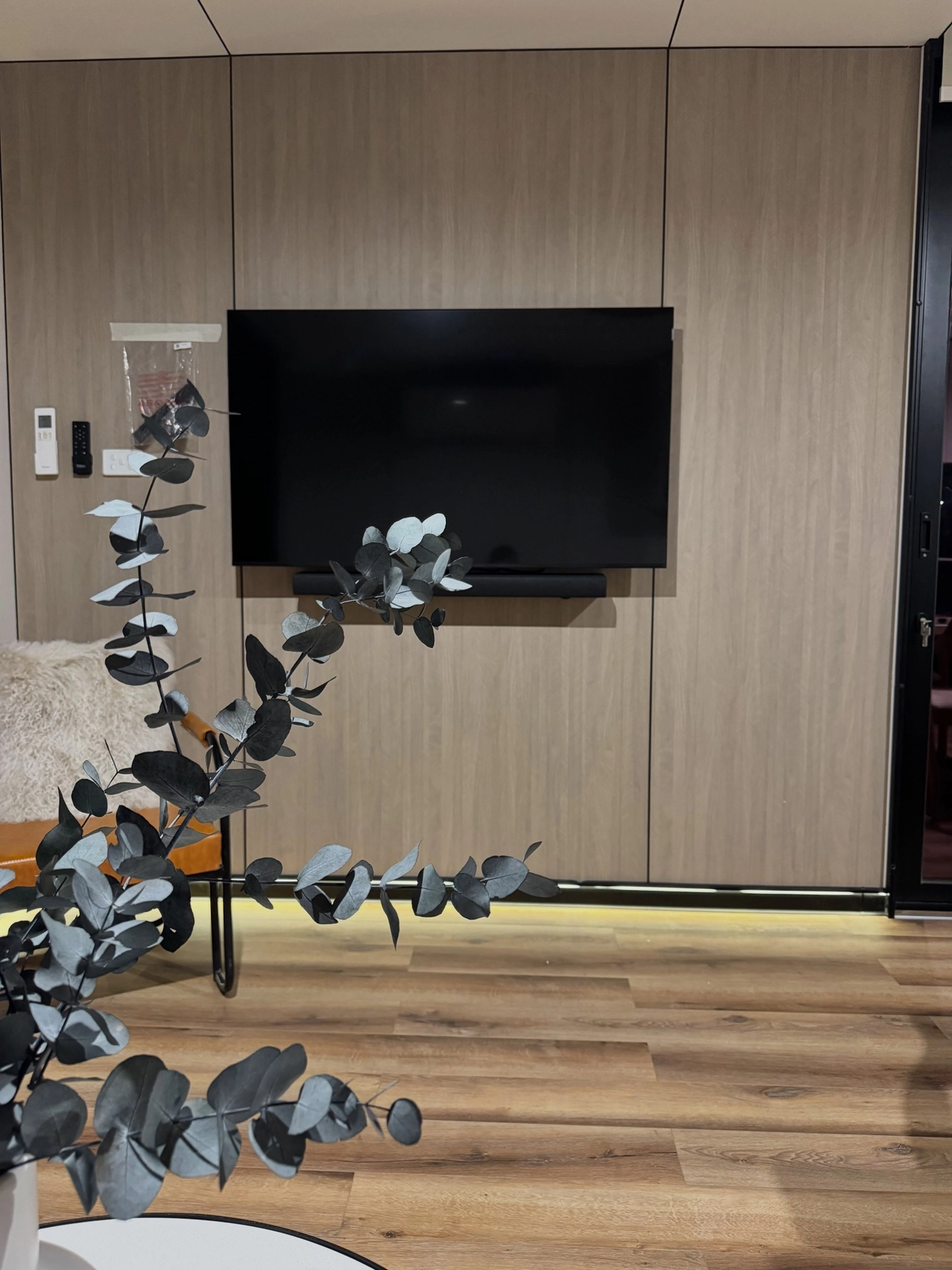
Photo: @lion_av_ on Instagram
A wood-panelled wall gives a TV and a soundbar a proper home without any joinery. The panels add texture and warmth, the soundbar mounts tight beneath the screen so there is no extra shelf, and the whole wall reads as finished even though nothing was built. The eucalyptus stems in the foreground are doing the styling, and very little else is needed.
Panel walls are a good middle step between a bare wall and a media wall: cheaper than joinery, warmer than paint, and removable if you rent. Run the panels floor to ceiling and keep them the same tone as your floor, and the wall will feel taller rather than busier. The soundbar matters too: better sound means you can watch at lower volume, which small rooms always appreciate.
TV size and viewing distance
| Seating distance | Comfortable TV size |
|---|---|
| 4 to 5 feet | 32 to 43 inches |
| 5 to 6 feet | 43 to 50 inches |
| 6 to 8 feet | 50 to 65 inches |
| 8 to 10 feet | 65 to 75 inches |
Start with the wall, not the TV
Every room on this list started with the same question, and it was not which TV to buy. It was which wall the TV should live on, and what that wall should do besides hold a screen. Answer that first, and the rest gets easy: the console width follows the TV, the seating follows the wall, and the room keeps its shape.
If you only change one thing, wall-mount the TV and float something long and low underneath it. That single move frees the floor, hides the boxes, and makes almost any small living room feel a few feet bigger. Then add the lighting, the shelving, or the art when you are ready: the wall will be waiting.