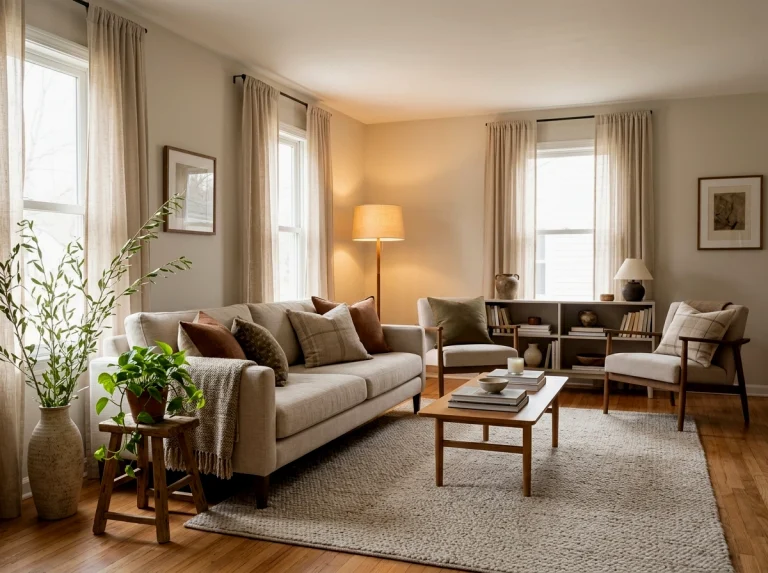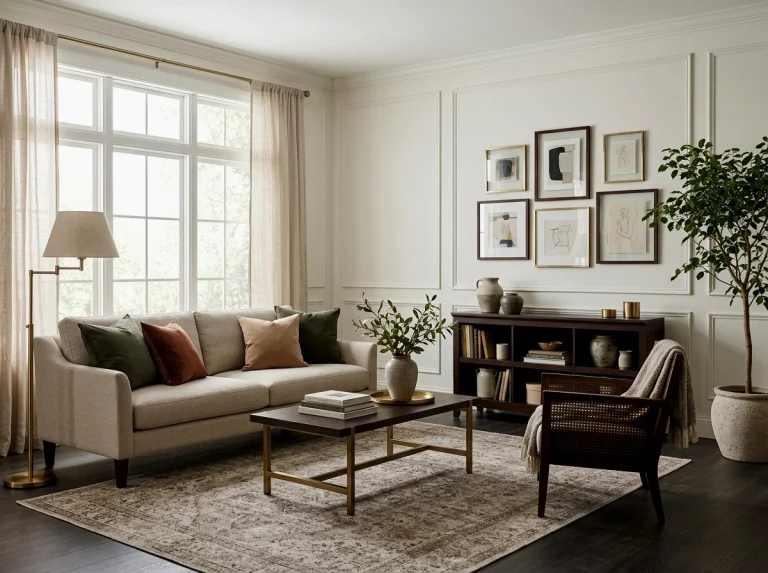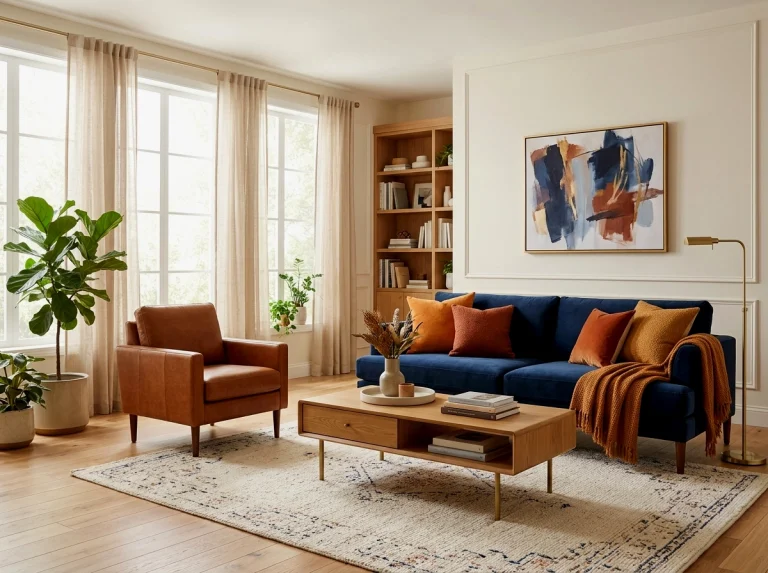
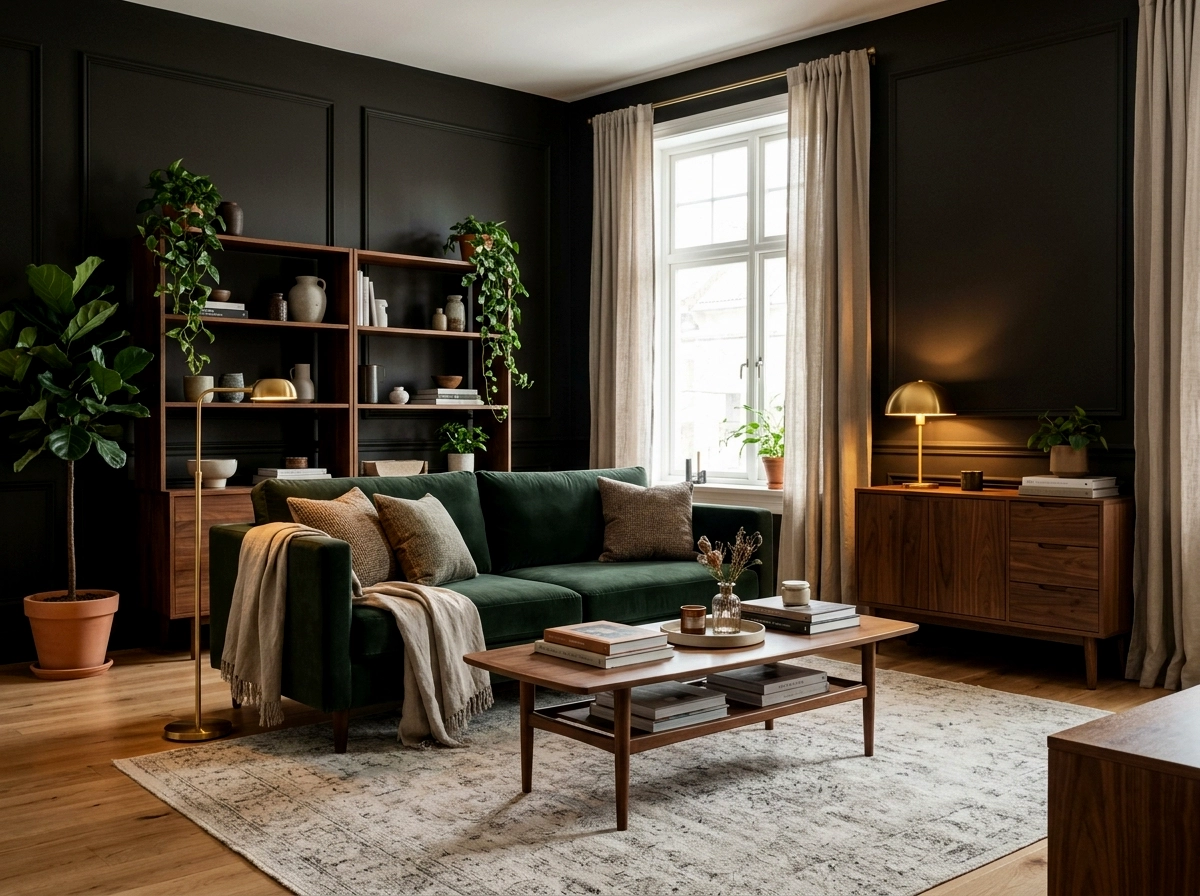
24 Black Living Room Ideas That Still Feel Warm
A black living room almost never fails because it is dark. It fails because it is cold: one bluish ceiling bulb, flat finishes everywhere, and not a single material in the room that reads as warmth to the skin. So treat this as an audit rather than a shopping list. Check your room against the four warmth sources below, wood, light, texture and one living colour, find the source that scores zero in your home, and fix that section first before you buy anything for the others.
The Light Temperature Fact
Warm light is not a taste choice in a black room, it is physics. Black paint and black fabric absorb most of the light that lands on them, so a black room needs roughly a third more light sources than a pale room to feel equally bright at the same hour. Keep every bulb at 2700K or warmer, because lamps near 3000K and above push black walls toward a cold blue grey that no cushion can rescue. Count your lamps the way you count your seats: fewer than three warm sources, and the room will feel chilly no matter what else you spend money on.
Warmth From Wood
Wood is the fastest warmth you can add, because its colour already sits halfway between black and firelight and the eye believes it instantly. Audit rule: stand on the sofa and look around; if no wooden surface is visible from where you sit, this is the group where your room is losing its heat.
1. Black walls with a walnut media unit
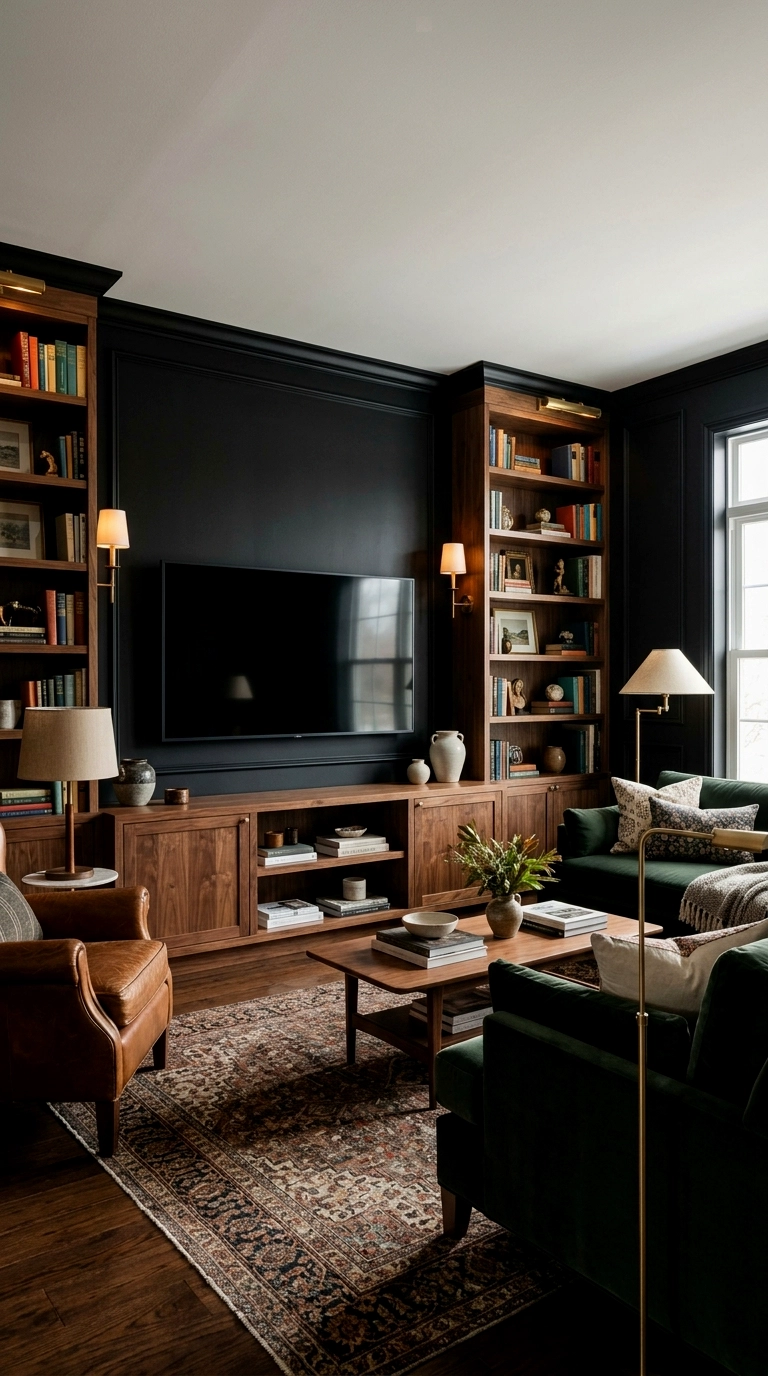
Walnut carries a red brown grain that has kept dark rooms company for centuries, and at media unit scale it stops being an accent and becomes a climate. A long low unit against black walls glows quietly all evening, especially with the television off and a lamp reflected in its polished top. Choose one generous piece over a scatter of small wooden ornaments, because warmth needs surface area to register.
Wood warms at furniture scale, so buy the big warm piece first and let the small ones follow.
2. Black sofa on a warm oak floor
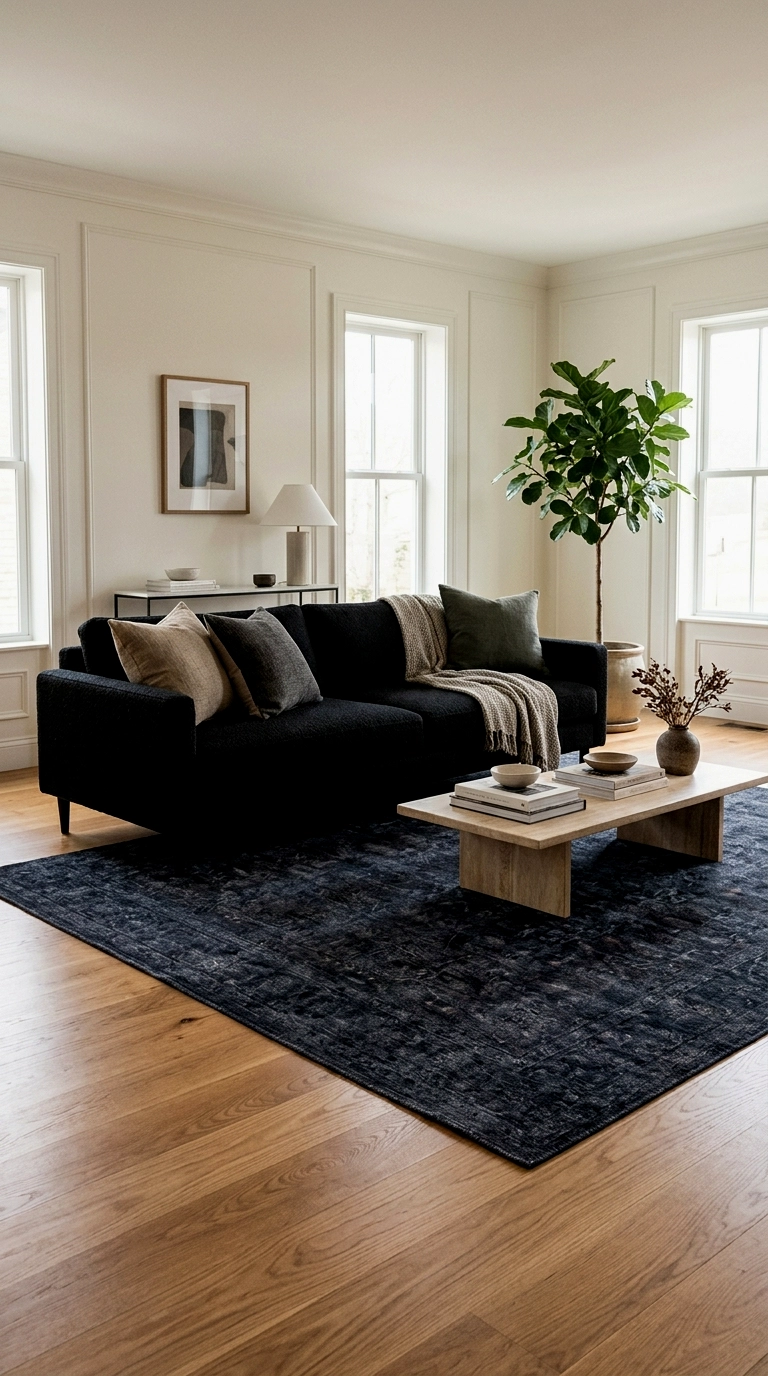
If your floor is warm oak or honeyed pine, it is already doing half this group’s work, so whatever you do, keep it visible. Choose a deep toned, low pile rug that leaves a generous border of floor showing on every side, like a frame around a picture. The sofa sits inside the dark centre, and the warm frame keeps the whole arrangement from feeling like a black box.
A warm floor left showing is free heating, and covering it completely is the most expensive mistake in a black room.
Warmth check: leave at least a hand’s width of bare floor visible on all four sides of the rug and live with it for a day before deciding the room still feels cold.
3. Black shelving styled with wood boxes, bowls and boards
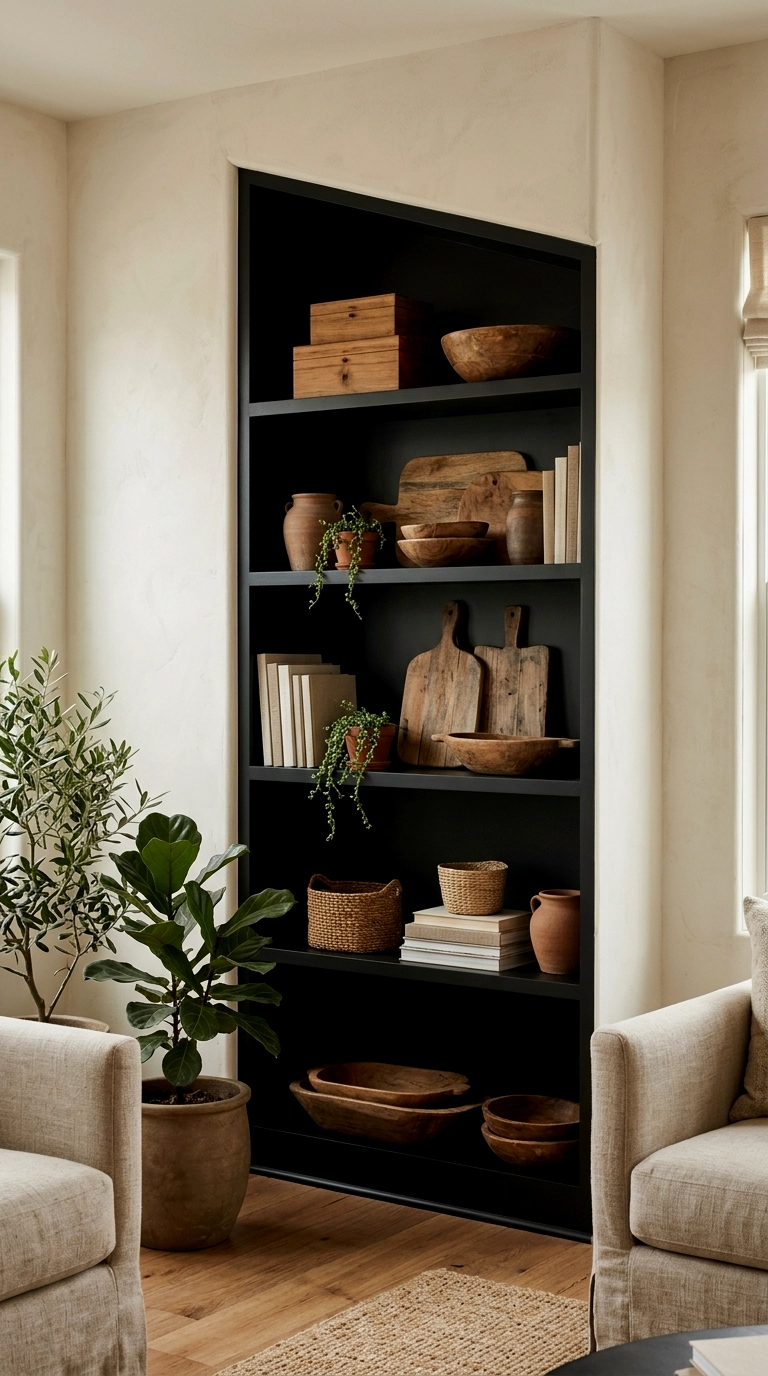
Black shelves can swallow everything placed on them, until the objects are wooden. Lidded boxes, turned bowls, chopping boards and woven baskets read as small glowing blocks of warmth against the dark, doubly so if a shelf light washes over them in the evening. Group your wooden pieces in clusters of three or four on two shelves rather than spreading one lonely bowl per shelf.
Wood warms in clusters, not in singles, so let it gather where the light can find it.
4. A black room with a reclaimed wood coffee table
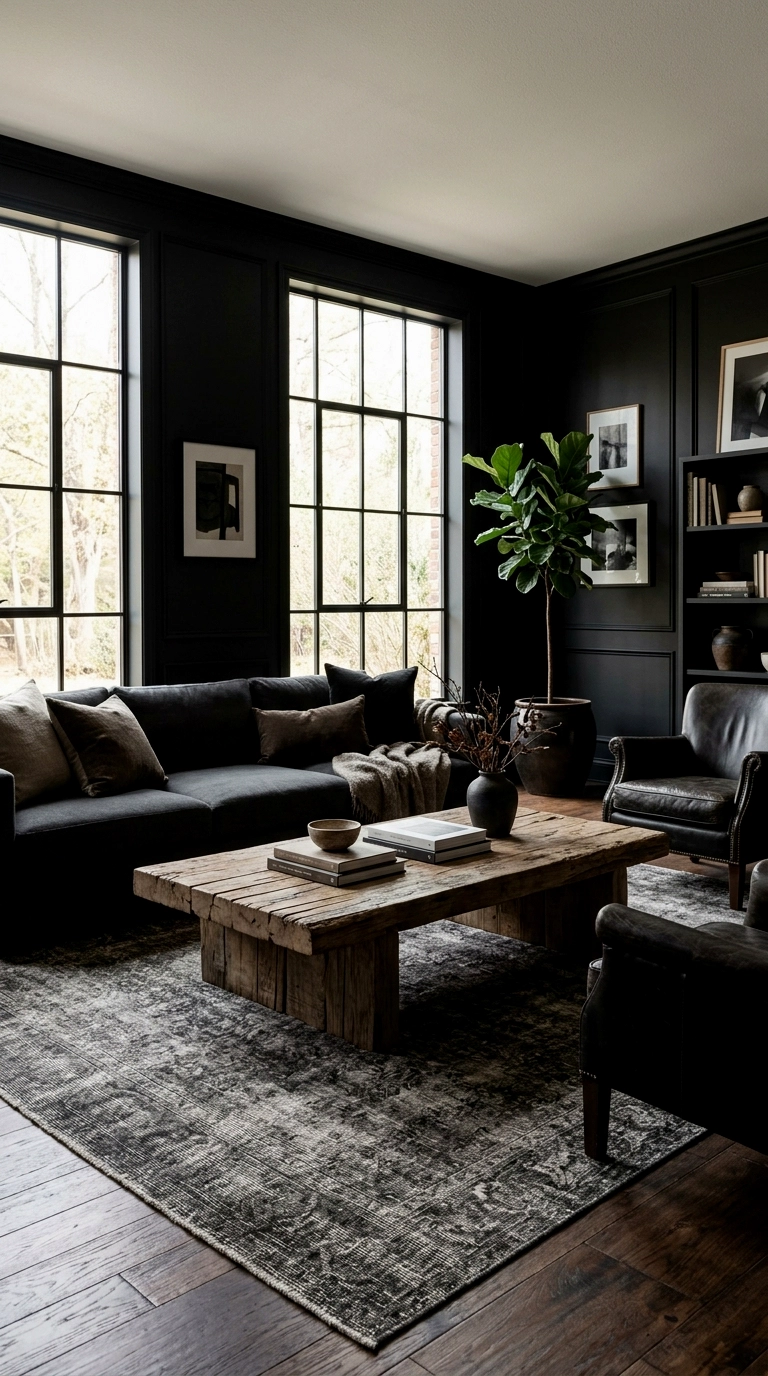
One rough, honest timber table in the middle of the room stops black furniture looking like it was delivered as a matching showroom set. Saw marks, knots and a slightly uneven edge give your eye somewhere soft and human to land between all that sleek darkness. Keep the top mostly clear, a book and a bowl at most, so the grain stays on show.
Rough wood is black’s best softener, because it proves the room was lived in and not just styled.
Warmth check: run your palm slowly across the table at dusk and watch the grain catch the lamplight in stripes; if it glows, the table is doing its job.
5. Black panelling with a wood picture rail and shelf
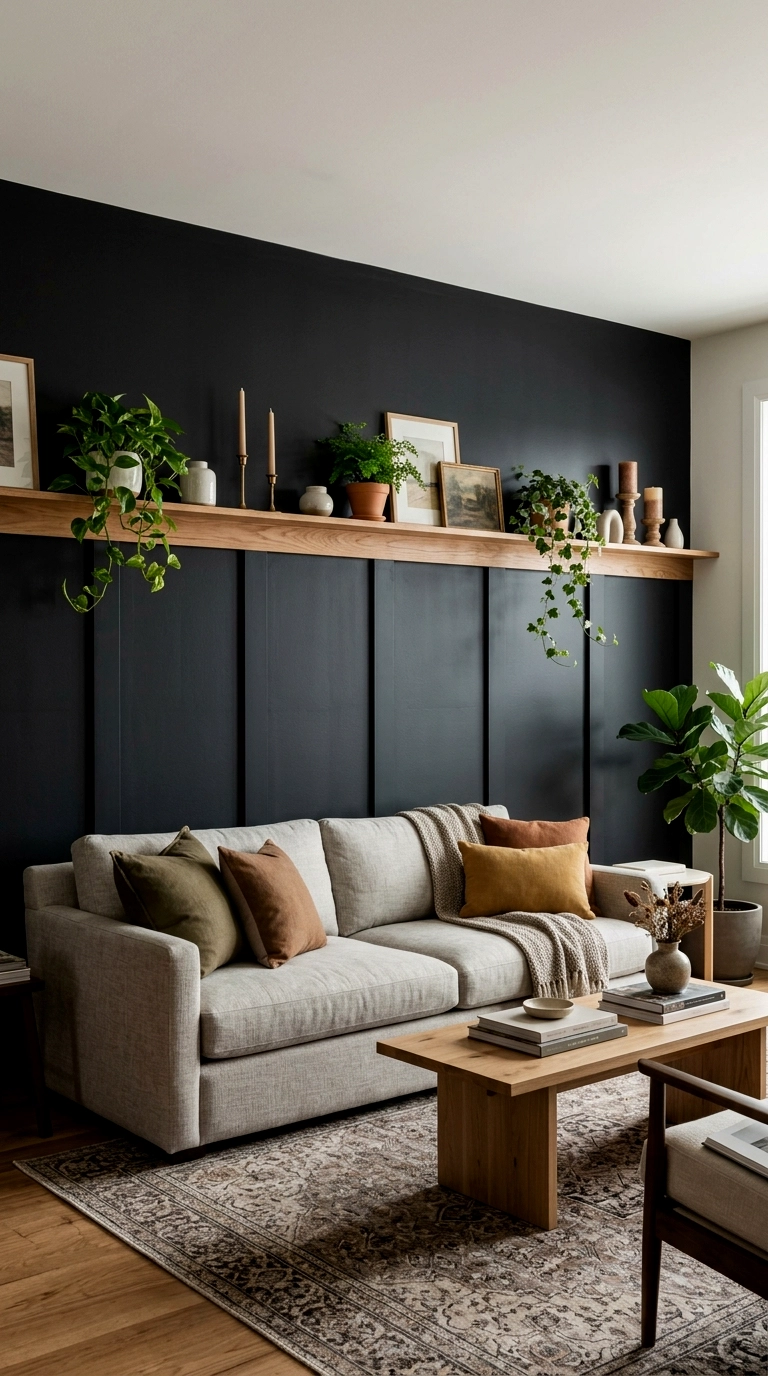
Run a timber picture rail or a shallow wood shelf around black panelled walls at shoulder height, and you break the darkness at exactly the level where eyes travel. The rail holds a changing parade of small prints, plants and candle jars, all sitting on a warm line that circles the room. It also earns its keep practically, since pictures hang from hooks instead of fresh holes in the panelling.
A warm line at shoulder height warms the whole wall, far beyond the few centimetres it actually covers.
6. Black walls, tan leather chair, wood side table
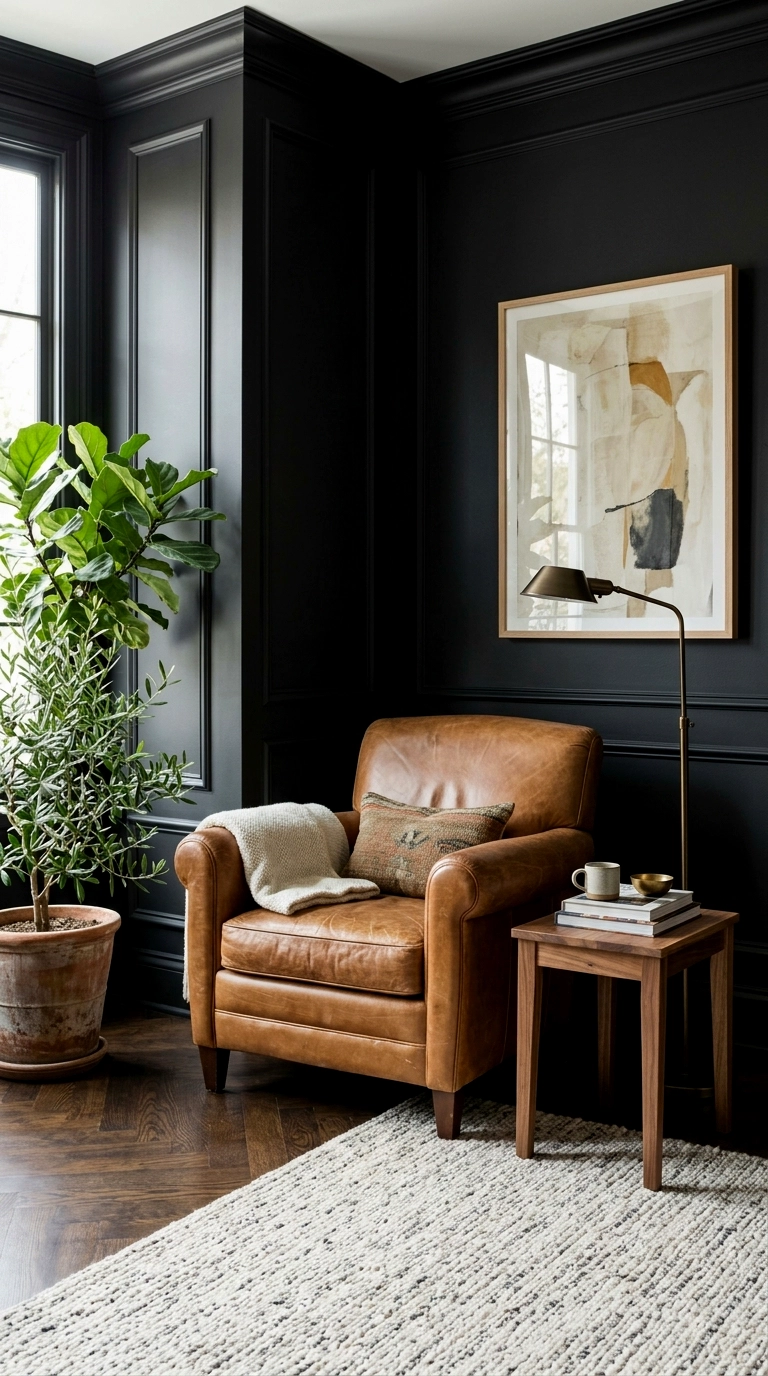
Tan and cognac leather are wood tones you can sit on, with the same amber depth and the same talent for glowing under lamplight. Set one generous leather chair against the black wall with a simple wood side table beside it, sized for a mug and a book. Within a week it will be the seat everyone in the house quietly competes for.
Treat leather like wood that happens to be comfortable, and place it wherever the room needs warming most.
Warmth check: sit in the chair after dark with the side table lamp on and confirm your drink, book and feet all land within easy reach, because warmth includes never having to get up.
Warmth From Light
Light decides whether black reads as a cocoon or a cave, and the deciding factors are warmth and number, not raw brightness. Audit rule: count your light sources from the doorway, then check the temperature printed on every bulb before you blame the paint colour for anything.
7. Three lamps minimum, all at different heights
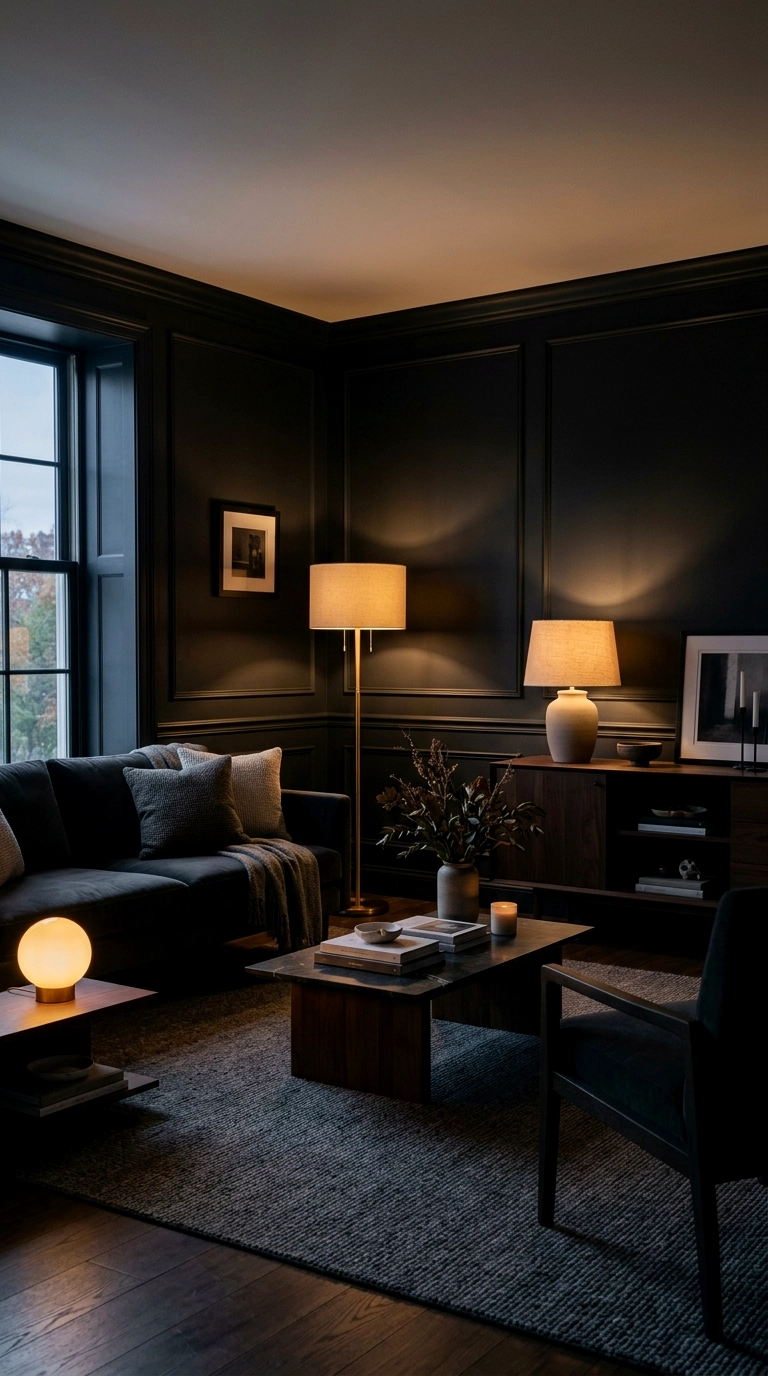
One ceiling light in a black room is an interrogation, but three lamps are an embrace. Set one at table height, one standing tall in a corner and one low on a shelf, and their overlapping pools of warm light give the walls something to drink. The different heights matter as much as the number, because they model faces, furniture and corners kindly instead of flattening them.
In a black room, light in threes or do not bother, because two lamps still leave a cold corner somewhere.
8. Brass and gold fixtures as the warm metal
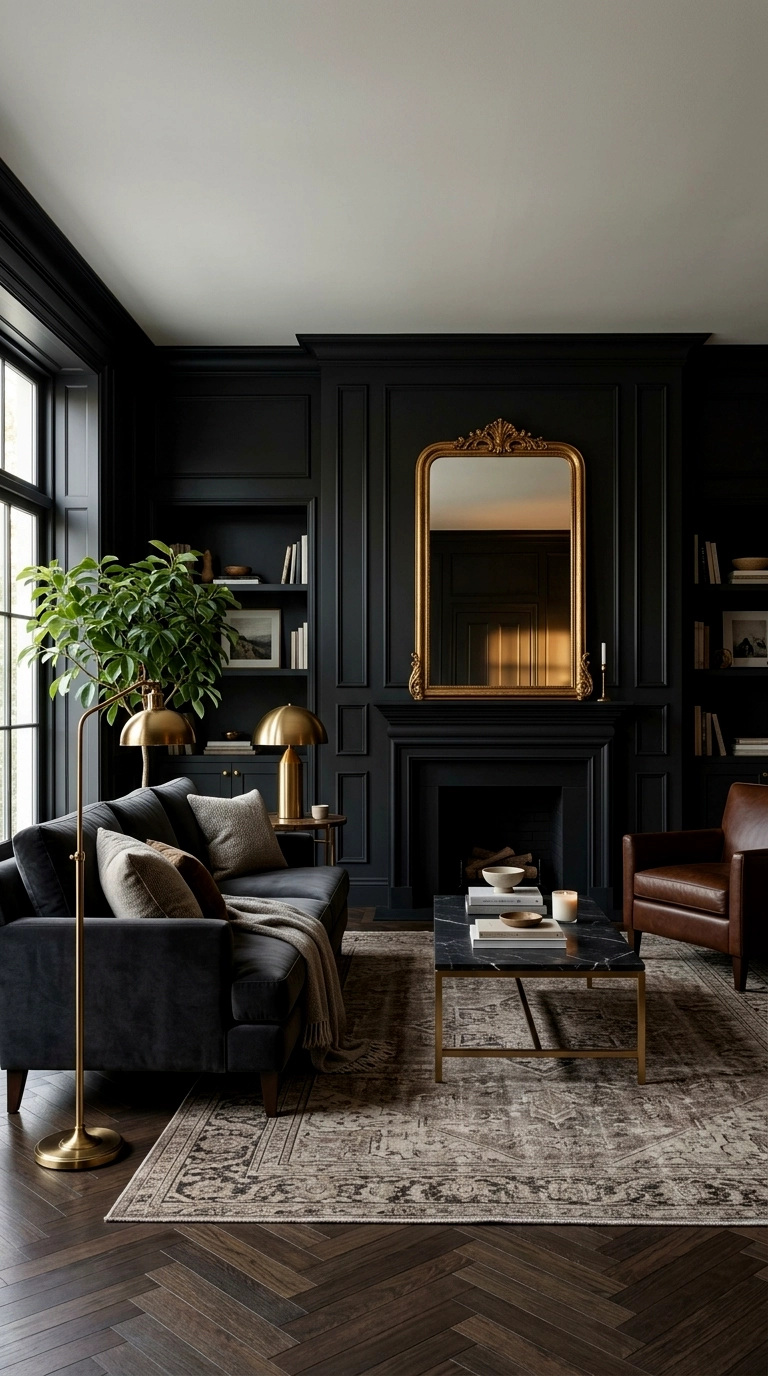
Warm metals hand warm light back to the room. A brass lamp, a gold framed mirror and a pair of picture lights bounce what little light you have around in amber, so the black surfaces stop absorbing and start reflecting a little. This is the same reason black, white and gold living rooms feel dressed rather than dark once the lamps come on. Keep the finish family consistent, brushed or antique, so the reflections agree with each other.
Against black, brass is not decoration, it is lighting equipment that happens to be beautiful.
Warmth check: stand in the doorway after dark and count the separate warm reflections you can spot in metal, glass and mirror; aim for at least four.
9. Candles and a real or realistic fire focal point

Nothing warms black as fast as a flicker. A working fireplace or stove is the dream, but a cluster of candles in glass jars on the hearth or the coffee table borrows most of the effect for a few pounds. The moving light keeps catching the edges of furniture and picture frames, so the room feels gently alive instead of statically dark. Group candles in odd numbers and vary the heights so the flames dance at different levels.
Flicker is the oldest warm light there is, and black rooms were quite literally designed around it.
10. Picture lights over art on black walls
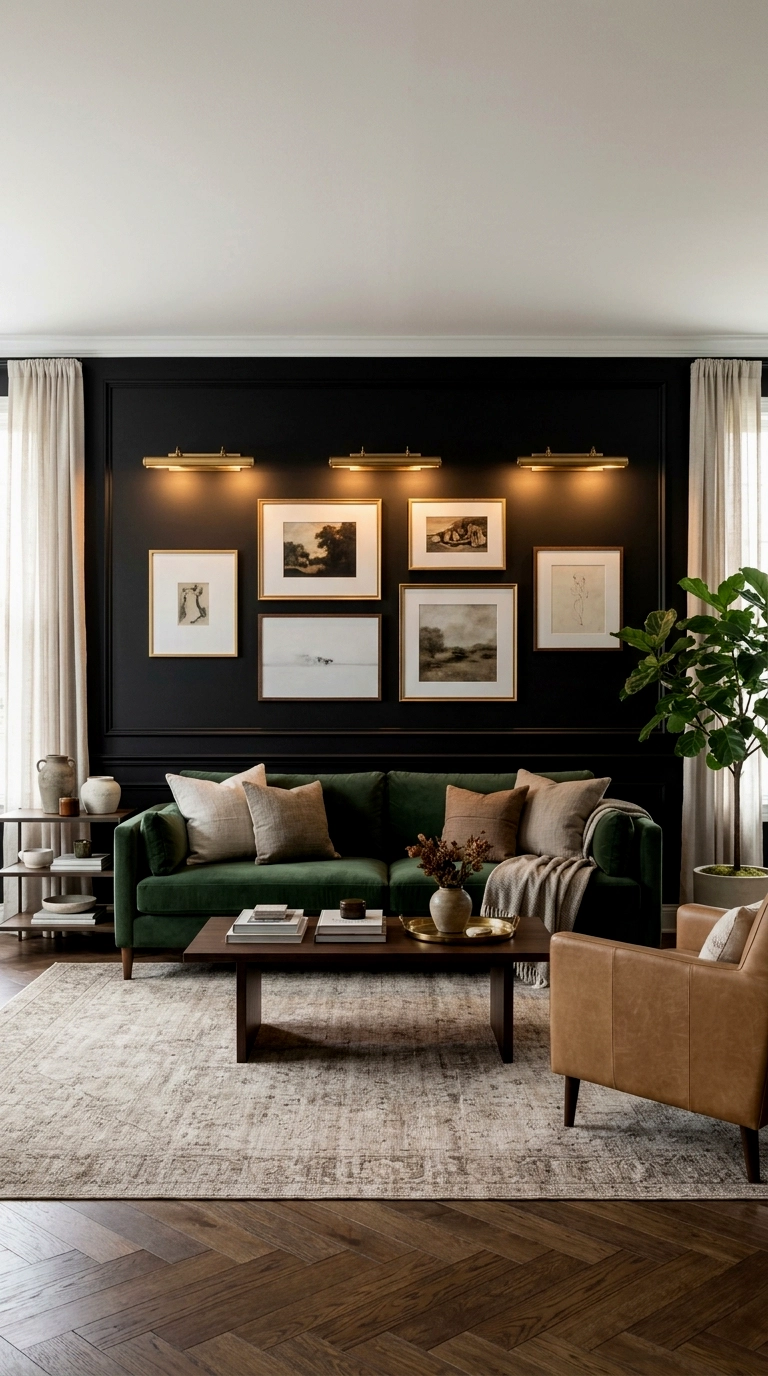
Small brass picture lights turn a black wall into an evening gallery, washing the paint in soft gradients and making the artwork glow from within. Two over your largest pieces are enough to change the whole wall’s temperature. Point them down the art rather than out into the room, and run them on the warmest bulbs you can find.
Light the art properly and the black wall behind it warms itself, without a single extra lamp on the floor.
Warmth check: switch on only the picture lights one evening; the wall should read as a soft glow you could sit beside, not a spotlight you would perform under.
11. A warm white rug under the main light pool
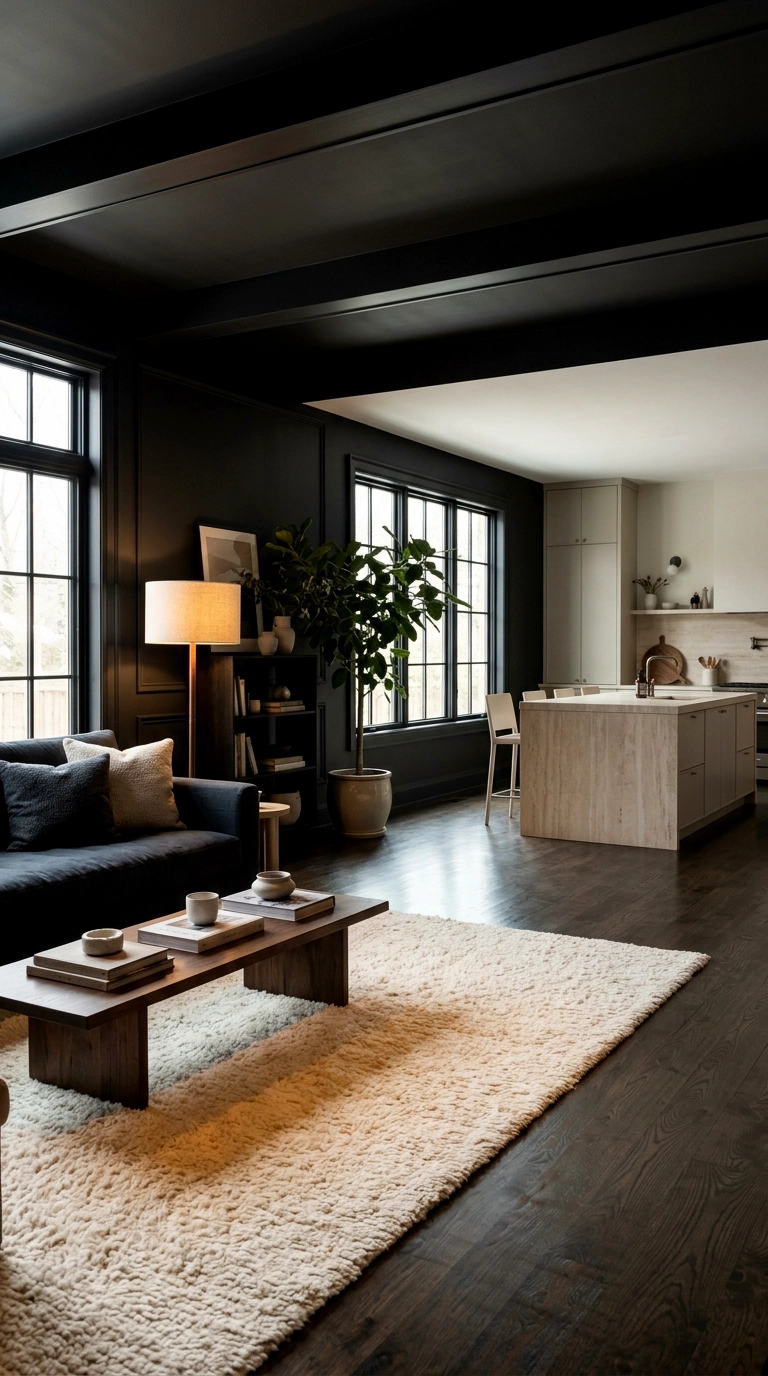
Place your palest rug where the lamplight lands hardest, and it catches that glow and holds it at floor level like a warm island in a dark sea. Choose warm white, oatmeal or cream, and avoid blue white completely, because a cool toned rug under warm lamps turns an unflattering grey. The contrast also quietly maps the seating zone for guests.
The rug is where warm light goes to rest, so give it a colour worth landing on.
12. Sheer curtains in warm white to filter daylight warm
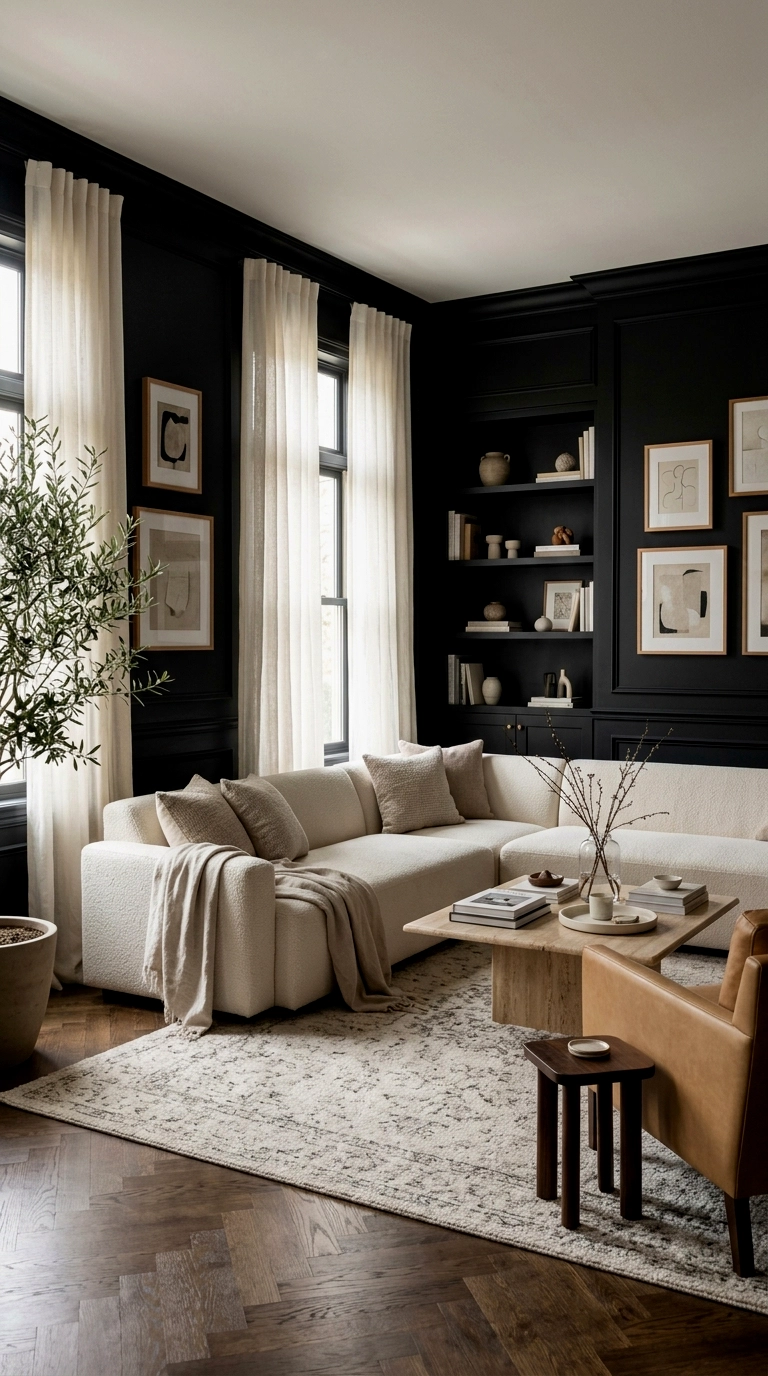
Evenings get the lamps, but daytime belongs to the windows, and a black room with cold north light needs its daylight warmed before it arrives. Warm white sheers tint the day a soft amber and stop black walls reading grey and flat at noon. They cost little, hang in an hour and ask nothing of the walls themselves.
Filter the day warm at the glass, and the evening lighting you worked so hard on takes care of itself.
Warmth check: look at your black walls at midday with the sheers drawn; if they read grey instead of black, the sheers are too cool a white and need swapping.
Warmth From Texture
Texture is the warmth your hands grade before your eyes get a vote, and smooth black surfaces fail that examination every time. Audit rule: sit on the sofa and touch the five nearest things; if all five are smooth, this group is where your room gets fixed.
13. Black velvet sofa with wool and boucle cushions
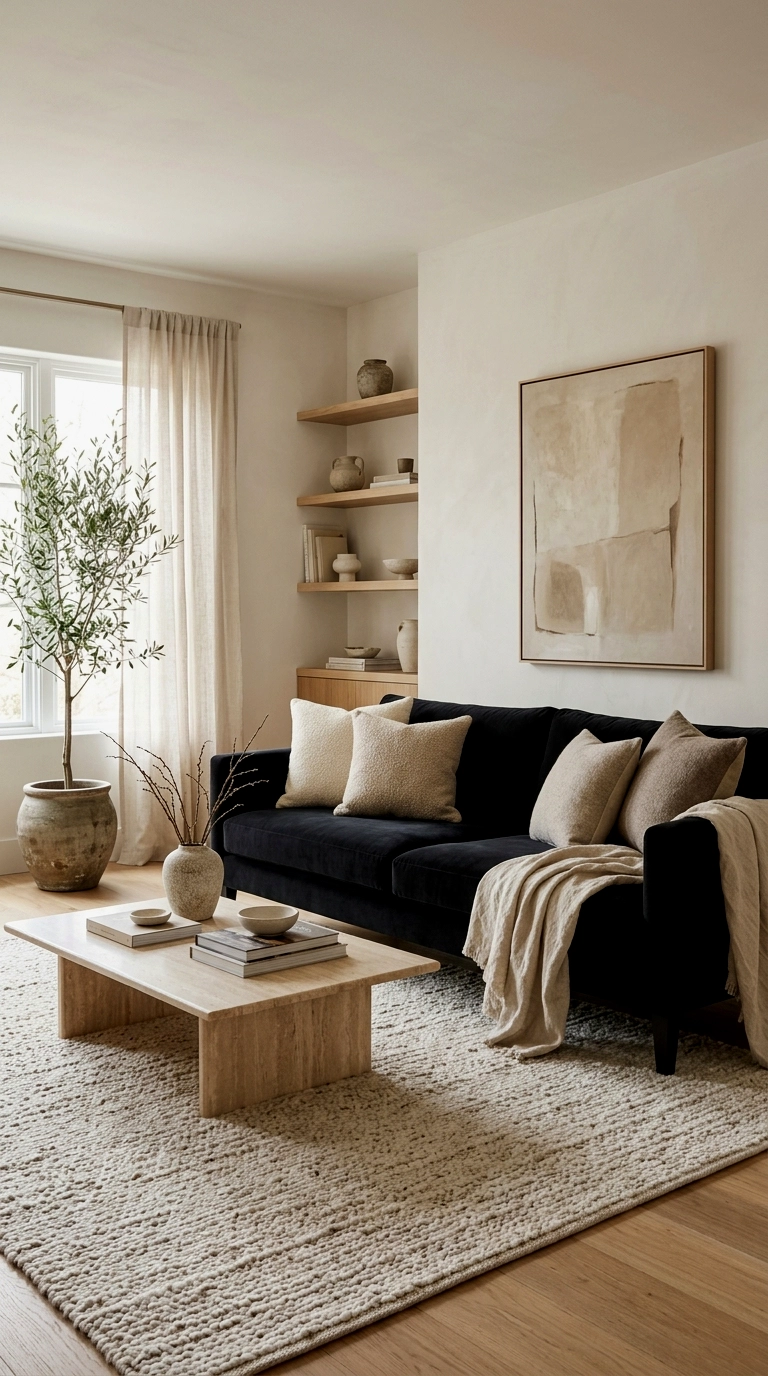
Velvet drinks light, wool and boucle scatter it back softly, and layered together on one black sofa the colour stops being flat and starts being deep enough to sink into. Run a hand across the seat and you can feel the room’s temperature change, which is rather the point. Mix two or three cushion fabrics and keep one cushion in a warm neutral so the black has company.
Flat black is cold black, but textured black is a blanket the whole room can wear.
14. A chunky knit or woven throw in charcoal and rust
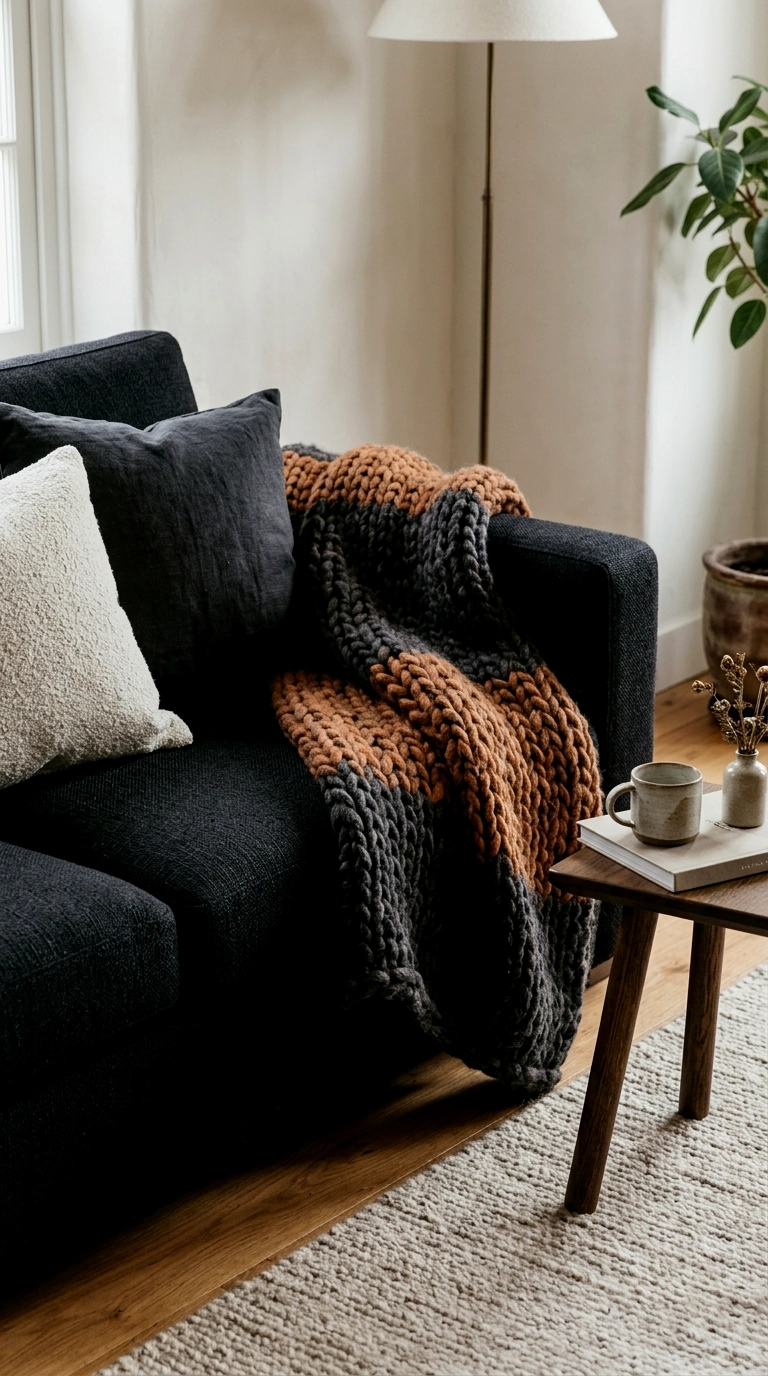
Charcoal keeps the throw inside the palette while rust smuggles the fire’s own colour in at textile scale. Drape it over the sofa arm or the chair back rather than folding it into a tidy square, because the loose weave and the hanging fringe are the warmth, not just the wool. A chunky knit also photographs beautifully, which your future self will appreciate.
Rust is the warmth cheat code of black rooms, a whole fire’s worth of colour in one throw.
Warmth check: spend one full evening with the throw over your legs; if the rust still looks cheerful in lamplight rather than muddy, you picked the right shade.
15. Black walls with a high pile warm toned rug
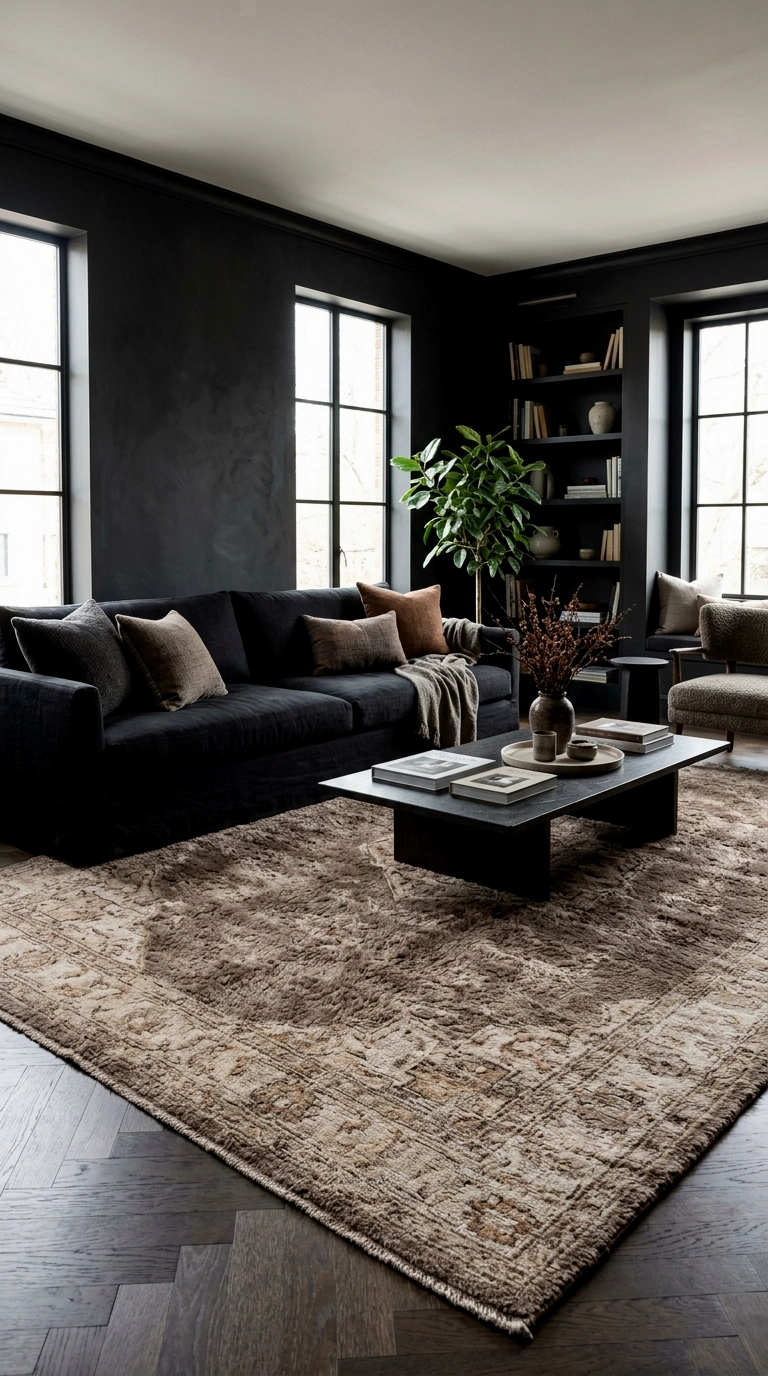
Feet grade a room before eyes do, and a deep pile rug in warm taupe or faded vintage reds and browns changes how the whole room feels and even how it sounds. Voices soften, footsteps disappear and the black walls start reading as shelter rather than statement. Choose the largest size the seating zone can take, with every front leg standing on the pile.
A black room should be quiet and soft underfoot, so let the rug carry the comfort the walls cannot.
16. Cane, rattan and basket texture against black
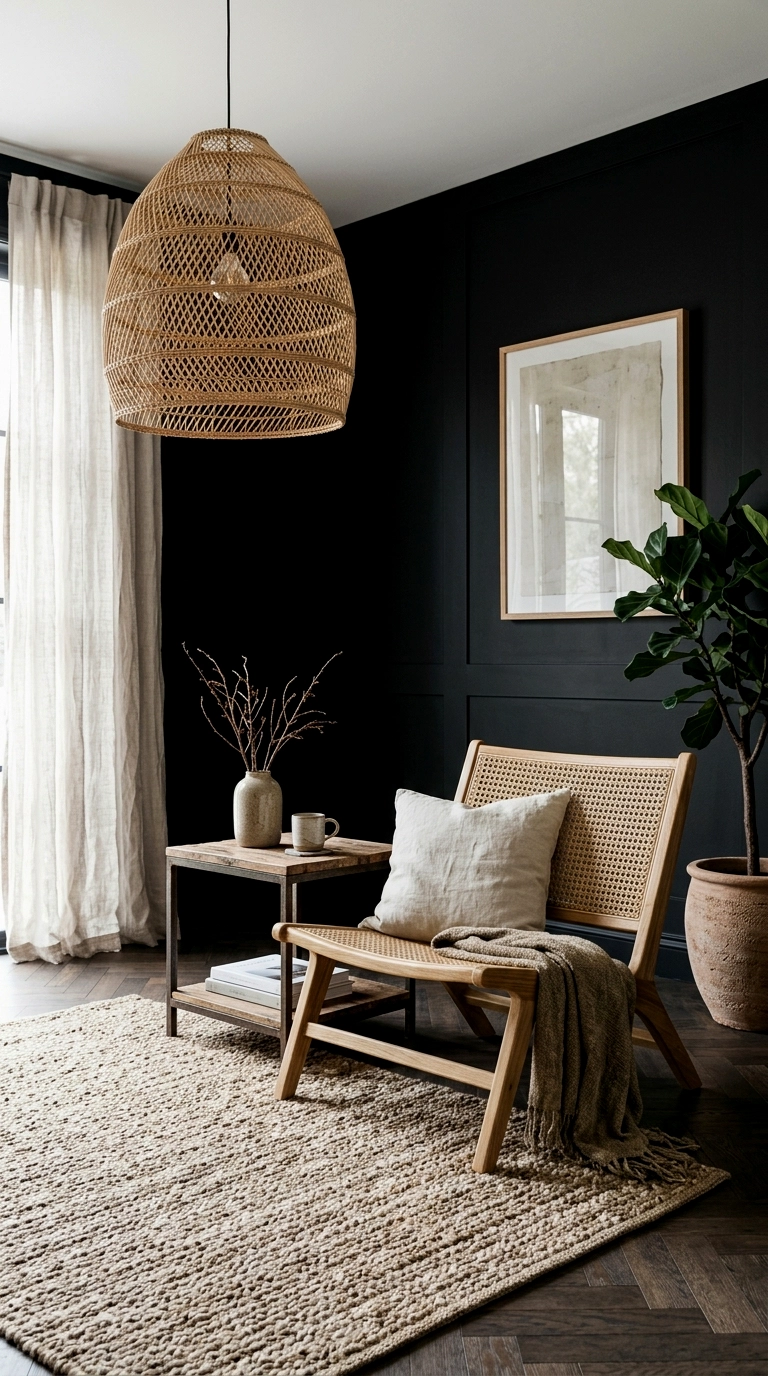
Woven natural fibres against black read as stored sunlight, golden even on a grey afternoon. A cane backed chair, a rattan lamp shade and a couple of baskets holding throws or logs all do the same job at different heights around the room. They are light to move, kind to budgets and impossible to make look formal, which is a relief in a dramatic room.
Woven texture is warmth you can still see at noon, not just after the lamps come on.
Warmth check: place one woven piece where the daylight lands and check it again in the afternoon; it should still read golden, never grey.
17. Black leather softened with sheepskin or faux fur
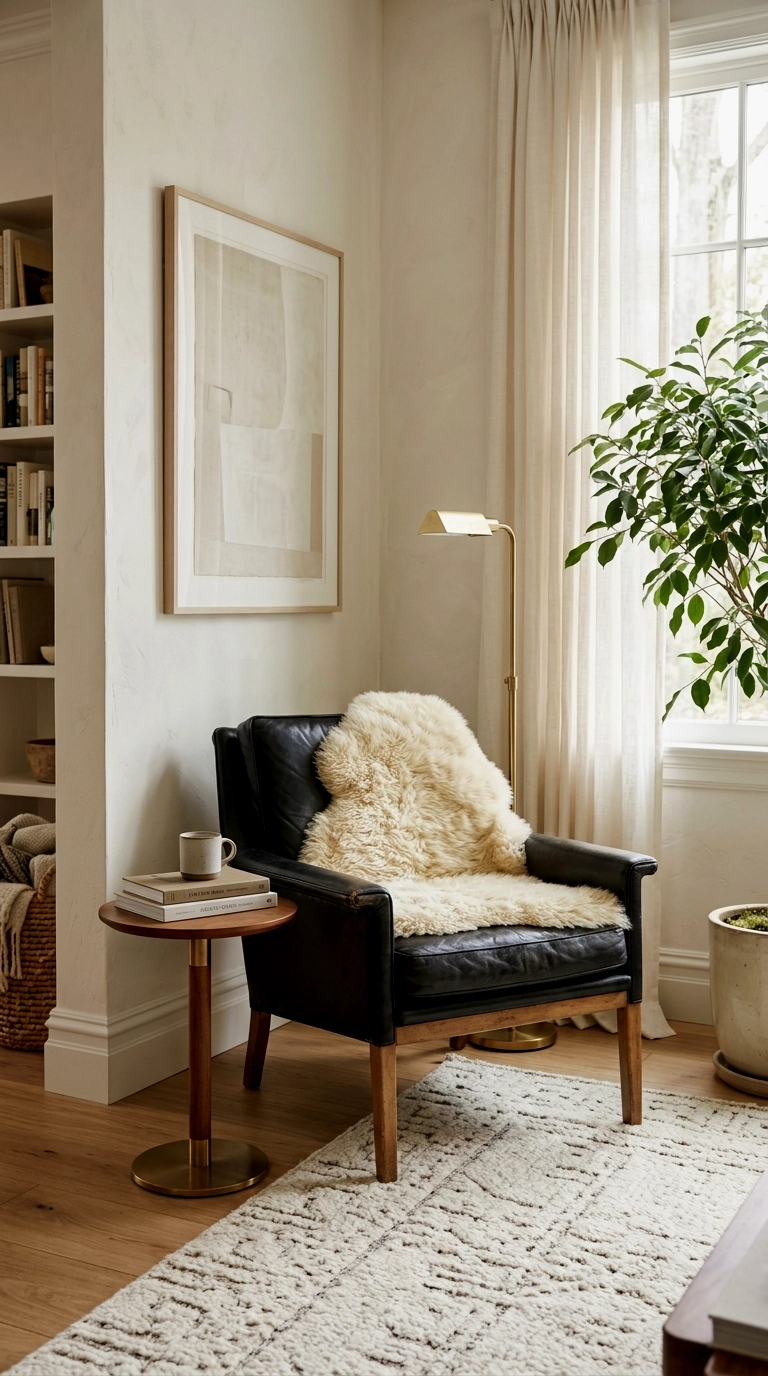
A black leather chair is often the coldest seat in the house, all shine and chill, until a cream sheepskin lands across it. One throw turns the least inviting chair into the seat with a waiting list, because fur against leather is contrast every hand understands. Faux sheepskins do the job nearly as well and wash far more bravely.
Fur over leather is the black room’s oldest invitation, and nobody has ever needed it explained to them.
18. Layered curtains: black outer, warm linen inner
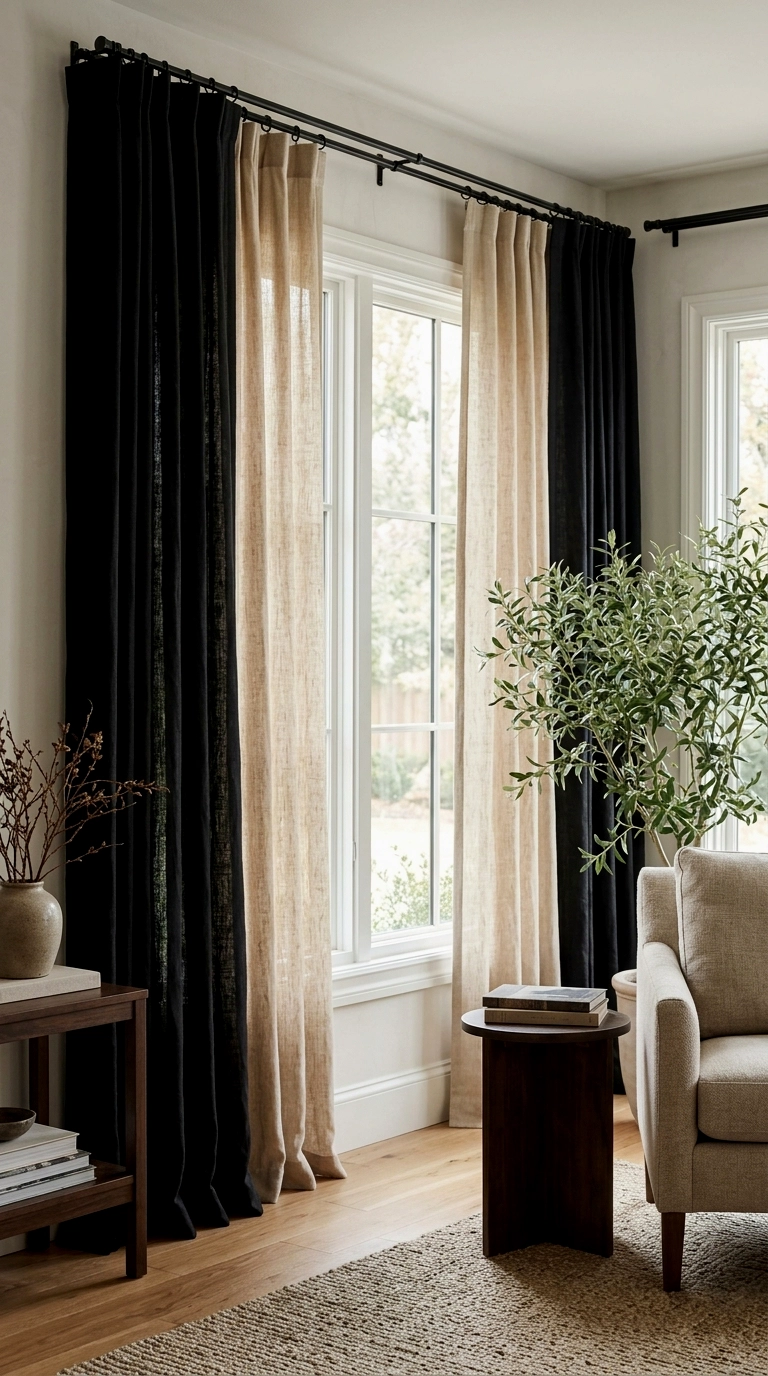
Black curtains alone can read like a stage set, heavy and theatrical, but a warm natural linen layer hanging at the glass changes their character completely. The linen glows faintly at the edges in daylight and keeps the window breathing softly instead of ending in a hard black line. Draw the black layer at night for the full cocoon, leave the linen for the day.
Every hard black surface in the room deserves one soft neighbour, and the window is the place to start.
Warmth check: draw both layers at dusk; the linen should still glow faintly at the edges rather than vanishing into flat black.
The Sheen Guide
| Sheen | Feels | Best on |
|---|---|---|
| Matte | Soft, chalky, calm, though it shows marks honestly | Walls, ceilings and any large quiet surface |
| Eggshell | A gentle glow, the living room all rounder | Family room walls and everyday woodwork |
| Satin | Warm reflection once the lamps come on | Furniture, doors and panelling |
| Gloss | Cold, formal and mirror sharp | Small pieces only: tables, trays and frames |
Warmth From Colour
One living colour gives black a heartbeat, and it takes surprisingly little: a chair, a crowd of plants, a wall of warm hearted art. Audit rule: if nothing in the room carries a colour you could find in a garden or beside a fire, this is your section, and it is the most enjoyable one to fix.
19. Black with cognac and caramel as the second colour
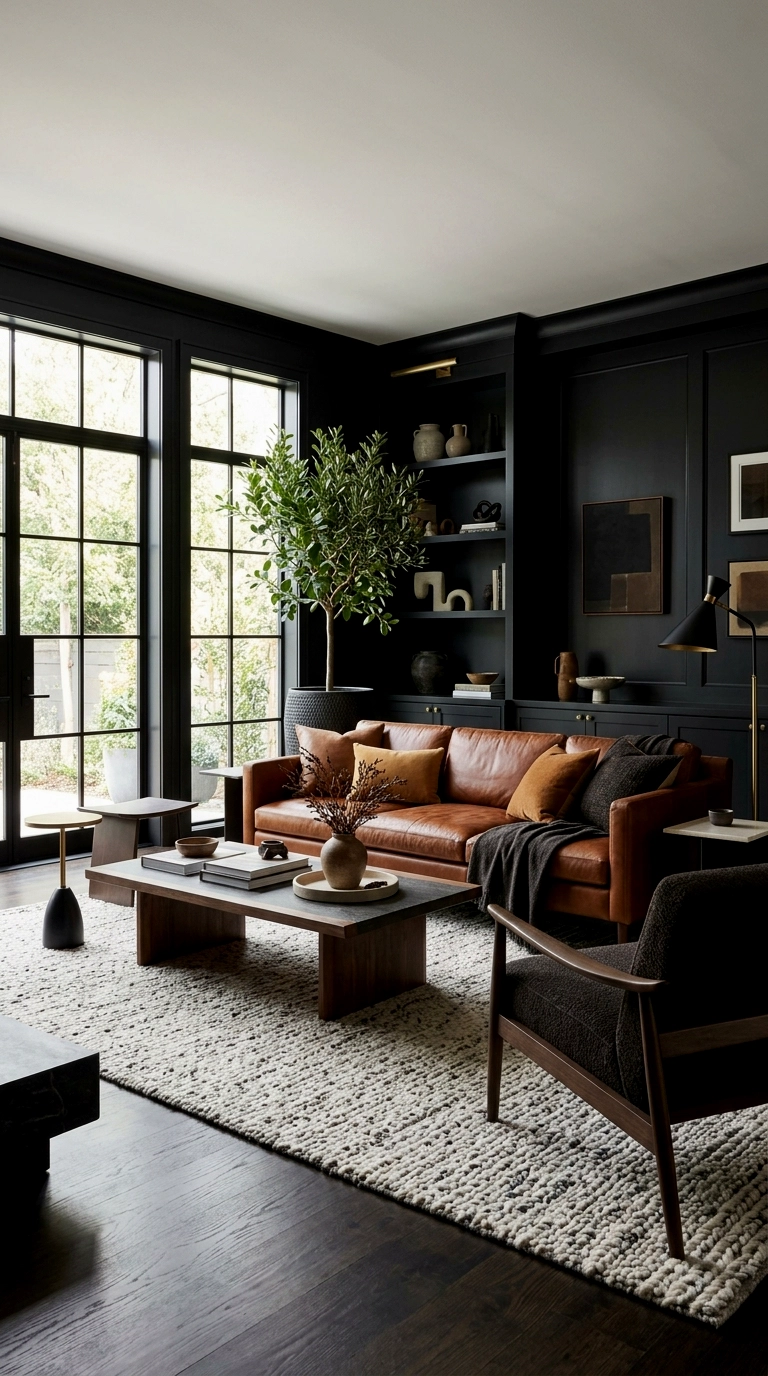
If the room is allowed one colour family, give it the caramels: cognac leather, caramel cushions, a honey toned throw and a lamp shade with a warm lining. It is firelight translated into fabric, and black deepens every shade of it. Spread the family across at least three objects so it reads as a scheme rather than a coincidence.
Caramel is not an accent in a black room, it is the heating system wearing a nicer name.
20. Black walls with deep green plants everywhere
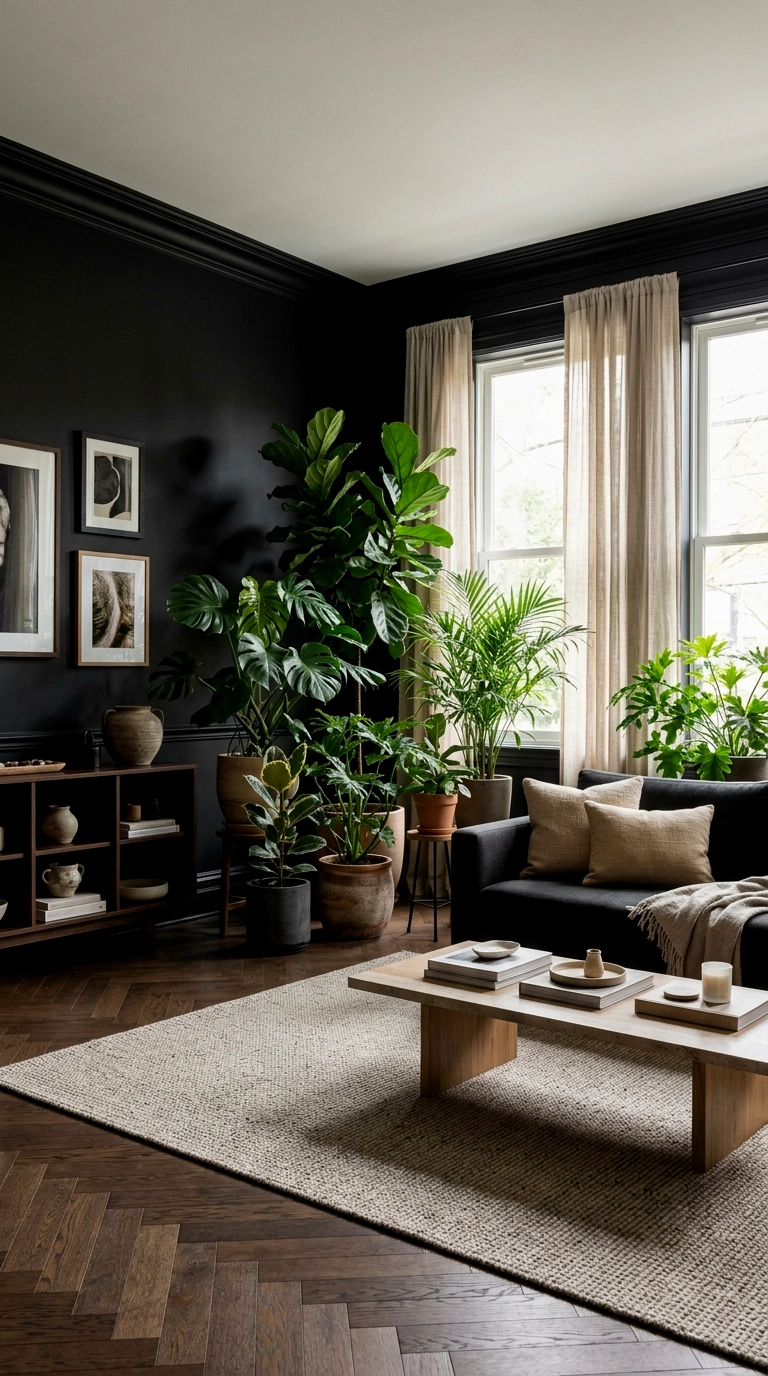
Green is the colour black flatters most, and large plants against black walls look quietly tropical and far more expensive than they were. Cluster them at the corners and beside the sofa, and let a few leaves cross in front of the dark paint so the boundary between plant and wall goes soft. Group plants at different heights, one tall, a couple middling, something trailing from a shelf.
Plants are warmth with roots, and black rooms need more of them than pale rooms ever will.
Warmth check: count the plants visible from the sofa; you are aiming for green in at least three corners of your view.
21. Black with warm artwork: landscapes, portraits, gold frames
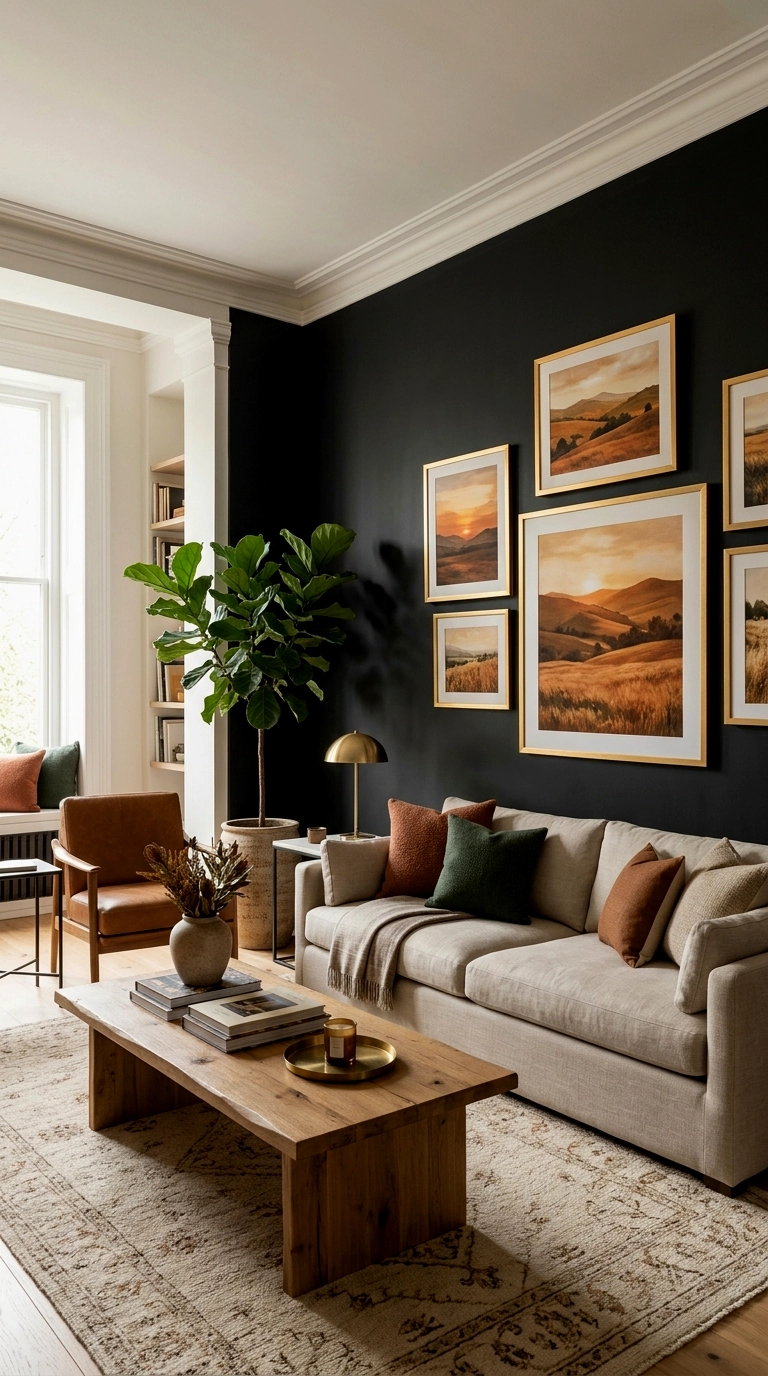
Choose art with warm grounds, ochres, umbers, dusky pinks and old gold skies, and frame it in gold or warm wood. A wall of warm art can carry a black room’s whole temperature on its own, like windows opening onto a sunnier climate. For the furniture equivalent of that courage, the rooms in blue couch living rooms show how one bold colour holds an entire scheme together.
Art is a window to a warmer place, so hang it where the room feels coldest.
22. Black kitchen style living: black units, wood worktop, brass
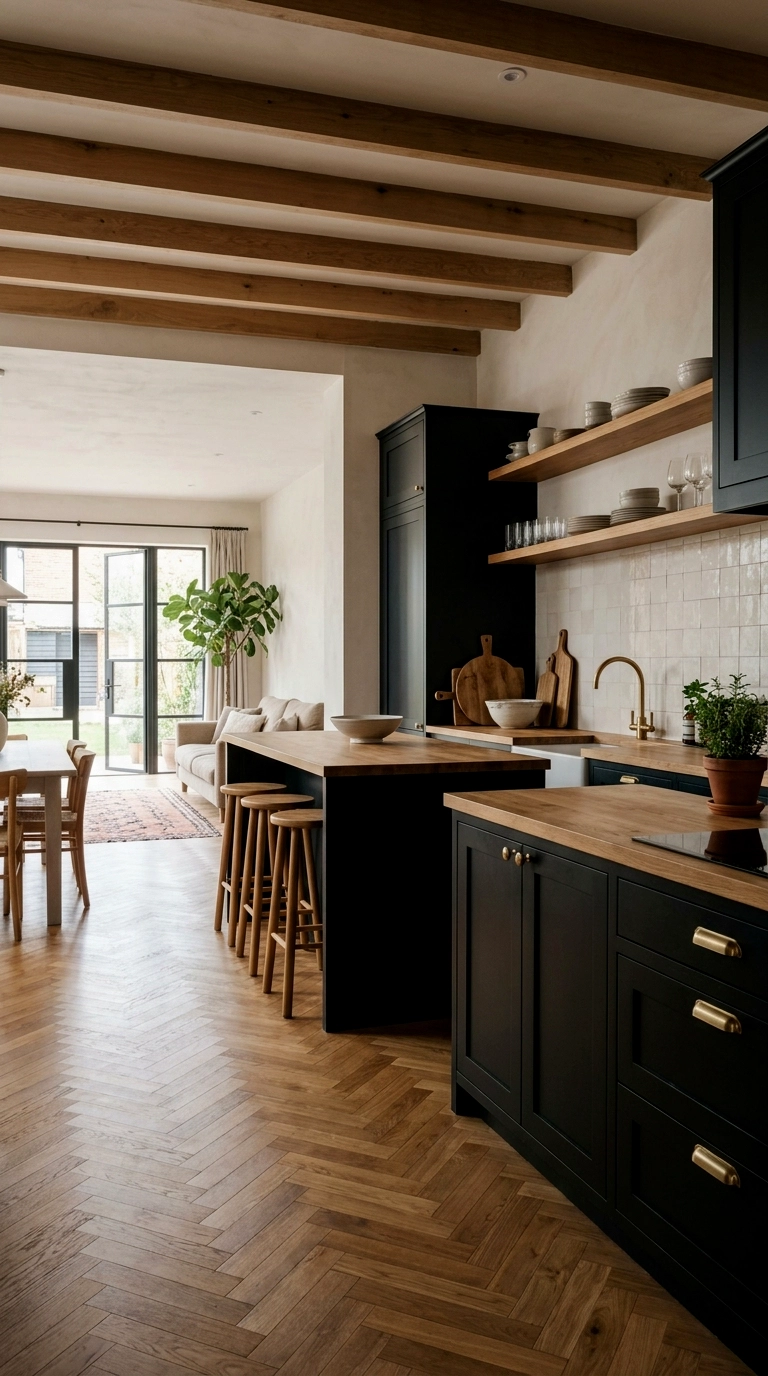
In an open plan space, the kitchen’s materials warm the living area whether you planned it or not. Black units with a solid wood worktop and brass handles catch light all day at the far end of the room, and that glow travels straight to the sofa. Choose the worktop wood with the same care as a coffee table, because it is effectively the room’s largest warm surface.
In open plan homes, the kitchen warms two rooms at once, so spend the warmth budget there first.
Warmth check: stand at the sofa in morning light and run a hand along the worktop in your mind; the wood should look honeyed beside the black units, never orange.
23. Black with one rust or terracotta armchair
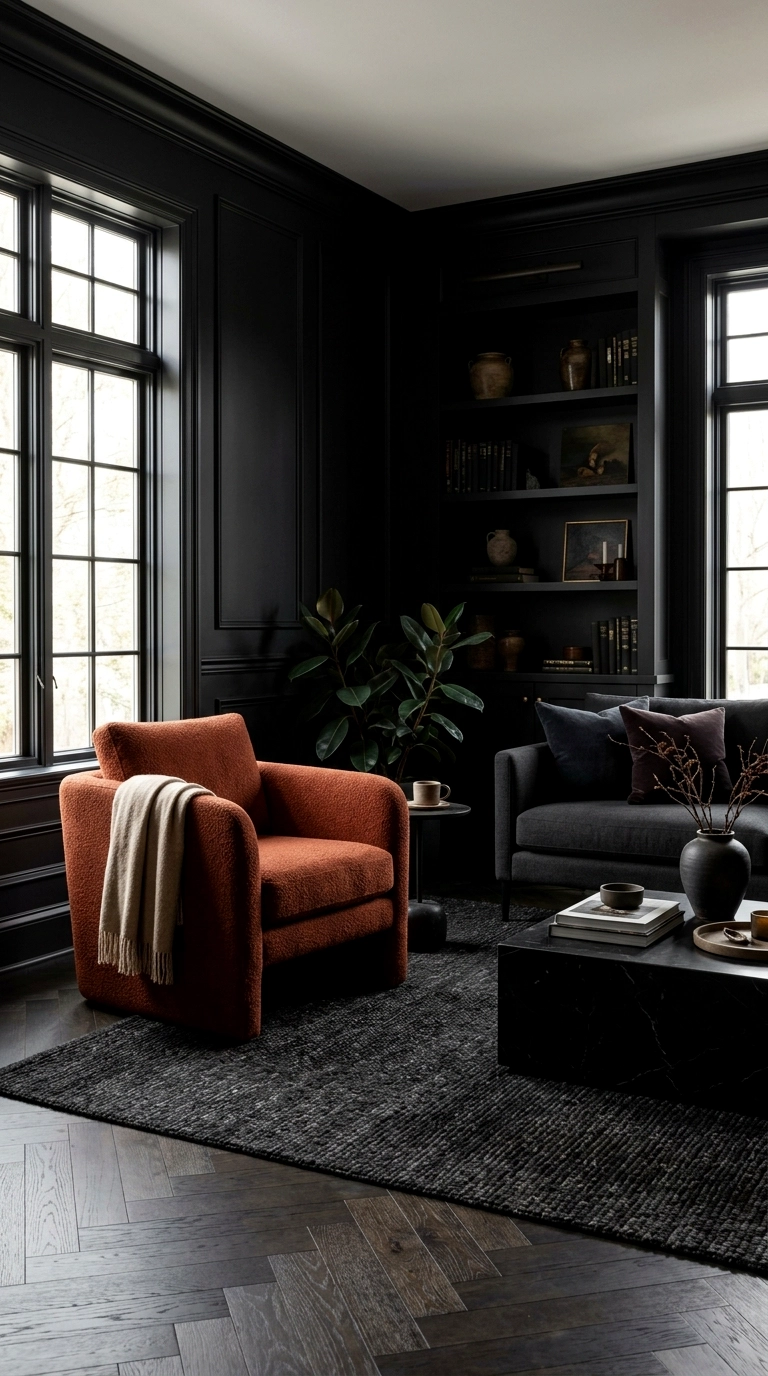
A single warm coloured chair in a black room is a fireplace you can sit in. Everything else can stay black, wood and brass, and that one rust or terracotta seat will still reset the temperature of the whole space. Place it where it catches lamplight, angled toward the sofa so it joins the conversation instead of posing in a corner.
One warm chair is sometimes the entire fix, and the whole room exhales around it.
24. Black ceiling or upper walls with warm white below
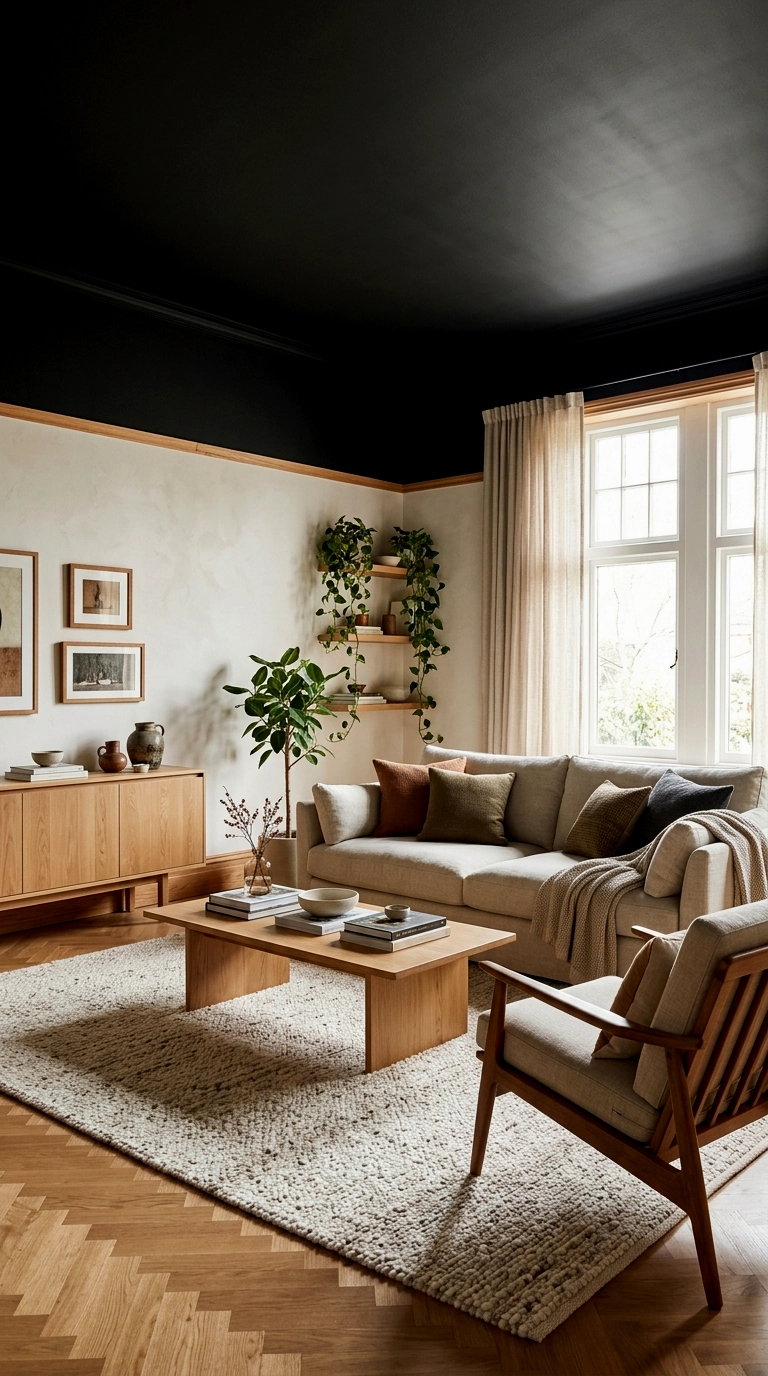
If full black feels chilly at sitting level, lift it. Paint the ceiling or the walls above the picture rail black, and keep warm white and wood below, where hands, faces and lamplight actually live. The drama stays in the room, floating overhead like evening, while the chill leaves the zone you sit in. It is also the friendliest version of black for a rented or low ceilinged room, oddly enough.
Black works hardest where nobody sits against it, so give the cold colour the high ground and keep the warmth at home level.
Warmth check: settle at sofa level one evening and check that everything inside your resting eye line is warm white, wood or lamplight; if it is, the audit is passed.
Evening is the honest test of a black room, so picture yours at seven, lamps on and curtains drawn. The walnut glows, the brass hands the light around, the rug is soft under your feet and one warm colour keeps the whole room company. Nothing about it is bright, and nothing about it is cold. That is the audit passed: black exactly as dark as you wanted it, and warm exactly where you live in it.